
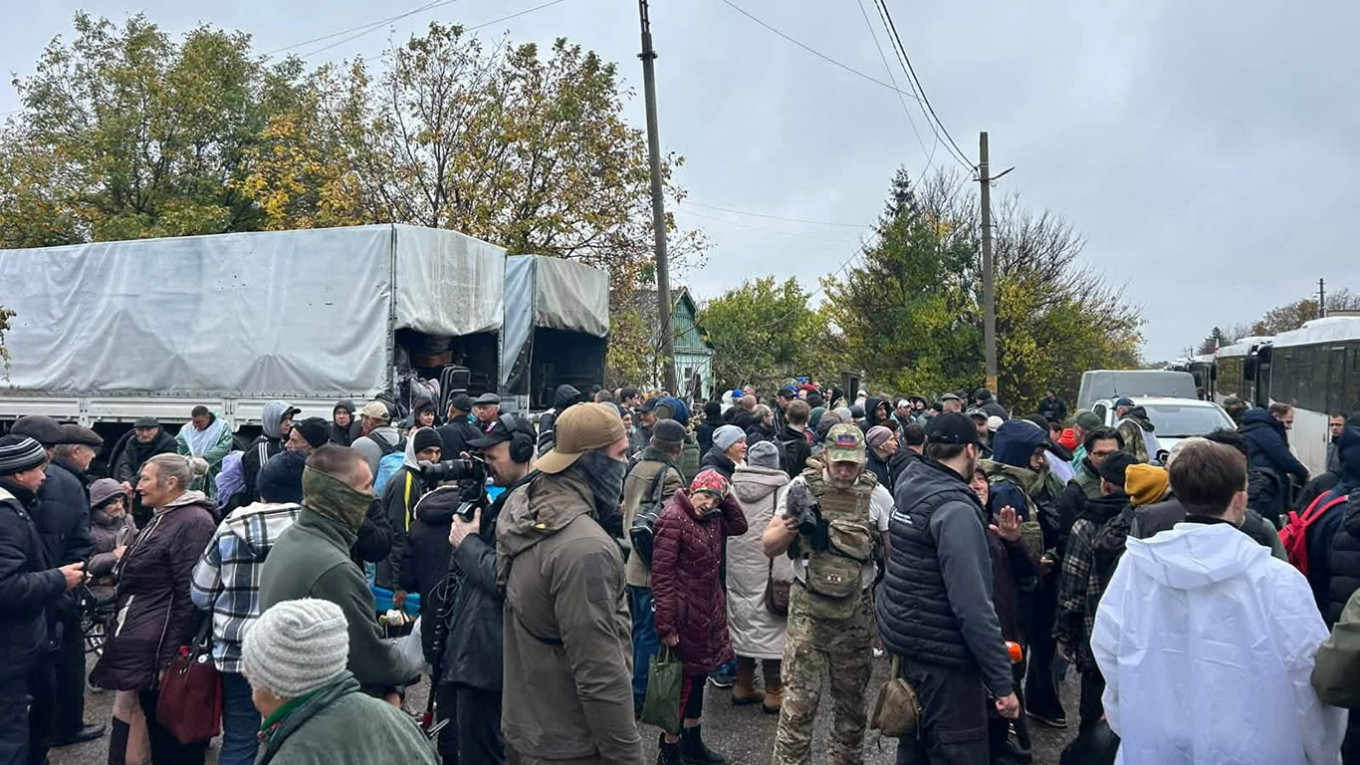
Before Russian television cameras arrived in Oleshky, the occupation authorities had cleared bodies and rubbish from the streets. Residents told volunteers the curbs were being painted for the cameras. Before filming itself supposedly saving Oleshky, Russia first had to hide what life under its rule had become.
Across 400 Russian TV segments and Telegram posts from October 20 to November 2, the script barely varied. The crisis was an “artificial humanitarian catastrophe” made by Kyiv, whose drones had mined the roads and blockaded the town; the ceasefire was Russia refusing to let Zelensky stage “a second Bucha.” Russia was the rescuer: sappers, medics, 25 buses with at least 750 seats, a separate bus for pets, and ombudsman Yana Lantratova working “round the clock”. The town was “the Russian settlement of Aleshki” in the Kremlin’s own readout and anyone spelling it with a Ukrainian "O" was copying “the Ukrops.”
Even the route out, via Russia and Belarus, was offered as evidence of residents’ true identities: one pro-war channel asked whether evacuating through Russian-held territory made the civilians Russian.
The fact missing from the discussion was that Oleshky has been under Russian control since February 2022. Before the invasion, roughly 24,000 people lived there; by autumn, around 2,000 remained, mostly the elderly and those caring for them.
Russian outlets blamed Ukraine for the hunger. The UN’s humanitarian coordinator Matthias Schmale identified a different obstacle: Ukraine had asked the UN to deliver aid as Moscow had not ensured safe access to the area for humanitarian organizations. Russian sources themselves let slip that food had not been delivered “since May” and that the last medical evacuation was in June.
Meanwhile, Ukrainian drones had been dropping food into the town since March, around four tonnes in all. Russian soldiers shot the drones down, confiscated the parcels and detained recipients as collaborators. Under Article 55 of the Fourth Geneva Convention, the occupying power must ensure food and medical supplies for the civilians it controls. That obligation surfaces only as a weakness Kyiv exploits: the pro-Russian analyst from Belarus, Yuriy Baranchik, recalled that the Council of Europe had held Russia responsible, seeing it as a problem for Moscow’s image rather than a duty.
What Russian television advertised as a model operation looked different from inside the town. Volunteers from Kryla, a Kherson charity whose founders are themselves from Oleshky, were collecting potential evacuees’ details for the Ukrainian ombudsman’s office in the days before the convoy. They reported occupation officials at the hospital persuading those who turned up to register for evacuation to Russia and telling others not to register at all. Evacuees would undergo filtration; they would be taken “who knows where,” so would be better off collecting food parcels and staying home. Russian jamming cut the only mobile signal from Kherson, which can usually be picked up across the river, so relatives could not get accurate information through. Lists of bedridden residents, compiled for the Ukrainian side alone, produced phone calls from Russian officials asking for addresses, leaving people frightened and confused about how Russia had their numbers.
On the morning itself, almost none of the immobile residents were collected from their homes. Some families with children stayed because they were afraid of the organised route; Kryla knows of at least six such children. The head of the Oleshky military administration said people left believing it might be “a one-way trip”. An evacuation offers little real choice when people can barely learn that it is happening, let alone reach it safely.
Russian commentators had seen the danger coming. “The most unpleasant detail,” wrote Baranchik on October 24, “is the residents’ right to leave for the Ukrainian side … The results will be interpreted precisely as an indicator of the population’s attitude.” Sergei Markov hoped “ours are ready” for the “information-political struggle over where the residents go”.
They were not. Moscow published no figures about the number of evacuees who left for Russia and Baranchik himself asked why there was no official information for two days. Ukraine’s ombudsman Dmytro Lubinets said Russia acknowledged that about 80% of evacuees chose Ukraine.
Russian coverage handled this by changing the question. More people stayed in the almost destroyed town than left, so the number that mattered, Alexander Kots insisted, was the one “nobody names. Thus staying under occupation became loyalty. Those who chose Ukraine were people waiting for Kyiv to save the day, or benefit-seekers with “almost no children” among them.
Andrei Medvedev, a state television journalist and Moscow city deputy, called the operation “a population exchange” that left the left bank with “not one Ukrainian patriot” and “a ready-made demarcation line”. A destination chosen during a humanitarian emergency is no referendum on sovereignty. In Moscow’s telling, occupation becomes protection, an inability to leave becomes loyalty and choosing Ukraine becomes betrayal of Moscow. Whatever civilians do, their actions are reinterpreted to serve Russia’s claim to the territory.
The evacuation saved lives. During the same ceasefire, a Russian drone hit Dnipro’s main railway station and killed at least 14 people. The humanitarianism U.S. envoy Steve Witkoff had recently discovered in President Vladimir Putin came with a flexible definition and strict geographical limits. Inside the pause, according to Ukraine’s General Staff and the marine brigade across the river, Russia rotated the troops cut off in Oleshky, retook abandoned positions, repaired artillery and brought in more fuel for its positions. Sky News footage showed soldiers carrying away boxes of food meant for civilians. Nine hours after the truce expired, a Russian drone struck a hospital in Kherson.
Lantratova now proposes monthly missions, and separatist official Oleg Tsarev hailed Oleshky as “a rehearsal for peace”. The rehearsal showed what Russia finds most unpleasant about peace: Ukrainians’ freedom to choose their destiny.
A Message from The Moscow Times:
Dear readers,
We are facing unprecedented challenges. Russia's Prosecutor General's Office has designated The Moscow Times as an "undesirable" organization, criminalizing our work and putting our staff at risk of prosecution. This follows our earlier unjust labeling as a "foreign agent."
These actions are direct attempts to silence independent journalism in Russia. The authorities claim our work "discredits the decisions of the Russian leadership." We see things differently: we strive to provide accurate, unbiased reporting on Russia.
We, the journalists of The Moscow Times, refuse to be silenced. But to continue our work, we need your help.
Your support, no matter how small, makes a world of difference. If you can, please support us monthly starting from just $2. It's quick to set up, and every contribution makes a significant impact.
By supporting The Moscow Times, you're defending open, independent journalism in the face of repression. Thank you for standing with us.

Remind me later.