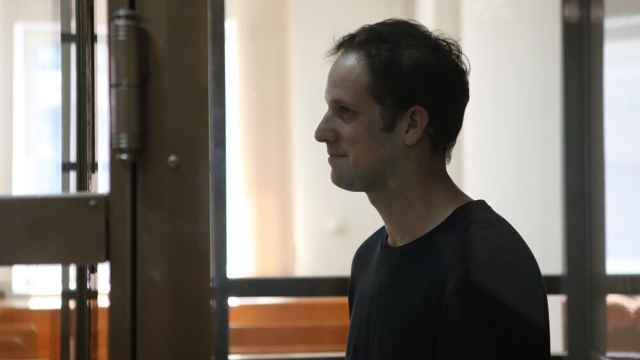
On Aug. 1, 2024, the world awoke to joyous news of a prisoner swap, freeing 16 prisoners from Russia and Belarus and 10 Russians from prisons in the United States and several other Western countries. Those flown out of Russia that morning included some of the most famous Russian political prisoners — Oleg Orlov, Ilya Yashin and Vladimir Kara-Murza — along with Wall Street Journal correspondent Evan Gershkovich. In total, he had served 491 days in prison on false charges of espionage.
Two years later, Gershkovich has turned these experiences into a striking memoir, “This Cursed Beautiful Land.” It is, above all, his dual identity and perspective — experiencing Russia and its prisons as both the American Evan and the Russian “Vanya,” his nickname — that makes the book stand out among the vast body of Russian prison writing.
This prison corpus can trace its roots back centuries: its origin text is usually considered to be the autobiography of the 17th-century monk Avvakum.
But it was testimonies of political prisoners in late 19th-century Russia, and especially the U.S.S.R., that established the genre and its readership. Combining documentary evidence with vivid storytelling and political critique, prison prose circulated widely in domestically produced samizdat underground texts and foreign-printed tamizdat and made household names of Aleksandr Solzhenitsyn, Yevgenia Ginzburg, Anatoly Marchenko and many others.
Today, with over 5,000 political prisoners behind bars in Russia (including hundreds of Ukrainians), new prison testimony continues to emerge. St. Petersburg artist Sasha Skochilenko, also freed in the 2024 exchange, is one of several contemporary political prisoners to experiment across multiple formats, producing memoirs, graphic novels and even performance art about imprisonment.
Gershkovich is steeped in this lengthy tradition, not least because his Russian language skills enabled him to use prison libraries that were, for a while, remarkably well-stocked with prison writing: Eduard Limonov; Andrei Rubanov; Vasily Grossman’s epic of Stalinist repression, “Life and Fate” (undeterred by that famously long novel, he then plowed his way through “War and Peace”).
His memoir also joins a long tradition of intensely self-reflexive writing, which intensively quoted, adapted, or directly polemicized with previous texts. The two most famous gulag writers, Aleksandr Solzhenitsyn and Varlam Shalamov, disagreed so profoundly about how to write about the camps that their relationship descended into acrimony.
Gershkovich’s memoir is studded with more respectful references to prison writers before him. Its title quotes from a dystopian novella by dissident and gulag returnee, Yuly Daniel, while direct and indirect references to Russian prison prose appear throughout the text. Of Ginzburg, he observes, “that we are fast friends, that she understands what I am going through,” though he also recognizes that the brutal Stalinist camps that she survived were in many ways incomparable with his own experiences.
What is most distinctive about Gershkovich’s account is this sense of being both inside and outside the prison literature tradition, as well as the prison experience that fueled it. As an American passport-holding journalist arrested for alleged espionage, Gershkovich was never going to be “just a regular Vanya” in the Russian prison system. He is keenly aware of what separated him — at times, literally — from domestic prisoners. He spent most of his time behind bars in the FSB-run Lefortovo prison, a strict but relatively well-appointed facility, which he attributes to being “a commodity to be kept in pristine shape.”
Even when transferred to the less salubrious Tsentral prison, he was put in a one-man cell of a Stolypin train as the other carriages headed for the Urals rammed full of prisoners. In another memorable scene, he and his first Lefortovo cellmate Seryoga — the most vividly and affectionately sketched character of the book — watch on their cell’s television as President Vladimir Putin himself discusses his case at a press conference. By the end of his first year in prison, Gershkovich already knows from lawyers and family that an international exchange is in the offing.
This peculiar position shaped his prison experience and limits its representativeness, as Gershkovich fully acknowledges. Like many gulag authors, he draws on the idea of “circles of hell,” first adapted from Dante in Solzhenitsyn’s 1968 novel “The First Circle,” to capture the many layers of the prison system. He describes his last cell in Yekaterinburg — filthy, infested with rodents and mosquitoes, and the first time he encounters threatening prisoners — as “closer to the inner circle of prison hell as I would ever get.”
However, for most of his time behind bars, he received care packages and letters from family and friends, was served edible food that he supplemented with his own quasi-gourmet concoctions, kept fit, watched endless television and sustained largely harmonious relationships with cellmates: prison experiences that were unimaginable to most gulag authors, and many contemporary political prisoners too.
Often, then, his account focuses not on existential challenges of survival, but on staving off boredom and depression. His efforts include crafting detailed rituals and timetables for cell life — described in a chapter whose title, “A Day in the Life of Ivan Mikhailovich,” again riffs on Solzhenitsyn — and reading and writing as much as possible. However, his experience of prison time — which seemed, and sometimes was, endless for 19th- and 20th-century political prisoners — is different too.
The last third of the book traces the countdown to the swap, but the prospect of early release and escape from Russia starts to emerge from early in his term. This cannot help but affect his feelings about what fate might (or might not) have in store for him. When the swap does occur, Gershkovich reflects on his main cellmates’ very different fates: one is still incarcerated, with no prospect of release, while the other was released, only to die in Russia’s war on Ukraine.
Another poignant contrast, running throughout the book, is to Alexei Navalny, subjected to exceptionally harsh treatment in remote prison camps and killed a few months before Gershkovich’s release. He mourns that Navalny should have been on the bus to freedom with him, even amidst the relief of leaving Russia.
Nevertheless, Gershkovich was able to immerse himself in prison life to a striking degree. His deepening fluency in Russian and his genuine fondness for Russian culture (highlighted in the book’s title and extending to the Soviet-style prison cuisine) allowed him to overcome many, if not all, barriers to communication. Honed by a journalist’s eye for good stories and sources, what results is a picture of prison and Russian life more generally oscillating between wry affection, ironic distance and frustration.
Many Soviet-era accounts of imprisonment describe political prisoners’ shock or disgust at prison’s elaborate rules, the violence meted out to those who violated them and the huge lexicon of prison slang (for which he provides a two-page glossary). Much of that subculture appears intact today — especially in more lax facilities than Lefortovo — and Gershkovich was better placed than most foreigners to navigate it. In one of the most vivid chapters, he evokes the excitement of nighttime communications in Yekaterinburg, through an elaborate prisoner-devised system of ropes, as well as through chats with heads stuck through the food delivery slots in their cell doors.
But the political apathy, cynicism and knee-jerk prejudices of the prison patsany (“lads”) also evoke frustration and despair, especially in light of the full-scale invasion of Ukraine, which began soon before his arrest and continues today, as his book is published.
In a poignant final chapter, Gershkovich reveals how his dual identity, which had enabled this unusually deep connection with prison culture, continued to shape his life beyond it. Having had little success with an American therapist, he realized that it was Vanya, his Russian self, who had experienced incarceration and therefore needed a Russian-speaking therapist instead.
Today, Evan lives in Berlin, reunited with the Russian journalist partner whom he so pined for in prison. The diary he kept there has been transformed into a compelling and insightful account that should secure a lasting place in the ever-expanding annals of testimony about Russia’s prisons.
Evan Gershkovich will deliver the inaugural Derk Sauer lecture at De Balie in Amsterdam on Oct. 31, in partnership with The Moscow Times. The event is sold out, but tickets may be available via the waitlist or at the box office on the day.
A Message from The Moscow Times:
Dear readers,
We are facing unprecedented challenges. Russia's Prosecutor General's Office has designated The Moscow Times as an "undesirable" organization, criminalizing our work and putting our staff at risk of prosecution. This follows our earlier unjust labeling as a "foreign agent."
These actions are direct attempts to silence independent journalism in Russia. The authorities claim our work "discredits the decisions of the Russian leadership." We see things differently: we strive to provide accurate, unbiased reporting on Russia.
We, the journalists of The Moscow Times, refuse to be silenced. But to continue our work, we need your help.
Your support, no matter how small, makes a world of difference. If you can, please support us monthly starting from just $2. It's quick to set up, and every contribution makes a significant impact.
By supporting The Moscow Times, you're defending open, independent journalism in the face of repression. Thank you for standing with us.

Remind me later.