

Yevgeny Anyamov, a rapper known as Bizzo, went viral in his home region of Sverdlovsk in Russia’s Ural Mountains for performing in his native Mansi, an endangered Uralic language closely related to Hungarian.
Dubbed “the world’s only Mansi rapper,” Bizzo was torn between his dream of becoming “as famous as Eminem” — which he said he could only achieve in Russian — and his wish to spark interest in the language among younger generations of Mansi.
Last month, his relatives said he was tricked into signing a contract with the Russian military to fight in Ukraine, silencing his Mansi-language music.
Russia’s Indigenous languages have been on the decline for decades, a process exacerbated by the invasion of Ukraine and its disproportionate drafting of many speakers of critically endangered languages. Only two of the 155 languages spoken in Russia — Russian and Russian Sign Language — are not at risk of extinction.
Now, a new wave of Indigenous rights activism is seeking to turn the many Indigenous languages facing extinction into a tool for anti-war resistance and revival of non-Russian identities.
But they remain unsure whether their efforts, largely carried out in exile, will be enough to turn the tide.
In Russia’s Far East, Itelmen and Copper Island Aleut each have just one native speaker left. At least 15 other Indigenous languages in Russia are classified as critically endangered, meaning their knowledge has not been passed down to younger generations at all.
Ksenia Bolshakova published her debut novel, “The Frost Also Melts,” in 2024, becoming only the second person in the world to write prose in Dolgan, an endangered language indigenous to the Arctic.
“I don’t have a choice. If I don’t write in the language, then there is no one else left to write in it, because I belong to the last generation of speakers,” Bolshakova told The Moscow Times.
Just 60% of the slightly more than 8,000 Dolgans living in Russia today speak the language, according to the 2020 census, though the actual number of speakers could be much lower.
Because Dolgan remains “heavily tied” to the group’s traditional nomadic lifestyle, it has been especially hard-hit by forced sedentarization and displacement by extractive industries, according to Bolshakova.
For Bolshakova, the Dolgan language also became “a great source of support” and a “lifeline to my land, my people, and my family” after she was forced into exile for anti-war activism.
“For Indigenous people, language is a fundamental pillar of identity. There is the pillar of family, the pillar of culture and the pillar of language,” she said.
Even Indigenous languages with millions of speakers are meeting the same fate.
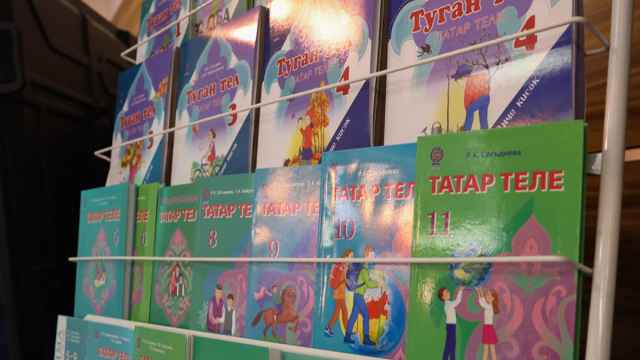
The number of people in Russia who reported speaking Volga Tatar, the native tongue of Russia’s largest Indigenous group that numbers over 6.5 million worldwide, fell by more than 1 million between the country’s two most recent censuses, to 3.2 million in the 2020 census.
Meanwhile, the republic of Tatarstan, the group’s ethnic homeland, ranks second in the number of war losses per region, according to an independent tally by Mediazona and BBC.
“Consciously I understand that [our] languages will die out regardless. It’s simply a mathematical model,” said Aynur Akhmatov, a Tatar language activist and creator of Aydä, a podcast for language learners.
“I personally have preserved the language within my family — my child speaks Tatar. But we live [in exile] in Germany and he only uses German when counting. Can we really consider his language to be the same Tatar that it once was?” Akhmatov said.
When asked whether a language should be allowed to die or preserved at all costs — a reference to the viral debate over Sophia Smith Galer’s book “How to Kill a Language” that was closely followed on the Russian-speaking internet — Akhmatov said it is ultimately a question of the “instruments available” to any given group.

With declining demographics and few Tatar-dominated spaces remaining, saving the Turkic language would require a “political solution” of imposing it as a mandatory lingua franca at schools and universities.
“Once again, the question arises: should it be this way? Do we have the right to impose a language on people — people who were not born into it, do not speak it and currently see no purpose for it?” Akhmatov said.
Khandama Tudebei, a Buryat language activist and teacher, said she “does not believe it is fair to place the responsibility for preserving and passing on a language solely upon families, educators and individual activists.”
“It is impossible to demand the intergenerational transmission of a language if it is not sufficiently present in the education system, public life and in the institutions with which people interact daily,” Tudebei told The Moscow Times.
“Language preservation cannot be separated from questions of power, access to education, cultural autonomy and a community’s right to determine its own future,” she added.
Tudebei’s native Buryat is a Mongolic language indigenous to the Siberian republic of Buryatia and surrounding lands historically inhabited by the group.
Russia’s two latest population censuses show an increase in the number of Buryat speakers from 218,557 in 2010 to 306,857 in 2021.
Yet Tudebei believes these numbers are misleading because “questions about language proficiency in the 2010 and 2020 censuses differed significantly,” making the figures difficult to compare.
Berlin-based Tatar writer and poet Dinara Rasuleva said that speakers of Indigenous languages “must do everything possible” to save their mother tongues.
She believes that steps as small as making an Instagram post or mixing a native language into everyday conversations in the dominant tongue can help.
“Language is a highly complex structure. It requires an incredible amount of time, effort and human interaction and culture to emerge and exist,” Rasuleva told The Moscow Times. “That is why the death of a language is, in my view, a far greater tragedy and loss than any other kind of death. And… we should do everything in our power to prevent it.”

Rasuleva is a co-founder and president of PEN Languages of Russia, an association of independent anti-war writers working in several of the country’s languages — one of dozens of language revitalization initiatives spearheaded by Russia’s Indigenous people in recent years.
Other initiatives include first-of-its-kind keyboards for languages of the North Caucasus, volunteer-created analogs of Duolingo and the first-ever Buryat-language school grade that opened in the Siberian city of Irkutsk in September.
And while some people doubt whether a language can be preserved in exile, Rasuleva said she remains firmly optimistic.
She pointed to the story of the Finnish Tatars, whose ancestors emigrated to Finland in the late 19th and early 20th centuries. The community, which numbers fewer than 1,000 people, has preserved its language and “a distinct Tatar culture over the course of a century,” she said.
“And that was pre-internet. In the age of the internet, I don’t think one’s physical location matters all that much,” she said. “We can…communicate with one another in our native language and study that language no matter where we happen to be.”
A Message from The Moscow Times:
Dear readers,
We are facing unprecedented challenges. Russia's Prosecutor General's Office has designated The Moscow Times as an "undesirable" organization, criminalizing our work and putting our staff at risk of prosecution. This follows our earlier unjust labeling as a "foreign agent."
These actions are direct attempts to silence independent journalism in Russia. The authorities claim our work "discredits the decisions of the Russian leadership." We see things differently: we strive to provide accurate, unbiased reporting on Russia.
We, the journalists of The Moscow Times, refuse to be silenced. But to continue our work, we need your help.
Your support, no matter how small, makes a world of difference. If you can, please support us monthly starting from just $2. It's quick to set up, and every contribution makes a significant impact.
By supporting The Moscow Times, you're defending open, independent journalism in the face of repression. Thank you for standing with us.

Remind me later.