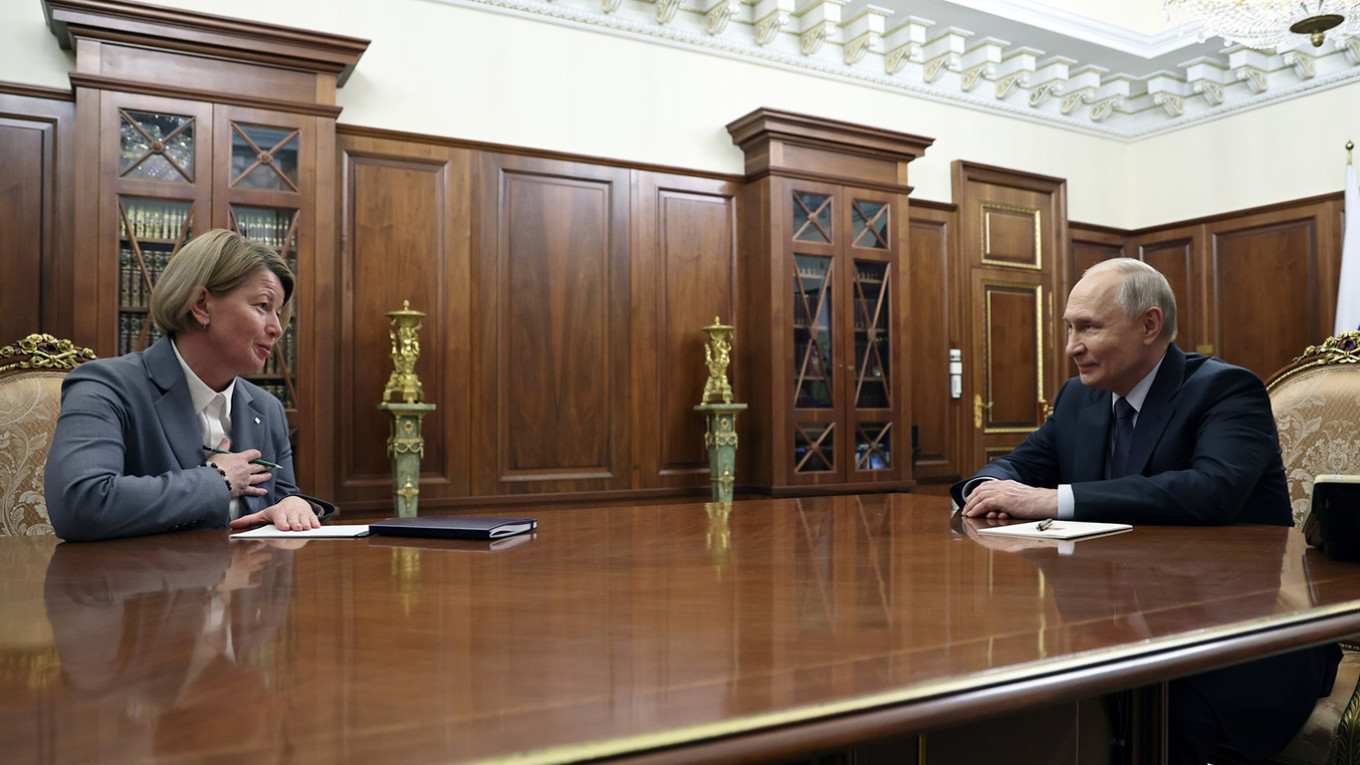
President Vladimir Putin has replaced the head of the republic of Udmurtia after his sudden resignation on Wednesday.
Alexander Brechalov stepped down “at his own request” after governing the western Urals region for nine years, according to a document published on the Kremlin’s website.
In a statement, Udmurtia’s regional government said Brechalov, a native of the North Caucasus republic of Adygea, was “moving to a new job,” but it did not provide further details.
Putin appointed Udmurtia native and former agricultural official Olga Abramova as acting governor until regional elections next year.
Abramova, who was little known nationally until Wednesday, served as Udmurtia’s agriculture minister and first deputy prime minister before moving to Moscow in 2024 to advise Russia’s minister of agriculture.
During a televised Kremlin meeting, Putin emphasized Abramova’s local roots while noting that defense manufacturing accounts for a “large share” of the republic's economy.
Udmurtia’s capital, Izhevsk, hosts several major arms producers, most notably Kalashnikov Concern, which manufactures assault rifles, guided missiles and combat drones.
Political strategist Yevgeny Minchenko warned earlier this month that Brechalov’s “micromanagement” of the Izhevsk mayor’s office could create problems for him and his future as regional head. In June, Minchenko’s gubernatorial rankings noted Brechalov faced a “moderate” risk of dismissal due to weak performance, administrative infighting and the arrests of local elites.
Still, Brechalov’s resignation came as a surprise for most observers.
“All discussions regarding his future were originally scheduled for the fall, as there was a fork in the road: he was heading the United Russia regional ticket for the State Duma elections and could theoretically have transitioned there,” Minchenko wrote Tuesday.
“That would have been a smooth, orderly exit, but instead we got a sudden resignation with reasons even insiders know nothing about. For me personally, the whole thing is completely baffling,” he added.
“I’m not so sure this resignation was even on the radar a month ago. Though Brechalov himself probably found out a week ago or so. My working theory is that he got caught on something,” political analyst Vitalny Ivanov said. “The question is, what?”
Brechalov originally took office in April 2017 after his predecessor, Alexander Solovyov, was arrested on bribery charges. When Brechalov ran for re-election in September 2022, he secured the narrowest margin of victory among all 14 incumbent governors on the ballot, winning 64.37% of the vote.
A Message from The Moscow Times:
Dear readers,
We are facing unprecedented challenges. Russia's Prosecutor General's Office has designated The Moscow Times as an "undesirable" organization, criminalizing our work and putting our staff at risk of prosecution. This follows our earlier unjust labeling as a "foreign agent."
These actions are direct attempts to silence independent journalism in Russia. The authorities claim our work "discredits the decisions of the Russian leadership." We see things differently: we strive to provide accurate, unbiased reporting on Russia.
We, the journalists of The Moscow Times, refuse to be silenced. But to continue our work, we need your help.
Your support, no matter how small, makes a world of difference. If you can, please support us monthly starting from just $2. It's quick to set up, and every contribution makes a significant impact.
By supporting The Moscow Times, you're defending open, independent journalism in the face of repression. Thank you for standing with us.

Remind me later.