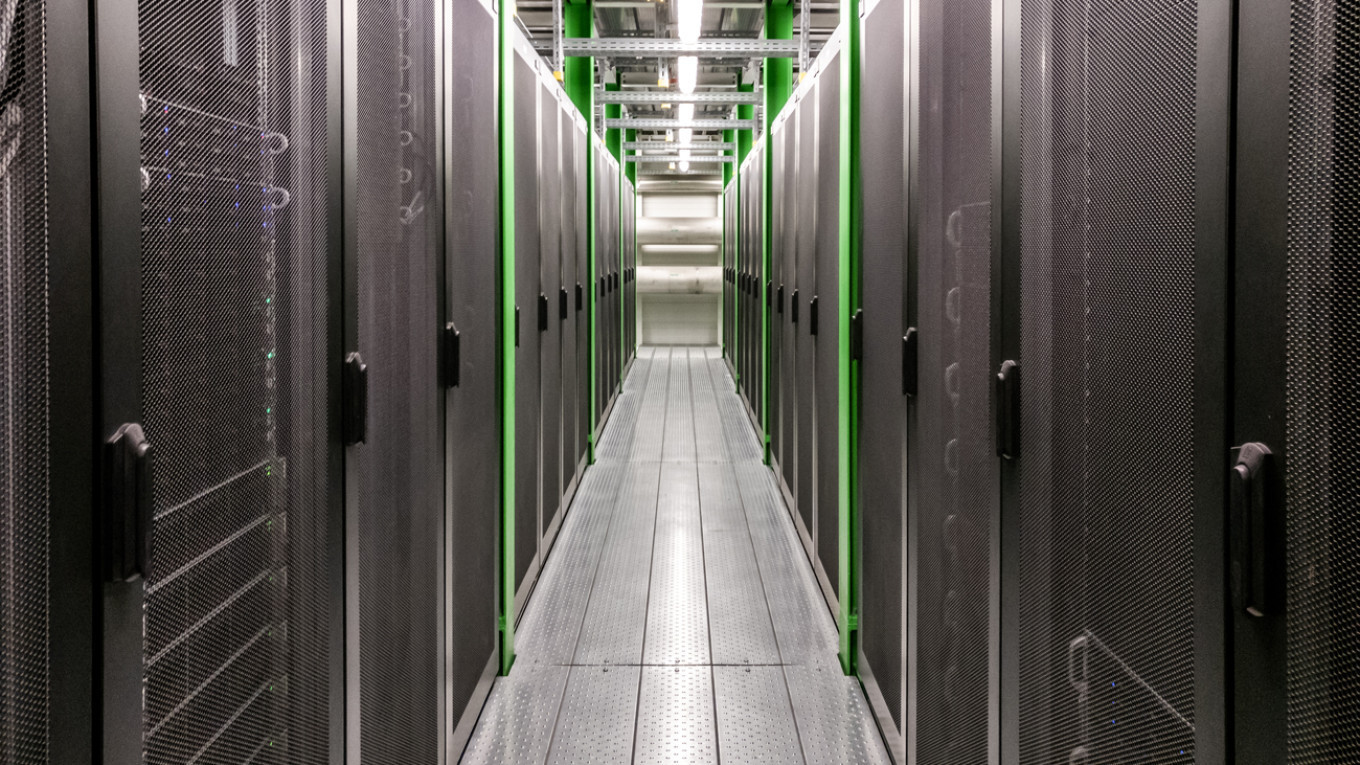
Russia has suspended construction of 38 data center projects worth a combined 168.6 billion rubles ($2.26 billion) over the past three years, highlighting mounting challenges for an industry the government sees as critical to the development of domestic artificial intelligence.
The projects were halted amid high borrowing costs and growing shortages of electricity capacity, according to a study by consulting firm Tekhexpo and research group PKR reviewed by Forbes.
Russia currently has 128 data center projects in various stages of development with planned investments totaling about 1 trillion rubles ($13.4 billion) as of June 2026, the study found. Of those, 42 projects worth 282 billion rubles ($3.78 billion) are under active construction.
Major projects include facilities being developed by technology and state-backed companies including Yandex, Sber, DataPro, AFK Sistema and VK.
The slowdown underscores the growing tension between Russia's ambitions to build domestic AI capabilities and the infrastructure constraints facing the country's technology sector. Industry executives warn that rising financing costs and limited access to power are making many projects economically unviable, potentially undermining efforts to develop independent AI systems.
Between May 2023 and May 2026, the number of data center projects under active construction fell 41.6%, while investment in those projects declined 26.3%, according to the study.
"At the same time, it remains unclear how the task of developing independent AI can be achieved, especially as legislation governing artificial intelligence is now being prepared for adoption," Tekhexpo Chief Executive Filipp Vratskikh told Forbes.
Commercial data centers, which are built to lease computing capacity to outside customers, have come under the greatest pressure because they rely heavily on private investment and bank financing, the study said.
Stanislav Mirin, an analyst at consultancy iKS-Consulting, said financing conditions remain challenging despite recent interest-rate cuts.
"In 2025, the benchmark rate reached 21%," Mirin told Forbes. "It has now fallen to 14.25%, but that is still very high given that commercial data center projects are typically designed to pay back over roughly 10 years. At such rates, the business model often simply does not work."
Industry participants say access to electricity is becoming an even more serious obstacle.
Connecting new facilities to the power grid can take more than a year, Mirin said. In the Moscow region, which hosts most of Russia's commercial data center capacity, obtaining approval for new power connections has become extremely difficult.
"According to market participants, obtaining such approval for new investors in the Moscow region is now virtually impossible," he said.
Consultancy IBC Real Estate estimates that about 75% of Russia's commercial data center market is concentrated in the Moscow region, which is already facing shortages of available power capacity.
Earlier, Rostelecom President Mikhail Oseyevsky warned that spare electricity capacity in Russia's largest cities had been nearly exhausted. He said the shortage was already limiting the construction of new data centers and hindering large-scale deployment of artificial intelligence technologies.
According to Russia's General Energy Development Plan through 2042, Moscow could face a power deficit of 1.6 gigawatts by 2030, rising to 4.2 gigawatts by 2042.
Read this article in Russian at The Moscow Times' Russian service.
A Message from The Moscow Times:
Dear readers,
We are facing unprecedented challenges. Russia's Prosecutor General's Office has designated The Moscow Times as an "undesirable" organization, criminalizing our work and putting our staff at risk of prosecution. This follows our earlier unjust labeling as a "foreign agent."
These actions are direct attempts to silence independent journalism in Russia. The authorities claim our work "discredits the decisions of the Russian leadership." We see things differently: we strive to provide accurate, unbiased reporting on Russia.
We, the journalists of The Moscow Times, refuse to be silenced. But to continue our work, we need your help.
Your support, no matter how small, makes a world of difference. If you can, please support us monthly starting from just $2. It's quick to set up, and every contribution makes a significant impact.
By supporting The Moscow Times, you're defending open, independent journalism in the face of repression. Thank you for standing with us.

Remind me later.