
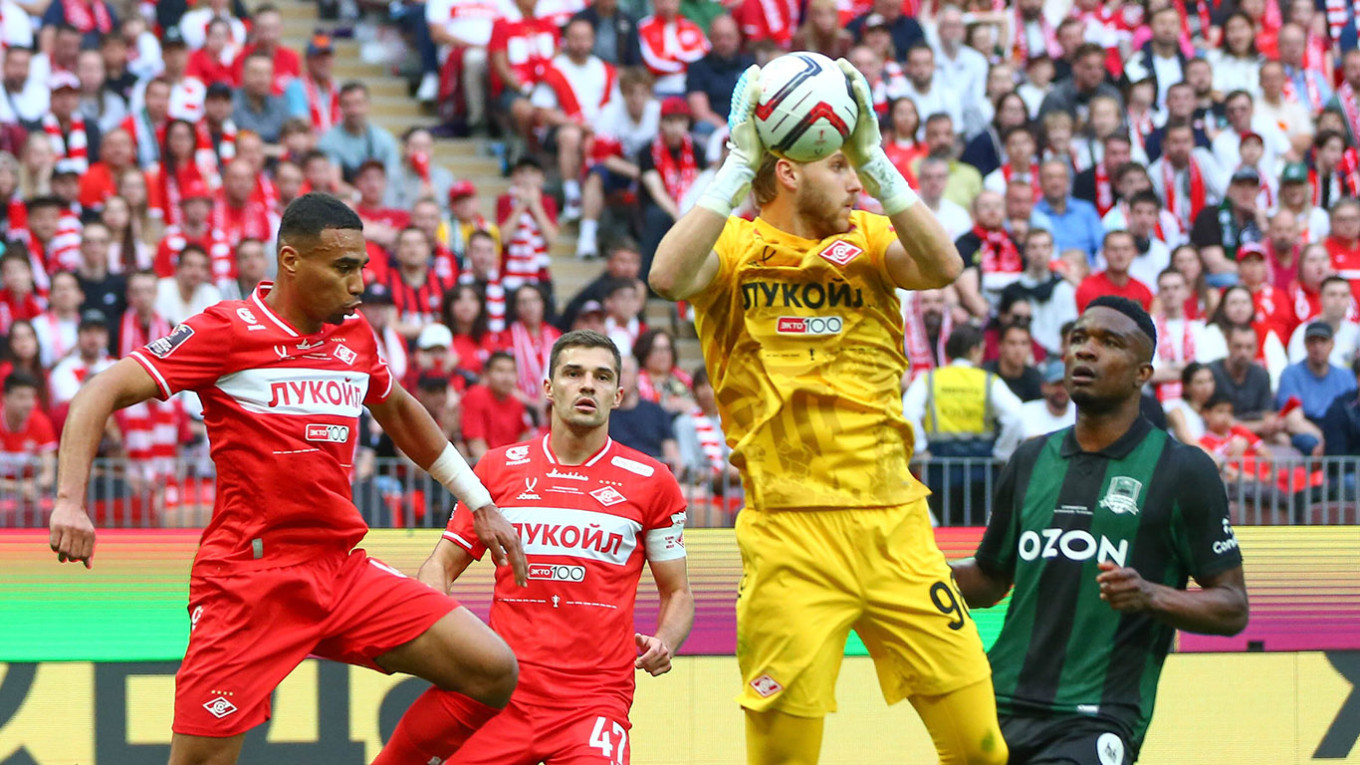
As the 2026 World Cup approached, Russia’s national team was closing out its season with a friendly against Trinidad and Tobago, a much lower-ranked team, in Kaliningrad.
After the final whistle, players bid farewell to the fans as the stadium echoed with a children’s choir singing “Goodbye, America” by Soviet rock legend Vyacheslav Butusov.
On giant screens around the stadium, organizers showed highlights from Russia’s past World Cup campaigns — a visual reminder that this team, which has spent more than five years outside major international tournaments due to the invasion of Ukraine, will again miss football’s biggest event.
Yet while the national team remains barred from major tournaments and clubs are excluded from European competition, Russian players continue to secure transfers abroad — and some football officials are quietly discussing a path back to the international game.
‘Russian players want the war to end soon’
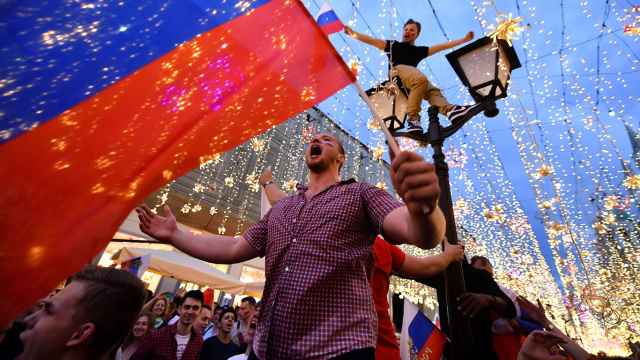
Russia’s footballing fortunes looked very different when it hosted the 2018 FIFA World Cup.
The tournament was widely regarded as a success for the host nation, whose team stunned former champion Spain in the round of 16 before reaching the quarterfinals for the first time in post-Soviet history. Russia was eliminated only after a penalty shootout defeat to Croatia, which went on to reach the final.
One of the stars of that team was striker Artyom Dzyuba, who later voiced support for Russia's war in Ukraine. Midfielder Fyodor Smolov, meanwhile, became one of the few prominent Russian footballers to publicly oppose the war, posting "No to War" on social media alongside a Ukrainian flag emoji.
Most players have avoided discussing the war publicly.
With most European national teams unwilling to play Russia, the national side now faces opponents largely drawn from countries that Moscow deems “friendly” and are often significantly lower-ranked.
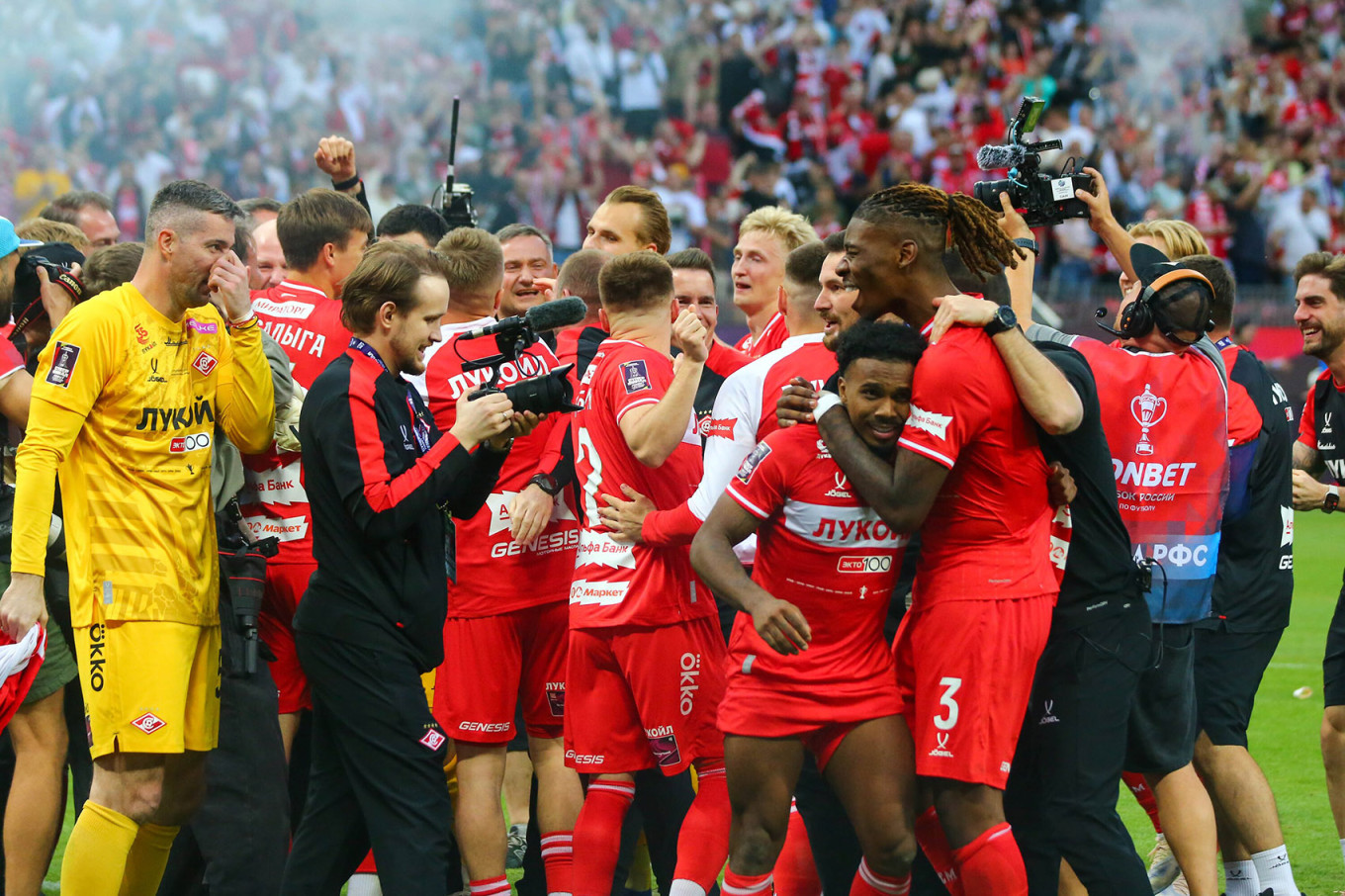
Since the invasion, Russia has played 28 matches, including only two against European opponents — Serbia and Belarus — both of which ended in 4-0 victories.
“I don’t follow these games,” Nikolai, a 30-year-old fan from Moscow, told The Moscow Times. “The opponents are mostly from the third tier of world football. And anyway, friendly matches are boring.”
Public interest in broadcasts and news about the national team has fallen sharply, according to a Russian sports journalist who spoke on condition of anonymity for safety reasons.
“Of course, [the players] want the war to end as soon as possible,” he said. “Many of them are young and would like to play in Europe. But the top leagues, such as England and Germany, are not even considering Russians right now.”
Despite the country's international isolation, a number of promising young Russian players have emerged in recent years.
“If the Russian national team had participated in the World Cup, it would at least have made it to the playoffs. We have a good generation of players, including some who are performing at a high level in European leagues,” Arseny, a 26-year-old fan from Moscow, told The Moscow Times.
European clubs continue to sign Russians
While sanctions have complicated transfers and some clubs remain wary of signing players from Russia, European football has seen a modest resurgence in Russian talent.
The highest-profile wartime transfer was Matvey Safonov's move from FC Krasnodar to Paris Saint-Germain in 2024 in a deal reportedly worth 20 million euros ($23 million), a record fee for a goalkeeper in French football.
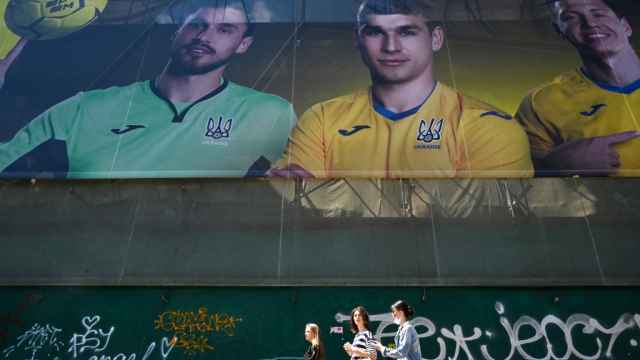
Safonov's arrival at PSG became particularly sensitive after the club signed Ukrainian defender Ilya Zabarnyi, who has publicly supported Ukraine's military and said he would not interact with Russians.
Today, the pair play together but avoid any public interaction. Zabarnyi notably refrained from hugging Safonov after the goalkeeper's penalty saves in the Intercontinental Cup final.
Another major transfer came in 2023, when midfielder Arsen Zakharian joined Spain's Real Sociedad from Dynamo Moscow, sponsored by the sanctioned state-owned bank VTB, for a reported fee of more than 12 million euros.
Neither club disclosed how the payments were processed.
Russian clubs have reportedly continued to complete transfers by using unsanctioned banks, intermediary jurisdictions such as Turkey and the United Arab Emirates, barter arrangements or player-financed release clauses.
Dutch investigative outlet Follow the Money reported in 2024 that nearly 40 European clubs, including PSG, had entered transfer arrangements with Russian clubs that may have violated Western sanctions. No regulators have publicly announced widespread enforcement action against the clubs.
Yuri Zaitsev, a lawyer involved in Safonov's transfer, told Russian broadcaster Match TV that Krasnodar held accounts with banks connected to the SWIFT international payments system and that French authorities did not block the transaction.
Other Russian players who have moved abroad during the war include Alexei Miranchuk, who joined Major League Soccer side Atlanta United, Anton Miranchuk, who signed for Switzerland's Sion, Daler Kuzyaev, who moved to France's Le Havre, and Fyodor Chalov and Magomed Ozdoev, who joined Greek club PAOK.
The growing number of departures reflects a decline in the status of the Russian domestic game.
Before the invasion, lucrative contracts and regular participation in European competitions encouraged many players to spend their entire careers in the Russian Premier League.
Today, some are willing to take pay cuts and move to less prestigious leagues for a chance to play in the Champions League or Europa League.
League value declines
The Moscow Times compared Transfermarkt’s June 2026 RPL valuation of 1.04 billion euros with archived July 2014 data, when the league was valued at 1.14 billion euros. Adjusted for football market inflation using CIES Football Observatory estimates, the 2014 figure would be equivalent to roughly 2.74 billion euros today — meaning the league has lost about 62% of its value in real terms.
The Russian Premier League reached its peak in the early 2010s, ranking among Europe's strongest competitions by both squad value and UEFA performance.
Its standing started to decline after the 2014 annexation of Crimea, as sanctions, economic weakness and the depreciation of the ruble reduced clubs’ spending power.
According to calculations by The Moscow Times based on Transfermarkt valuations and inflation estimates from the CIES Football Observatory, the league's value has fallen by about 62% in real terms since 2014.
Yet the league has proved more resilient than some expected after the 2022 invasion.
Although many foreign players and coaches left Russia during the early months of the war, clubs subsequently turned to Latin America, bringing in players from Brazil, Argentina and Colombia.
The Russian Premier League remains among Europe's 10 most valuable domestic leagues by squad value, according to Transfermarkt. Zenit St. Petersburg, backed by state-controlled gas giant Gazprom, can afford high-profile transfers like its purchase of Brazilian midfielder Luis Henrique for more than 30 million euros.
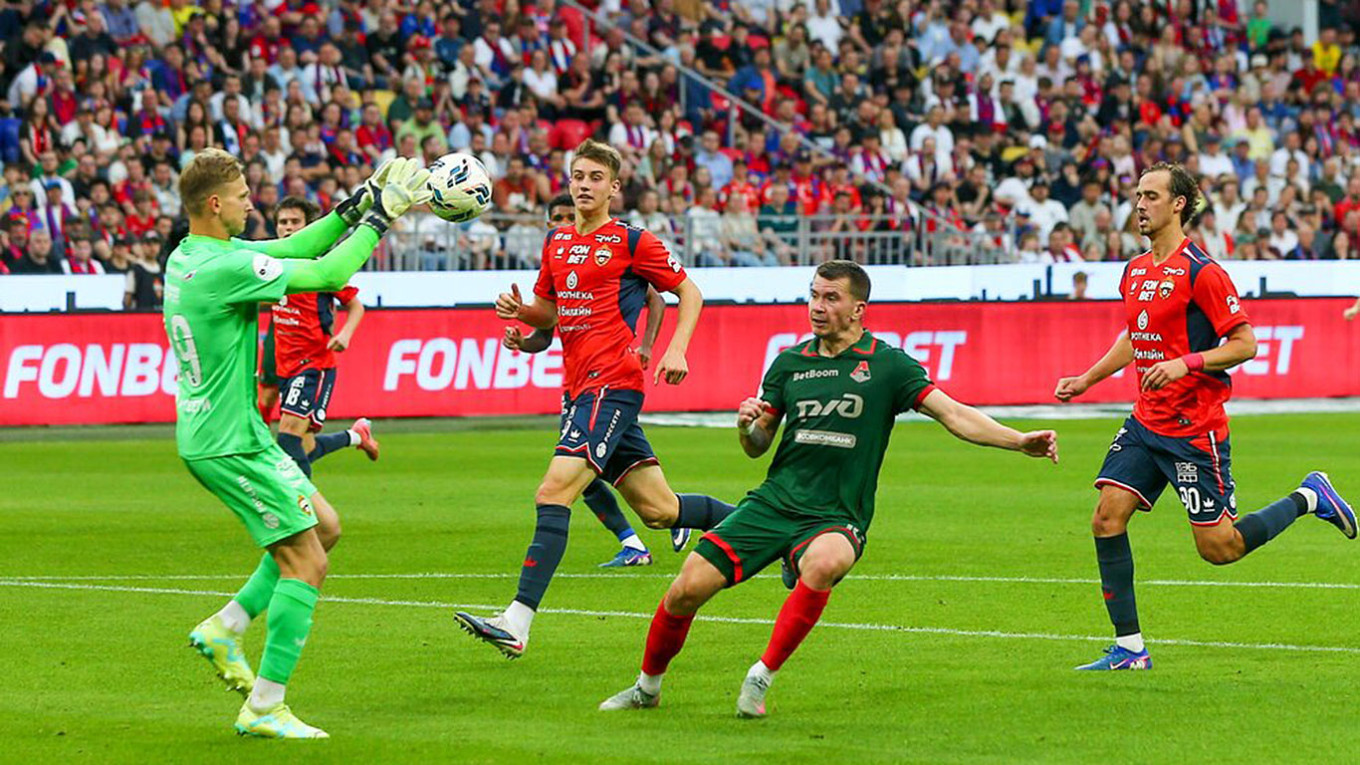
Russia's return?
Debate over whether Russia should return to international football has become more pronounced as the war drags on for a fifth year.
In February, FIFA President Gianni Infantino said Russia's exclusion had "achieved nothing" and argued that the measure had generated "more frustration and hatred."
UEFA President Aleksander Čeferin responded that Russia would only be allowed to return after the war ends.
According to The Guardian, Russian football officials continue to wield influence within UEFA. In 2023, the governing body briefly explored allowing Russian youth teams to return to competition before reversing course after protests from more than a dozen national associations.
The anonymous Russian sports journalist said football officials would welcome Russia's return, given that FIFA is seeking to expand into new markets and increase revenue, but remain concerned about political fallout.
“They understand that some European teams will refuse to play against us. There will be difficulties organizing tournaments, and there could be fights in the stands between fans,” he said.
The debate has intensified amid calls from some football associations and human rights groups to suspend Israel over the war in Gaza, a move FIFA and UEFA have not pursued.
For some Russian supporters, the comparison has reinforced perceptions of double standards.
Igor, a 27-year-old CSKA Moscow fan, said Russia’s suspension had seemed fair to him at first, but that “the world has changed” since then.
“There are so many wars now,” he said. “Yes, FIFA and UEFA are essentially Western corporations, and it would be strange if the U.S. and Israel — which are part of this Western world — were to suspend themselves. But there are double standards here.”
While Russian football awaits its return to the world stage, its fans have no choice but to cheer on their favorite foreign teams at this year’s World Cup.
“I’ll be rooting for Uzbekistan,” said Arseny. “They’re the only team from the former Soviet Union in the tournament. One way or another, they’re the closest to us.”
A Message from The Moscow Times:
Dear readers,
We are facing unprecedented challenges. Russia's Prosecutor General's Office has designated The Moscow Times as an "undesirable" organization, criminalizing our work and putting our staff at risk of prosecution. This follows our earlier unjust labeling as a "foreign agent."
These actions are direct attempts to silence independent journalism in Russia. The authorities claim our work "discredits the decisions of the Russian leadership." We see things differently: we strive to provide accurate, unbiased reporting on Russia.
We, the journalists of The Moscow Times, refuse to be silenced. But to continue our work, we need your help.
Your support, no matter how small, makes a world of difference. If you can, please support us monthly starting from just $2. It's quick to set up, and every contribution makes a significant impact.
By supporting The Moscow Times, you're defending open, independent journalism in the face of repression. Thank you for standing with us.

Remind me later.