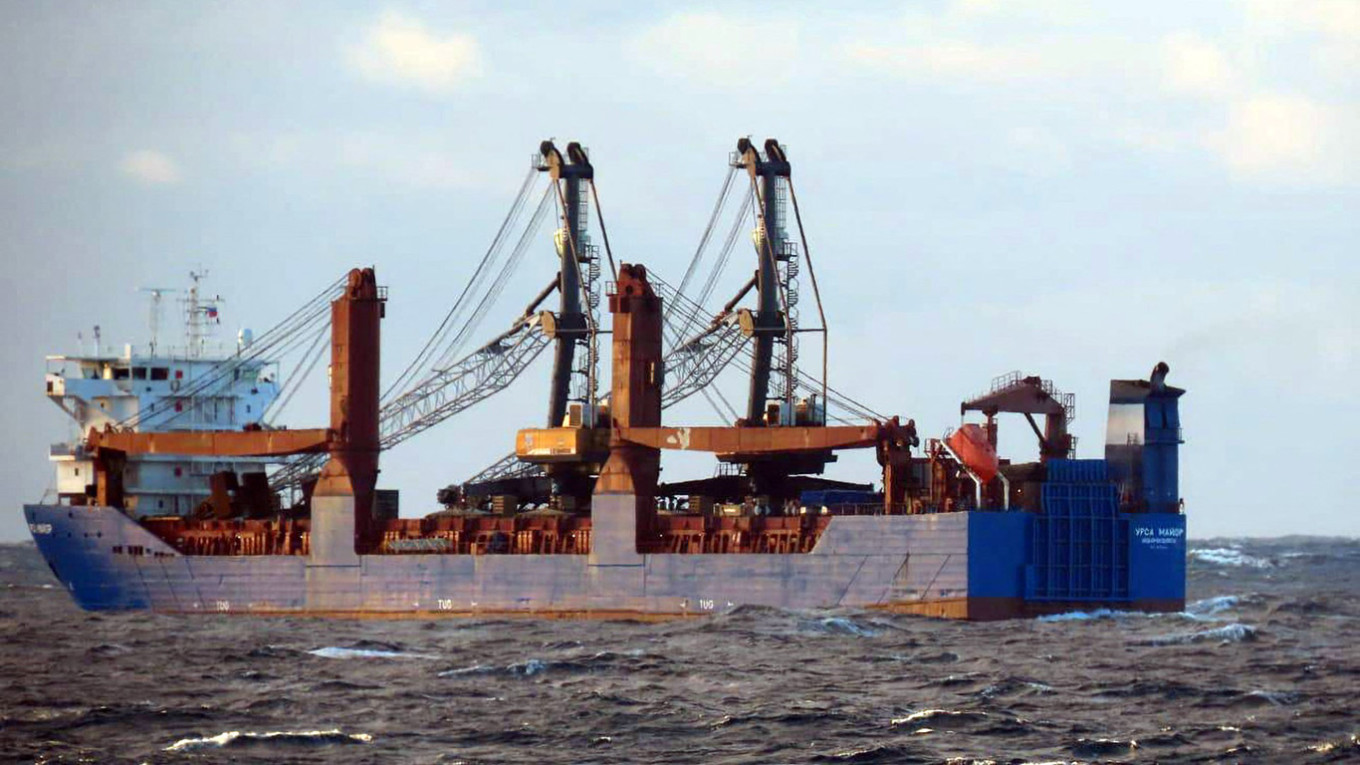
In December 2024, a Russian-flagged ship called the Ursa Major, whose itinerary claimed it would be sailing from St. Petersburg to Vladivostok, abruptly sank near Spain. This May, a new CNN report claims that the vessel was carrying submarine nuclear reactors destined for North Korea’s Rason port.
The incident naturally raised questions about what nuclear-related cargo Russia could be supplying North Korea with and the potential danger it poses. But its circuitous route through international waters to Russia’s Far Eastern border with the Hermit Kingdom — via Spain and the Suez Canal — raises questions about why a much shorter route along Russia’s arctic coast or even overland was out of the question.
The answer likely lies in some of Russia's own domestic infrastructure problems.
First, the incident reveals the ongoing difficulties in using the Northern Sea Route (NSR) as a reliable trade or security route, as it is largely unnavigable for stretches at a time. Although this varies with ice conditions and vessel capability, the seasonal window to navigate along the NSR is usually from late June to mid-November.
There is an increasing and dangerous trend of ships traversing the NSR unescorted and without ice-class certification, hoping for thinner sea ice and favorable conditions rather than investing in fortifying vessels. This leaves vessels vulnerable to highly changeable ice conditions.
The risks inherent to this route have already been borne out. In September 2025, a non-ice-class vessel thought to be part of Russia’s shadow fleet became trapped in ice along the NSR. It had been carrying oil from Murmansk to China without an icebreaker escort and was forced to wait for help for several days. Controversially, a China-linked container ship navigated along the route that same month, becoming the first ship to do so without proper ice-class capabilities.
But Russia is acutely aware of some of the limitations of the NSR. Successive Arctic strategies, including the newly updated version ordered last year, have all pointed to the lack of search and rescue capabilities along the High North, patchy port infrastructure and reduced investment in constructing ice-class vessels. The decision not to use this route was likely due to seasonal navigational issues. But it could have been an option had Russia’s sanctions-hit shipbuilding capabilities been stronger.
Second, this incident underscores some of the domestic pressures that the country’s shipbuilding sector is under.
The Ursa Major had an ice class rating of 1A. While systems vary, this specification refers to the thickness of ice that a vessel can safely traverse, involving modifications including strengthening a ship’s hull. While a Class 1A vessel could traverse the NSR in theory, it would still rely on an icebreaker to navigate difficult conditions with ice a meter thick. Other ice-class 1A vessels have navigated the NSR before, most notably in 2011, although still escorted by Russia’s nuclear icebreakers even in August.
At the time of the incident, in December 2024, it would have been the depths of winter. At that time, there were heavy ice formations along the NSR, having started to form as early as October, forcing less robust ships to end their navigable season early. That said, had the Ursa Major been accompanied by one of Russia’s specialized icebreakers, the route would have been hazardous but traversable.
Russia does have this capability — its icebreaker fleet totals 41 vessels. But while the fleet is large, most of the vessels are small and designed to maintain the navigability of ports and river systems. The country’s aging ships require repair, keeping them out of operation for months.
It could have been that the Kremlin either could not spare an icebreaker for such allegedly important cargo, or wanted to avoid the risk of getting stuck in the ice altogether. Either way, it highlights the risks of transportation along this route, which is at odds with the Kremlin’s desire to use this as a mainstream alternative supply route.
Third, and perhaps less obviously, the Ursa Major case indicates that a laborious, expensive and circuitous sea route was preferable to traveling across Russia over land to North Korea. If, as the CNN investigation suggests, the ship was carrying heavy components for two nuclear reactors without fuel — the Soviet-era VM-4SG reactor for use in submarines — it raises the question of why they were not transported by rail.
Rail systems can accept heavy loads of this size. In fact, transporting this type of cargo by rail is much safer, particularly if there is a risk — of which there was no suggestion in this case — of nuclear contamination. Russia has long used its specialized railcars to transport spent nuclear fuel from nuclear power stations and Russian Railways has specific routes where it can operate heavy trains with cargo far exceeding the deadweight tonnage of the Ursa Major.
But there might have been a few issues there as well.
First, due to the heavy tonnage, sensitivity of the material and potential damage to the components, specialized railcars — of which Russia has several — might have been necessary. Among other things, this requires heavy-duty multi-axle flatcars. The route would need to be cleared in advance due to the size of the reactors, which would not be able to pass under certain bridges. Many bridges in the Far East of Russia are notoriously approaching the end of their service life, constructed around the turn of the 20th century. In some places, they are even made of wood. The risk of the train derailing would have been high.
Second, some parts of the reactor could have been shipped by river barge, as is common in the United States. But Russia’s river fleet and inland waterway system have not been modernized since the Soviet era and the Kremlin’s push to upgrade them and dredge canals remains in its infancy.
Third, much of Russia’s existing rail capabilities are taken up by the war effort, expanding trade with China in the east and meeting domestic demand. The network is at capacity with little scope for adding new railcars. Adding a slow-moving specialized railcar could have slowed down the network at a critical juncture in the war, particularly in parts of the country where the railway is single-track.
Fourth, the problem could have been at the other end of the journey. For now, the only border crossing in the Russian Far East with North Korea is a 1950s-era bridge spanning the Tumen River. While rail traffic has increased along the bridge since the two countries deepened their cooperation over the war, it is unclear how much tonnage the steel bridge can bear. The different rail gauge systems between Russia and North Korea would have required lifting the cars between tracks, which may also have been a factor in the decision.
Ultimately, this incident and the circumnavigation required for sensitive trade with an ally demonstrated a plethora of problems in Russia’s supply chain network, which the Kremlin will be forced to confront.
A Message from The Moscow Times:
Dear readers,
We are facing unprecedented challenges. Russia's Prosecutor General's Office has designated The Moscow Times as an "undesirable" organization, criminalizing our work and putting our staff at risk of prosecution. This follows our earlier unjust labeling as a "foreign agent."
These actions are direct attempts to silence independent journalism in Russia. The authorities claim our work "discredits the decisions of the Russian leadership." We see things differently: we strive to provide accurate, unbiased reporting on Russia.
We, the journalists of The Moscow Times, refuse to be silenced. But to continue our work, we need your help.
Your support, no matter how small, makes a world of difference. If you can, please support us monthly starting from just $2. It's quick to set up, and every contribution makes a significant impact.
By supporting The Moscow Times, you're defending open, independent journalism in the face of repression. Thank you for standing with us.

Remind me later.