
In late February, Russia’s Justice Ministry announced fresh additions to its extensive list of “foreign agents” — a label that authorities use to target individuals and organizations seen as enemies of the state.
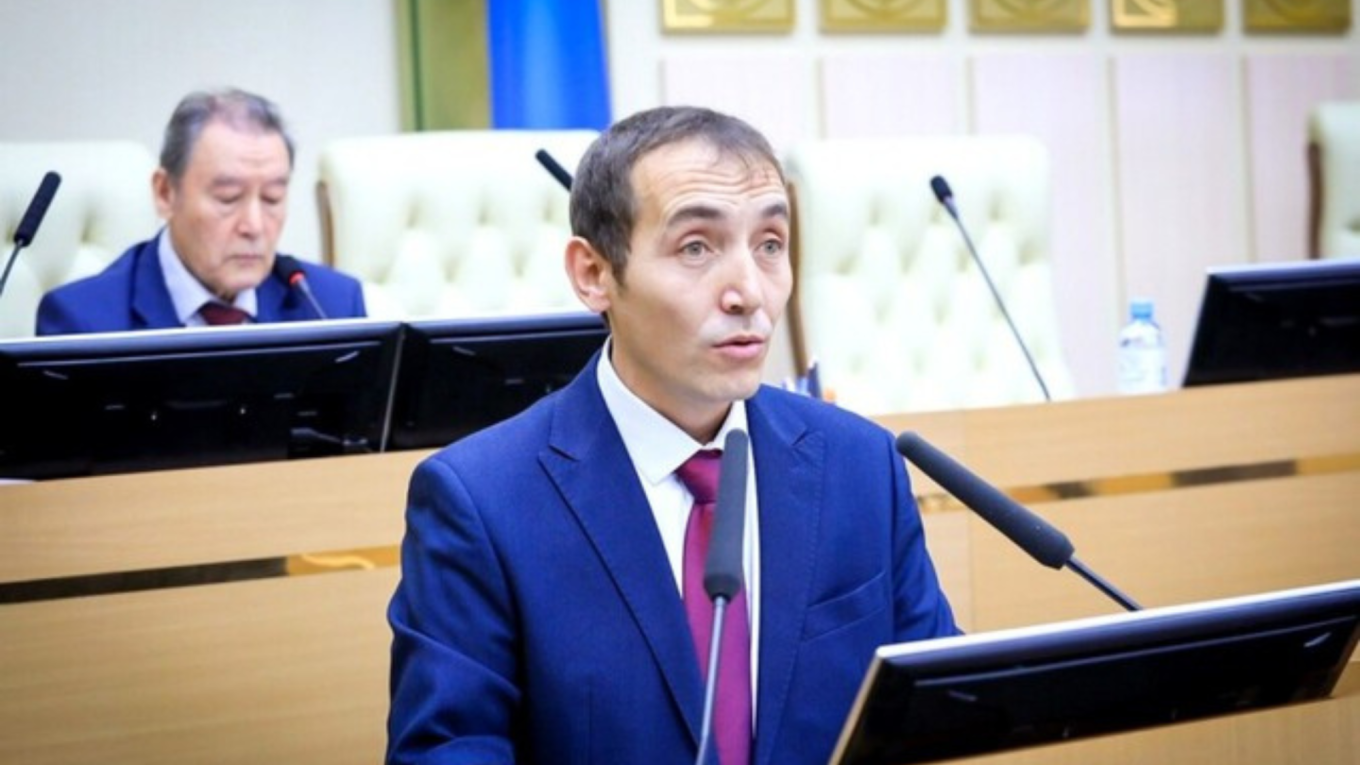
While these weekly updates typically name independent journalists and activists, this one included an acting government official: Alexander Ivanov, a member of the Il Tumen regional parliament in the republic of Sakha (Yakutia).
“I hear shouts of joy coming from the ranks of my opponents: ‘That is what he deserves!’ Well, today it is me and tomorrow they might come for others, my friends. Don’t be so happy about it,” Ivanov said of the news.
Just two days earlier, a group of fellow deputies asked law enforcement authorities to investigate Ivanov for spreading “fake” news and violating Russia’s anti-extremism laws, crimes punishable with prison sentences.
The inquiry was linked to a video posted by Ivanov during a recent trip to Kazakhstan in which he called the country’s independence “the greatest treasure of the Kazakh nation” and expressed regret that the Sakha people “don’t have the same fortune.”
“We are not allowed to study our language, study our true history, to control the lands inherited from our forefathers,” said Ivanov.
“Even if all the gold in the world is piled up in a mountain and all the forests in the world are turned into money — all of that would be nothing compared to [the possibility of] my people having free will,” he added.
Ivanov’s candor about what he describes as Sakha’s diminishing political autonomy, economic agency and Indigenous rights have made him a target at a time when expressions of dissent in Russia’s regions have come under heightened scrutiny amid the war in Ukraine.

As Russia’s largest region, Sakha is roughly the size of India but has a population of about 1 million.
The Sakha, the Indigenous Turkic ethnic group from which the republic takes its name, comprise over 55% of the population, followed by Russians at more than 32%, according to Russia’s latest census.
Following the U.S.S.R.’s collapse, as Kazakhstan and other former Soviet republics declared independence, Sakha also sought greater sovereignty from Moscow.
The republic’s 1992 constitution declared Sakha and Russian as its official languages — and designated the region’s abundant natural resources, including some of the world’s largest diamond deposits, as “the property and inalienable heritage” of Sakha’s peoples.
Sakha’s first president Mikhail Nikolayev also pursued several ambitious projects aimed at securing the region’s autonomy within Russia.
These included making English the third working language of Sakha’s government and introducing state-funded student exchange programs with several countries, including Britain.
Born in 1980 in the small Sakha-majority village of Zharkhan in the southwestern Nyurba ulus (district), Ivanov witnessed these post-Soviet transformations firsthand.
But he also witnessed the regression of regional sovereignty that has accompanied Vladimir Putin’s quarter-century in power.
After graduating from university in St. Petersburg, Ivanov spent nearly a decade working for the marketing wing of Sakha’s flagship Yakutia Airlines before venturing into politics.
He became the head of his native Zharkhan in 2012, and within five years he had risen to head the Nyurba ulus’ capital city of the same name.
Running as an independent, Ivanov defeated United Russia hopeful Nikolai Burnashev in the mayoral race by a nearly 7% margin.
Although he called himself a “supporter of United Russia” at the outset of his term, Ivanov quickly earned a reputation as a rebellious opposition politician.
He had a strained relationship with the ulus’ United Russia-backed head, Alexei Innokentyev, and publicly challenged republic-level authorities on issues far beyond the domain of his office.
Apparently too ambitious to settle for heading a town of 10,000 people, Ivanov resigned as mayor of Nyurba in 2022 to challenge Innokentyev in the district head race.
But Ivanov’s campaign was cut short over a copyright infringement case by composer Ayaal Kirillin-Kundel, who claimed Ivanov featured his music in an election video without permission.
A local judge ruled in favor of Kirillin-Kundel and disqualified Ivanov from the race.
“The first feeling is that there is too much freedom [in my life now],” Ivanov said about being barred from the race. “For 10 years, I worked and lived for the people. All my thoughts were only about Nyurba. Today I have an unusually large amount of time that I can devote to my family.”
But Ivanov’s absence from politics did not last long.
Though space for lawful political dissent has been shrinking rapidly since Russia’s full-scale invasion of Ukraine, Ivanov was elected to Sakha’s parliament in September 2023 as an independent backed by the New People party.
New People, who hold just six seats compared to United Russia’s 55, immediately nominated Ivanov for parliament chairman.
In his nomination speech, Ivanov warned veteran parliament members that the upcoming term would not be business as usual.
“Some of our colleagues…are living with a dangerous illusion that the State Assembly of the republic is almost like their private business office,” said Ivanov. “They think that their small group can control not only the work of the Il Tumen but also the fate of the republic.”
Though Ivanov was not elected as chairman, local media hailed his speech as “the main political event of the week.”
This fiery inaugural speech would come to define Ivanov’s time in parliament.
Less than two years later, he would be expelled from the New People faction.
The move came after pro-government Telegram channels and news agencies accused Ivanov of harboring Sakha nationalist, separatist and even pan-Turkic sentiments, citing his 2024 interview with pro-Russian Turkish blogger Cem Kıran.
Ivanov denied the accusations, arguing that quotes from the interview were taken out of context.
Last week, Ivanov acknowledged that his “foreign agent” designation was likely linked to the interview as well as his trip to the republic of Altai to support mass protests against local self-government reform.
In a viral address published on social media, Ivanov said the designation was “just the beginning,” hinting that the authorities are likely gearing up to press criminal charges against him.
“All of this will lead to a situation where it will be impossible to live comfortably on my native land, on the land of my ancestors, to think freely and to speak freely,” said the politician, adding that he would not consider leaving the country as long as he has a parliamentary mandate.
“How can I leave without fulfilling my civic duty until the very last day — my duty to the people, to the nation?” added Ivanov.
Sakha’s Il Tumen is due to debate and vote on Ivanov’s possible expulsion from the republic’s parliament at its next plenary session on March 25-26.
A Message from The Moscow Times:
Dear readers,
We are facing unprecedented challenges. Russia's Prosecutor General's Office has designated The Moscow Times as an "undesirable" organization, criminalizing our work and putting our staff at risk of prosecution. This follows our earlier unjust labeling as a "foreign agent."
These actions are direct attempts to silence independent journalism in Russia. The authorities claim our work "discredits the decisions of the Russian leadership." We see things differently: we strive to provide accurate, unbiased reporting on Russia.
We, the journalists of The Moscow Times, refuse to be silenced. But to continue our work, we need your help.
Your support, no matter how small, makes a world of difference. If you can, please support us monthly starting from just $2. It's quick to set up, and every contribution makes a significant impact.
By supporting The Moscow Times, you're defending open, independent journalism in the face of repression. Thank you for standing with us.

Remind me later.