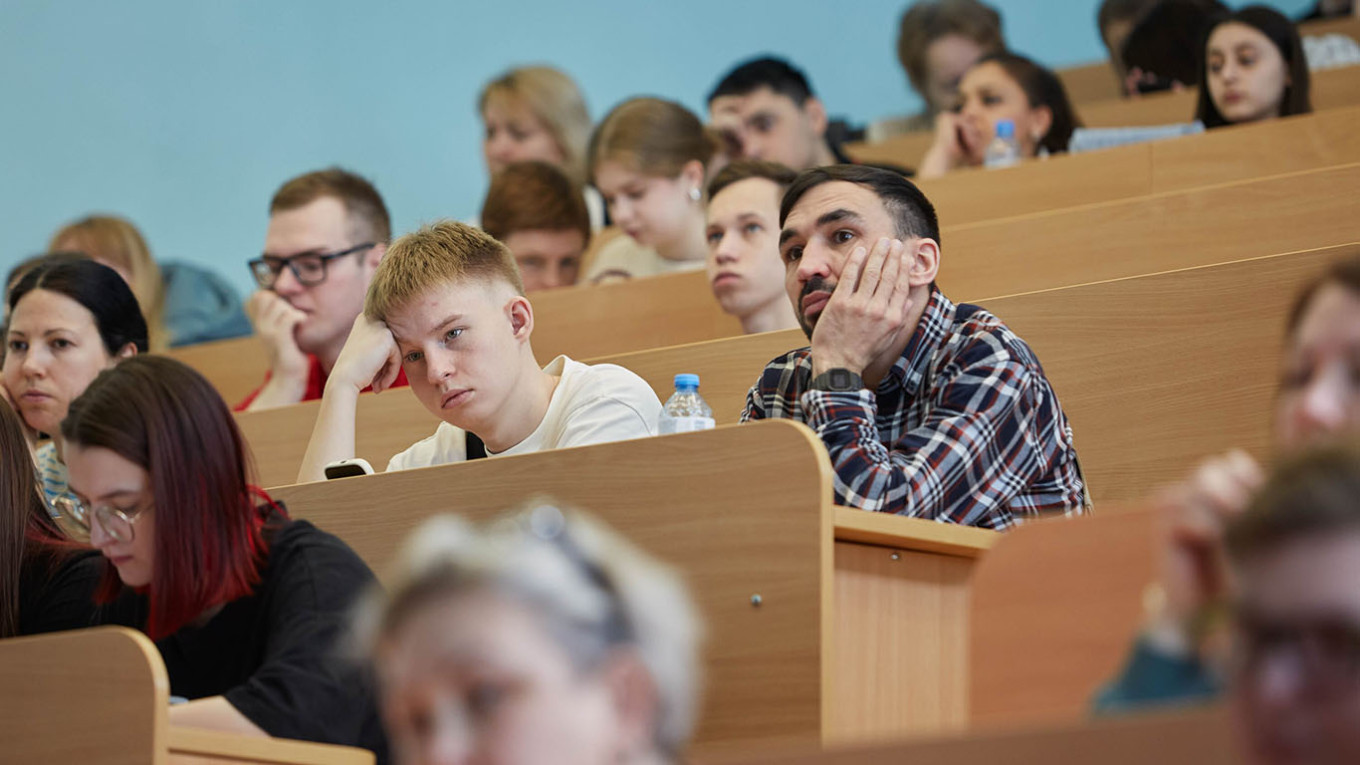
Russian education officials have eliminated 47,000 paid spots for university students as part of a wider government effort to stymie the oversupply of degrees in several fields.
Science and Education Minister Valery Falkov said Wednesday the cuts had primarily affected degree programs like economics, law, business management and advertising at private universities.
In total, Falkov said the cuts accounted for 13% of paid student places in the designated disciplines at universities nationwide.
The reduction in paid spots comes after education authorities previously announced plans to eliminate 45,000 state-funded university slots, known in Russia as “budget places,” in the 2026–27 academic year.
Last year, the Russian government granted itself the authority to regulate the number of tuition-free slots at both public and private universities, expanding oversight beyond state-funded enrollments.
In November, the authorities finalized a list of 40 subject areas, including 28 Bachelor’s and 12 specialist programs, where it could cap the enrollment numbers for paying students starting this academic year.
Falkov said Wednesday that the Science and Education Ministry was working to increase the number of tuition-free slots for engineering students.
President Vladimir Putin has urged the government to prioritize engineering and technical disciplines in higher education, which he said should be brought into closer alignment with Russia’s economic and technological priorities.
His calls to channel more students into industrial fields amid labor shortages have coincided with sharp increases in tuition fees.
A Message from The Moscow Times:
Dear readers,
We are facing unprecedented challenges. Russia's Prosecutor General's Office has designated The Moscow Times as an "undesirable" organization, criminalizing our work and putting our staff at risk of prosecution. This follows our earlier unjust labeling as a "foreign agent."
These actions are direct attempts to silence independent journalism in Russia. The authorities claim our work "discredits the decisions of the Russian leadership." We see things differently: we strive to provide accurate, unbiased reporting on Russia.
We, the journalists of The Moscow Times, refuse to be silenced. But to continue our work, we need your help.
Your support, no matter how small, makes a world of difference. If you can, please support us monthly starting from just $2. It's quick to set up, and every contribution makes a significant impact.
By supporting The Moscow Times, you're defending open, independent journalism in the face of repression. Thank you for standing with us.

Remind me later.