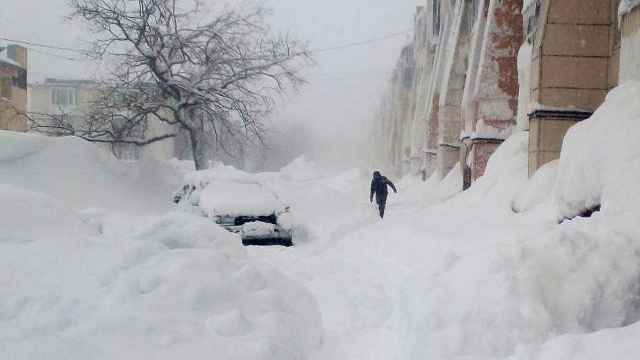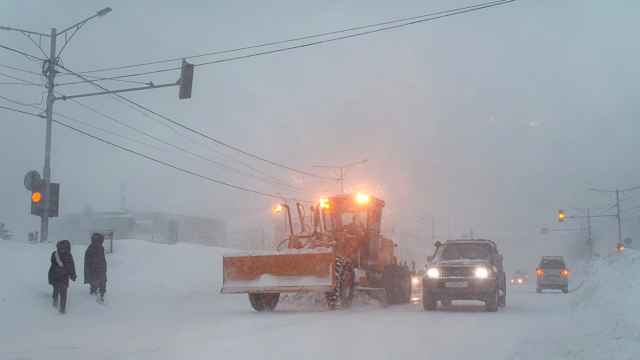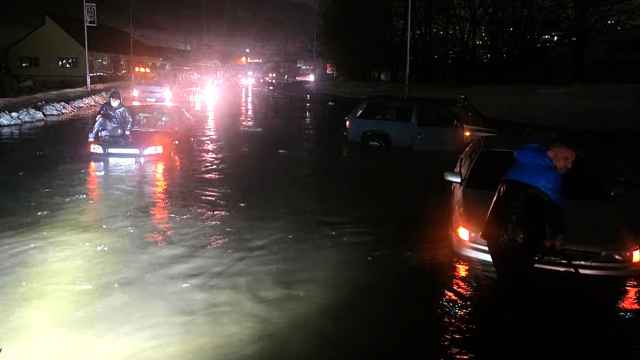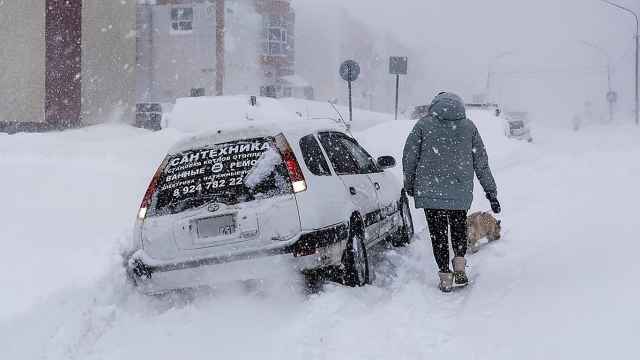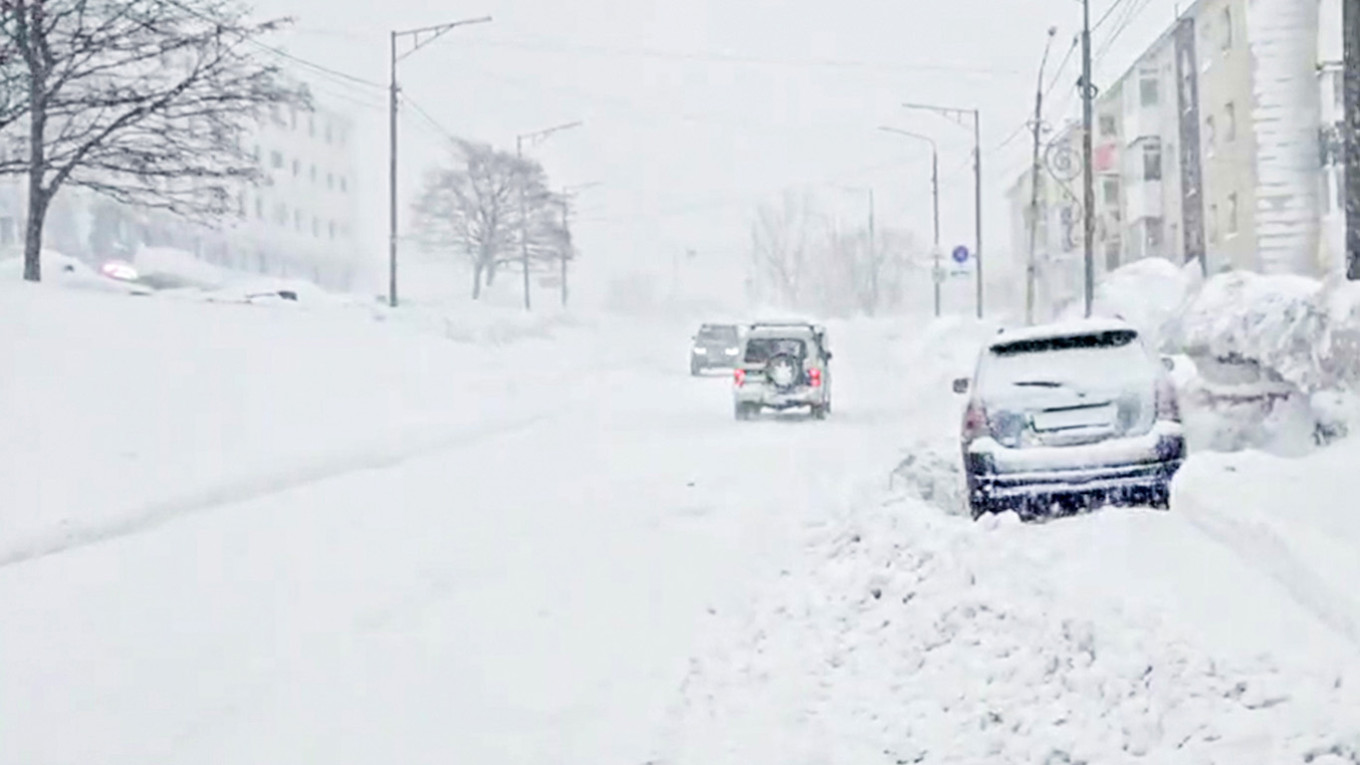
Road conditions in Kamchatka’s capital city of Petropavlovsk-Kamchatsky remain extremely hazardous after a series of powerful winter storms blasted the Far East peninsula last week with a potent mixture of snow, ice and wind, officials said Monday, as efforts continue to get the far-flung region back on its normal footing.
“The situation on the city’s roads is critical,” Kamchatka region Governor Vladimir Solodov said at an emergency meeting. “I’ve set a Jan. 21 deadline for all major roadways to be cleared, for the restoration of regular traffic.”
City officials announced a state of emergency in Petropavlovsk-Kamchatsky on Thursday after two elderly men were killed by falling snow. The mayor blamed their deaths on property management companies, who he accused of failing to promptly remove snow.
Several low-pressure systems forming in the Sea of Okhotsk, located off the coast of northern Japan, swept across Kamchatka and other parts of Far East Russia last week, bringing strong winds and heavy snow.
Meteorologists say the level of snowfall in Kamchatka since early January has not been seen since recordkeeping began half a century ago.
In December, Petropavlovsk-Kamchatsky saw triple the monthly average of snowfall, while Jan. 1-16 saw around 150% more than the monthly average for that period. The average height of snow in the city reached 170 centimeters (5.5 feet), with drifts exceeding 2.5 meters (8 feet) in certain neighborhoods.
“The last time we saw something like this was over 50 years ago, in the early 1970s,” said Vera Polyakova, head of Kamchatka’s Hydrometeorology Center. “These conditions are exceptionally rare as far as modern observations go.”
Governor Solodov ordered schools in Petropavlovsk-Kamchatsky to reopen as soon as possible. He also told city officials to manually track the movement of food and fuel supplies until a full recovery could be declared.
Solodov warned that icicles hanging from the roofs of buildings continued to pose a risk to people walking nearby, while Polyakova said the period of prolonged snowfall had created local avalanche risks in a number of residential areas.
A Message from The Moscow Times:
Dear readers,
We are facing unprecedented challenges. Russia's Prosecutor General's Office has designated The Moscow Times as an "undesirable" organization, criminalizing our work and putting our staff at risk of prosecution. This follows our earlier unjust labeling as a "foreign agent."
These actions are direct attempts to silence independent journalism in Russia. The authorities claim our work "discredits the decisions of the Russian leadership." We see things differently: we strive to provide accurate, unbiased reporting on Russia.
We, the journalists of The Moscow Times, refuse to be silenced. But to continue our work, we need your help.
Your support, no matter how small, makes a world of difference. If you can, please support us monthly starting from just $2. It's quick to set up, and every contribution makes a significant impact.
By supporting The Moscow Times, you're defending open, independent journalism in the face of repression. Thank you for standing with us.

Remind me later.