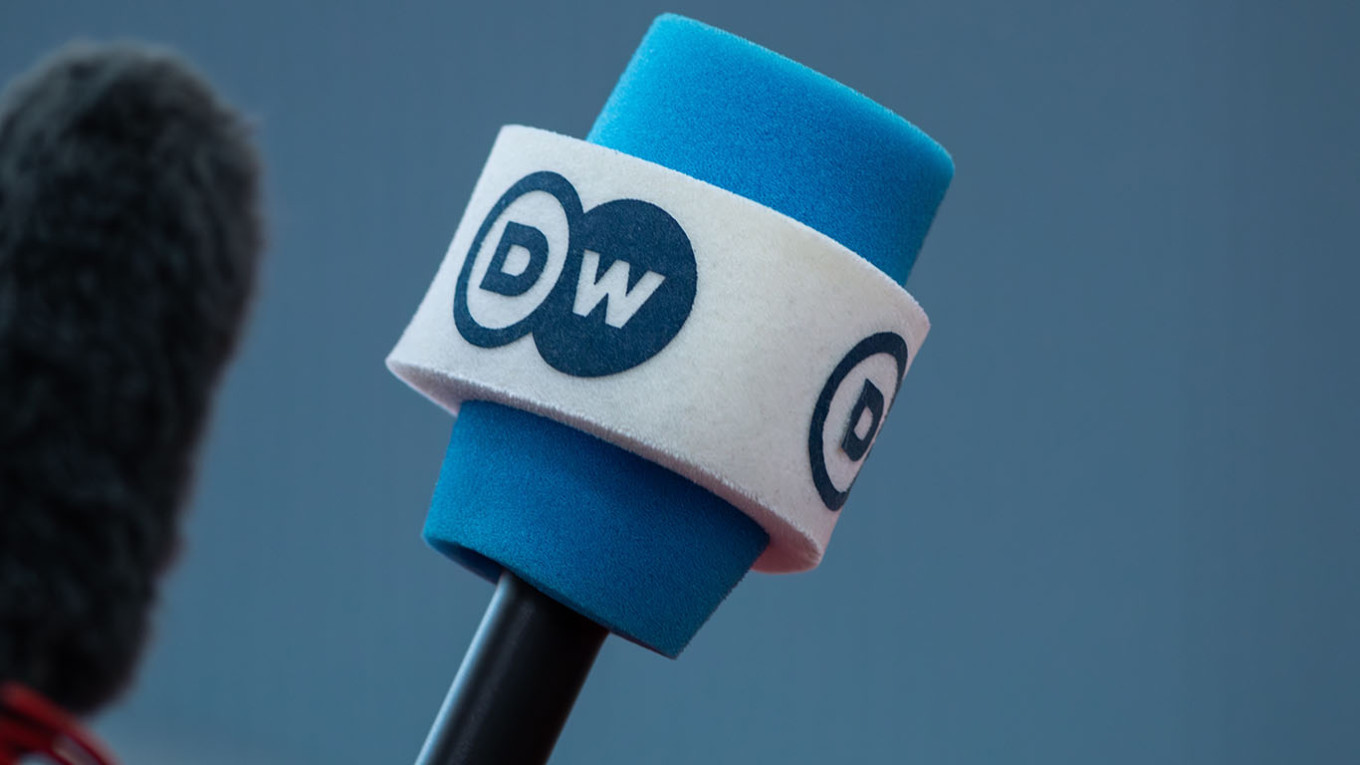
Russia’s Justice Ministry on Tuesday designated the German broadcaster Deutsche Welle as an “undesirable” organization, making it the latest foreign news outlet to be blacklisted in the country amid a broader crackdown on press freedom.
The designation bans the broadcaster from operating in Russia. Under Russian law, individuals found to be affiliated with “undesirable” organizations face up to four years in prison, while organization leaders risk up to six years.
The Justice Ministry did not issue a statement accompanying DW’s designation, but State Duma lawmaker Vasily Piskaryov, who heads the lower house’s Commission of Foreign Interference, accused the German broadcaster this weekend of spreading “anti-Russian propaganda” and training “disinformation specialists.”
Amid reports that authorities in Moscow were preparing to blacklist the outlet, DW Director General Barbara Massing said on Sunday that she and her colleagues would not be deterred.
“Despite censorship and blocking of our services by the Russian government, DW’s Russian language service now reaches more people than ever before,” Massing said in a statement.
Weeks before invading Ukraine in February 2022, Russia forced the closure of the German broadcaster’s Moscow bureau in response to Berlin’s ban on the German-language service of the Kremlin-funded broadcaster RT.
In March 2022, Russia’s Justice Ministry labeled DW a “foreign agent” and its website was subsequently blocked inside Russia.
Russia introduced its “undesirable” law in 2015, using it to crack down on independent media, opposition groups and foreign-funded organizations. Hundreds of organizations are currently blacklisted, including The Moscow Times.
The German government condemned Russia’s ban on DW, accusing the Kremlin of “fear of independent information, especially about the aggressive war against Ukraine.”
A Message from The Moscow Times:
Dear readers,
We are facing unprecedented challenges. Russia's Prosecutor General's Office has designated The Moscow Times as an "undesirable" organization, criminalizing our work and putting our staff at risk of prosecution. This follows our earlier unjust labeling as a "foreign agent."
These actions are direct attempts to silence independent journalism in Russia. The authorities claim our work "discredits the decisions of the Russian leadership." We see things differently: we strive to provide accurate, unbiased reporting on Russia.
We, the journalists of The Moscow Times, refuse to be silenced. But to continue our work, we need your help.
Your support, no matter how small, makes a world of difference. If you can, please support us monthly starting from just $2. It's quick to set up, and every contribution makes a significant impact.
By supporting The Moscow Times, you're defending open, independent journalism in the face of repression. Thank you for standing with us.

Remind me later.