

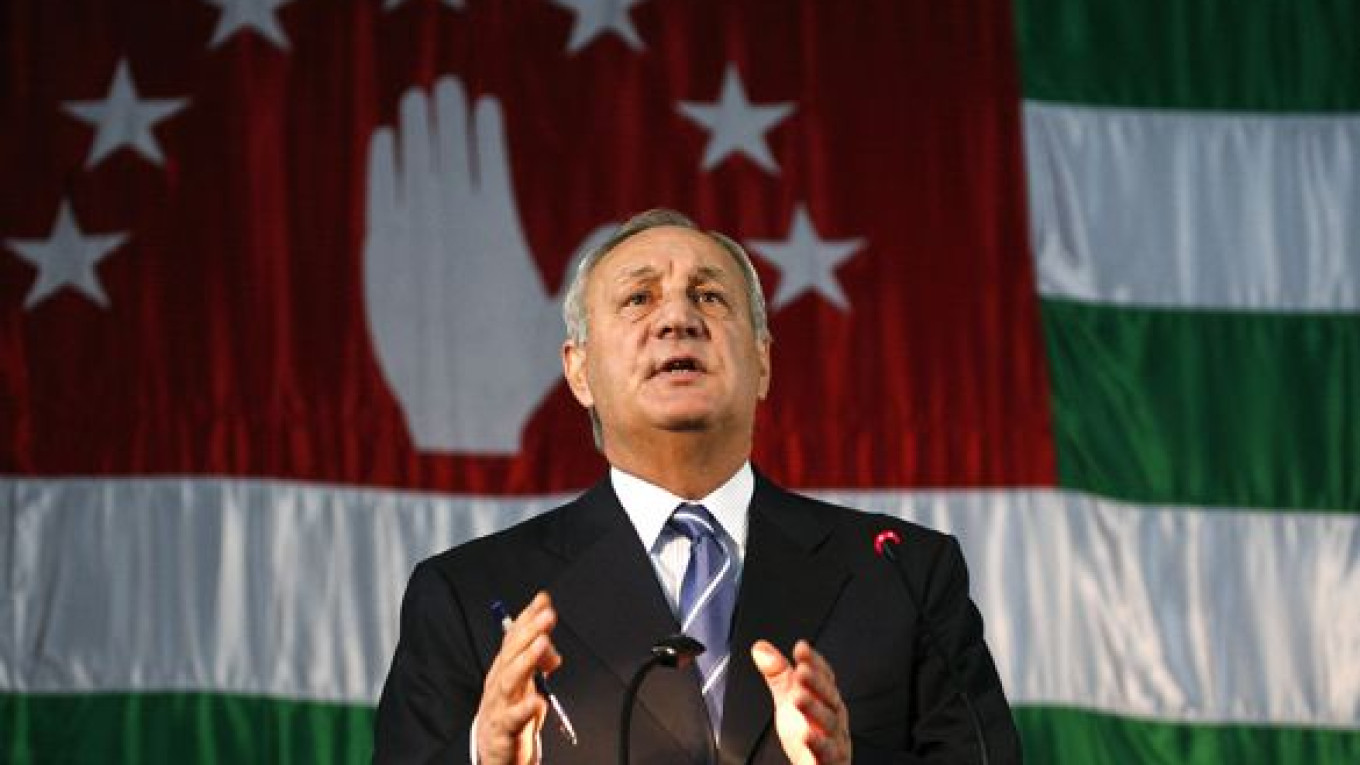
Tiny Nauru on Wednesday completed its debut on the big battlefront of Caucasus politics by becoming the fourth country to recognize both Abkhazia and South Ossetia as independent states.
A treaty establishing the Pacific island nation’s diplomatic relations with South Ossetia was signed in Moscow, said South Ossetia envoy Dmitry Medoyev, who signed the document.
The other signatory was Kieren Keke, Nauru’s foreign minister who had just arrived from Abkhazia, where he had signed a similar agreement Tuesday.
Nauru’s recognition prompted a war of words between the governments in Tbilisi and Moscow.
“This underlines the utter shame and complete collapse of Russia’s foreign policy. It is just trading and has nothing to do with politics,” Temur Yakobashvili, Georgia’s minister for reintegration, told The Moscow Times.
But the Foreign Ministry was quick to dismiss any criticism from Tbilisi. “These skeptical comments just serve as more evidence of Georgian officials’ disdain for small peoples and states,” ministry spokesman Andrei Nesterenko said in a statement.
Medoyev echoed those comments, saying in an interview that Nauru had merely exerted its sovereign right under the charter of the United Nations. “They are a full UN member, and I am saddened that [Georgia does] not honor this and people’s right to self-determination,” he said.
National and international media have mocked the fact that after Moscow’s lobbying for more than a year, a destitute Pacific nation with barely more than 10,000 inhabitants occupying 21 square kilometers has become the third country to follow its lead in recognizing the separatist regions. The other countries are Nicaragua and Venezuela.
Medoyev, however, said the size of a country has no effect on the legitimacy of its decision to recognize another state. “Size does not matter,” he said.
He also dismissed a media report as “rumors” that Nauru had asked Moscow for $50 million in aid in exchange for its recognition.
Nauru’s delegation led by Foreign Minister Keke actually visited South Ossetia’s capital, Tskhinvali, on Saturday. Asked why the recognition treaty was only signed in Moscow four days later, Medoyev said the Nauruans had not received permission then. “They only were authorized to do so on their way back to Moscow,” he said.
Abkhazia’s foreign minister, Sergei Shamba, said Wednesday that Abkhazia would not open an embassy in Nauru but send a delegation to work at a representative office there at the beginning of next year, Interfax reported.
Medoyev said South Ossetia would decide later if it would dispatch a delegation.
Nauru is located about 14,000 kilometers from the Caucasus.
Nauru has made headlines before for its seemingly opportunistic recognition policies. In 2002, it severed diplomatic relations with Taiwan in favor of relations with China, which, according to the U.S. State Department’s web site, had promised more than $130 million in aid.
Three years later, the island switched sides again, and Taiwan subsequently rescued Nauru’s airline from bankruptcy. Currently, Nauru’s government web site boasts a banner saying, “Sponsored by the government of the Republic of China (Taiwan).”
In the late 1990s, Nauru tried to become an offshore banking center , but acquired a reputation for providing cover to money launderers, including Russian organized crime.
The Central Bank has said about $70 billion transferred from Russian banks to offshore destinations in 1998 ended up in banks chartered in Nauru.
The Foreign Ministry said Nauru’s recognition of South Ossetia and Abkhazia will boost stability in the South Caucasus.
“This will strengthen Abkhazia’s and South Ossetia’s international legal position. And it will widen the young republics’ international contacts,” ministry spokesman Nesterenko said.
South Ossetian leader Eduard Kokoity said another 10 countries would soon follow suit. “The process of recognizing South Ossetia’s independence is irreversible,” he told Interfax.
A Message from The Moscow Times:
Dear readers,
We are facing unprecedented challenges. Russia's Prosecutor General's Office has designated The Moscow Times as an "undesirable" organization, criminalizing our work and putting our staff at risk of prosecution. This follows our earlier unjust labeling as a "foreign agent."
These actions are direct attempts to silence independent journalism in Russia. The authorities claim our work "discredits the decisions of the Russian leadership." We see things differently: we strive to provide accurate, unbiased reporting on Russia.
We, the journalists of The Moscow Times, refuse to be silenced. But to continue our work, we need your help.
Your support, no matter how small, makes a world of difference. If you can, please support us monthly starting from just $2. It's quick to set up, and every contribution makes a significant impact.
By supporting The Moscow Times, you're defending open, independent journalism in the face of repression. Thank you for standing with us.

Remind me later.