

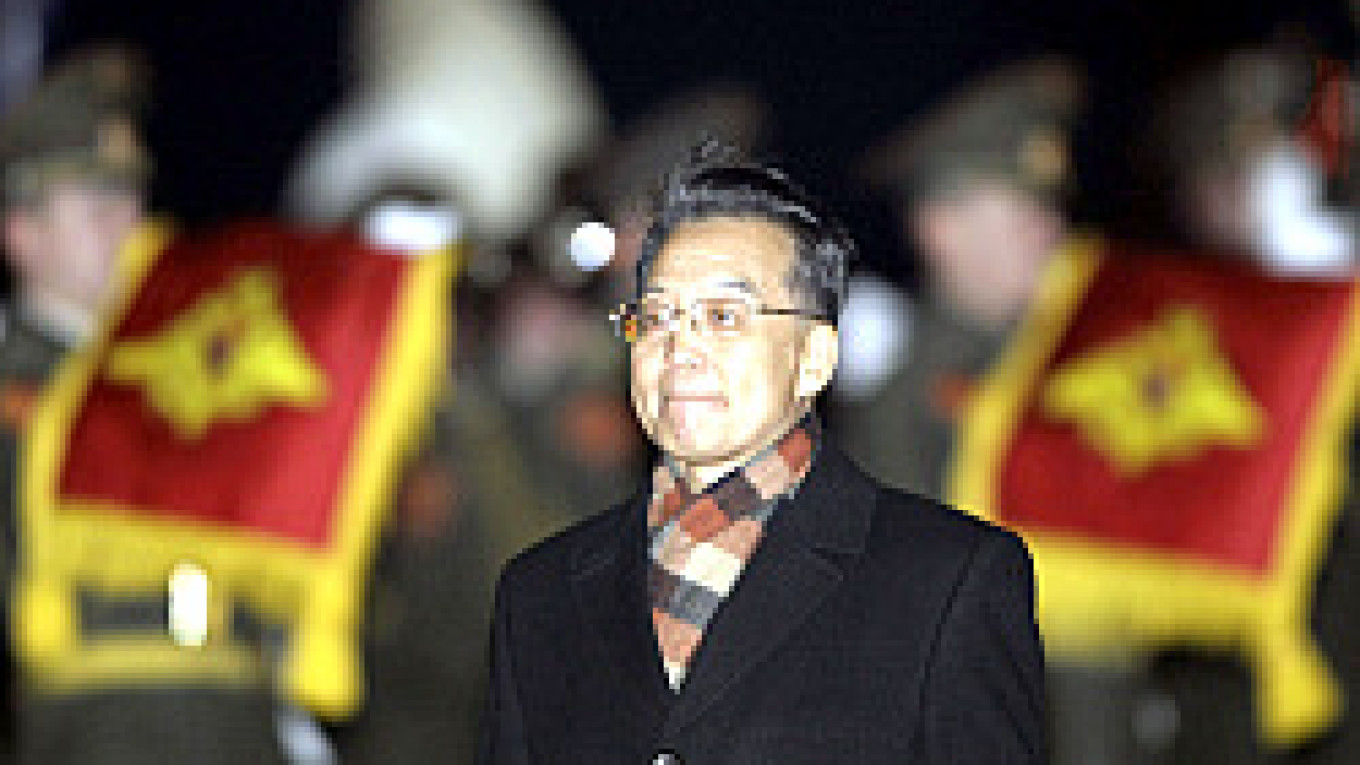
But the government has downplayed expectations that the visit will clinch an agreement with China's state-owned CNPC, even as Russia tries to accommodate a chorus of requests for funds to refinance companies' foreign debt.
Putin and Jiabao, who arrived Monday, will meet for trade talks after addressing a Russian-Chinese economic forum, a Cabinet spokeswoman said. She referred inquiries about the agenda to the Cabinet web site, which had no relevant information Monday evening.
Industry sources said the deal would be signed Tuesday and that Beijing was in talks to provide Russian firms with $20 billion to $25 billion in export-backed loans, with Rosneft getting three-fifths of the funds and Transneft receiving the rest, Reuters reported.
But in a meeting with a top Chinese official last week, Energy Minister Sergei Shmatko gave a longer time frame for replacing the current contract, which expires in 2010.
The government is hoping for an agreement within six weeks, Shmatko said Thursday after a meeting with Zhang Guobao, head of the National Energy Administration. Under the deal, Rosneft would export crude to China for 15 years, he said, adding that he was pleased with talks on the price formula.
Russia and China are planning to sign a broader memorandum on cooperation in the oil industry, including the creation of a working group, Deputy Prime Minister Igor Sechin said Sunday.
The export contract would mark the second time that Rosneft has seen a timely inflow of cash from China. In 2004, Rosneft agreed to supply CNPC with 48.4 million tons of oil by 2010 as collateral for a $6 billion loan to buy Yuganskneftegaz, one of the main producing units of the now-defunct Yukos.
"Possibly, something like that will take place this time as well," said Artyom Konchin, an analyst at UniCredit Aton. "Rosneft has a quite big debt burden, and it needs to service it in some way and pay it back."
Rosneft's debt stands at more than $21 billion.
Such a borrowing opportunity is of particular importance now, as banks are hard-pressed for liquidity, said Viktor Mishnyakov, an analyst at UralSib.
"For oil companies, it's a unique way of accessing loan capital," he said.
Rosneft's other option would be borrowing the money from the government through Vneshekonombank. Earlier this month, Kommersant reported that $9 billion had been allocated for several oil and gas companies, including $4.2 billion for Rosneft.
Even if Rosneft and CNPC reach a deal, supplies will have to continue by rail until the countries build a branch from the East Siberia-Pacific Ocean pipeline toward the Chinese border. Shmatko said the 70-kilometer stretch to China would not be ready before the current export contract expires.
Putin and Jiabao will also discuss the possible participation of Chinese construction firms in the 2012 Asia-Pacific Economic Cooperation forum in Vladivostok and the 2014 Olympics in Sochi, said Sergei Sanakoyev, president of the Russian-Chinese Center for Trade and Economic Cooperation, a nongovernmental organization.
A Message from The Moscow Times:
Dear readers,
We are facing unprecedented challenges. Russia's Prosecutor General's Office has designated The Moscow Times as an "undesirable" organization, criminalizing our work and putting our staff at risk of prosecution. This follows our earlier unjust labeling as a "foreign agent."
These actions are direct attempts to silence independent journalism in Russia. The authorities claim our work "discredits the decisions of the Russian leadership." We see things differently: we strive to provide accurate, unbiased reporting on Russia.
We, the journalists of The Moscow Times, refuse to be silenced. But to continue our work, we need your help.
Your support, no matter how small, makes a world of difference. If you can, please support us monthly starting from just $2. It's quick to set up, and every contribution makes a significant impact.
By supporting The Moscow Times, you're defending open, independent journalism in the face of repression. Thank you for standing with us.

Remind me later.