


Archie Brown is the dean of Gorbachev experts, and in his latest collection of essays, "Seven Years That Changed the World," he points out that these judgments are as crude as they are superficial. Many of the essays have appeared before; they are now supplemented with the fruits of his mature thinking and new archival material, and set out, systematically and persuasively, the case for a more sober perspective.
The trouble is that sobriety is very difficult to achieve. The events are too recent and still arouse too much emotion, above all inside Russia itself. The debate will continue for a very long time to come: After all, we are still arguing about the reasons for the decline and fall of the Roman Empire. But the questions are clear enough. Why did the Soviet Union collapse when it did? Could it have been reformed? Could it have long survived in its unreformed state? Its disappearance was a cataclysmic event, both for Russia and for the rest of the world: Why did it happen with so little expenditure of blood?
The roots of the Soviet collapse go back well before Gorbachev was anywhere near the top of the system. In the early 1960s, the Soviet Union was already in serious trouble. The economy was faltering, growth rates were down and the government was forced to turn for grain to its Cold War enemy. Nikita Khrushchev tried a variety of ingenious expedients to jumpstart the system. These harebrained schemes, as his enemies in the Politburo rightly called them, were a failure, and he lost his job.
His successors were equally unable to devise effective remedies. At a loss as to what to do next, they allowed the country to bumble along, spending vast sums on a military machine which was itself losing its way despite a glittering array of new weapons squeezed out of a national economy that could not afford it. There was a small margin to spare for the ordinary Soviet consumer, enough to give people the feeling that things were getting better. There was political repression, too. But it was no longer on a mass scale, and so did not affect most people, who rather liked the political stability that seemed to come with it.
But the successive deaths of the Three Old Men -- Leonid Brezhnev, Yury Andropov, Konstantin Chernenko -- forced the survivors to realize that things could no longer go on that way. They elected as general secretary Gorbachev -- young, energetic, imaginative, from the right peasant background, with a wealth of practical experience and a good Party member to boot. Gorbachev identified three main problems: nuclear confrontation, imperial overstretch of the Soviet Union and a stagnant economy. His remedies were unprecedented.
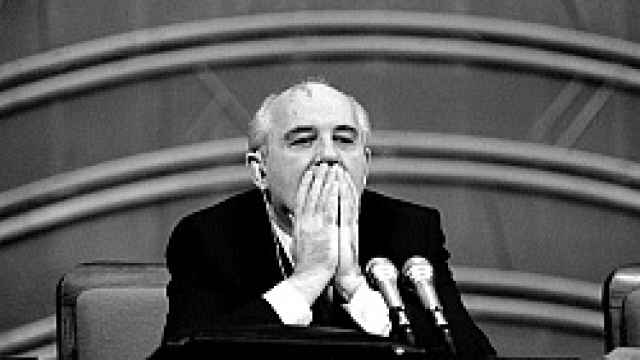 Itar-Tass By December 1990, the reforms that Gorbachev introduced had taken on their own momentum. |  |
| |
But once the process of dismantling the Soviet Union's military and imperial positions had begun -- under constant political and economic pressure from the Americans -- it would have been hard to stop. Nuclear disarmament led to conventional disarmament. Withdrawal from outposts in distant continents led to withdrawal from Germany and Eastern Europe. The Army came home. There was nowhere for it to live. Not surprisingly, the senior officers turned against Gorbachev. Many were involved in the attempted coup against him in August 1991.
Gorbachev saw that the gray stagnation of the Soviet economy, its inability to match the vitality and inventiveness of Western capitalism, was not only due to the burden of empire and a bloated war machine. A stodgy political system inhibited imagination and enterprise. Gorbachev believed that the inventiveness of a talented nation could only be unleashed by letting ordinary people take more control of their lives through some form of democracy. He freed the media and then organized the first contested elections to be held anywhere in the Warsaw Pact. In March 1989, Soviet voters threw out Party bosses all over the country, and transformed the nation's politics.
Without the freedoms that Gorbachev introduced, Yeltsin might have remained an unconventional but authoritarian provincial Party boss. Gorbachev's new politics made it possible for Yeltsin to mount his tank and to defy the men who made the putsch. But it was Yeltsin -- not Gorbachev -- who four months later announced, without consulting the people, that the Soviet Union had ceased to exist; and who reached naturally for the gun to resolve his political problems with the unruly Russian parliament in 1993, and with the Chechens in 1994.
The Soviet Union may well have been doomed, even if Gorbachev had not tried to reform it. But as Brown persuasively argues, its demise could have been much more protracted. It could have been much more bloody, too, and spilled over into an incalculable international confrontation. It was in significant measure thanks to Gorbachev that a terrible threat was lifted from a world that had skirted nuclear annihilation for four decades. That is something for which we should be profoundly grateful.
So should Gorbachev's countrymen. But for very many of them he is the incompetent, vacillating and pusillanimous traitor who fatally undermined a great power, and who drove them into poverty and near-starvation in the winter of 1991-92. The simultaneous collapse of the Soviet state, its political and economic system, its military power and its international prestige, to the undisguised satisfaction of its rivals and enemies, was a humiliation that few Russians could forget or forgive. They made Gorbachev the obvious scapegoat and turned to the more authoritarian Vladimir Putin to restore their self-respect.
But it is implausible to attribute the whole historical process to one man, whether you like him or not. Gorbachev could not have single-handedly brought down an otherwise healthy superpower. But he did, in Bismarck's words, "hear God's footsteps marching through history, and ... catch on to His coattails as He marches past." Although he made serious mistakes, his political courage and ingenuity began the process of transforming the Soviet Union into a modern country at ease with itself and the outside world. The transformation can only come to fruition over many decades, and then only with luck and with many fits and starts. But that is the historical perspective against which Gorbachev will eventually be judged.
Rodric Braithwaite was British ambassador in Moscow from 1988 to 1992 and is the author, most recently, of "Moscow 1941: A City and Its People at War."
A Message from The Moscow Times:
Dear readers,
We are facing unprecedented challenges. Russia's Prosecutor General's Office has designated The Moscow Times as an "undesirable" organization, criminalizing our work and putting our staff at risk of prosecution. This follows our earlier unjust labeling as a "foreign agent."
These actions are direct attempts to silence independent journalism in Russia. The authorities claim our work "discredits the decisions of the Russian leadership." We see things differently: we strive to provide accurate, unbiased reporting on Russia.
We, the journalists of The Moscow Times, refuse to be silenced. But to continue our work, we need your help.
Your support, no matter how small, makes a world of difference. If you can, please support us monthly starting from just $2. It's quick to set up, and every contribution makes a significant impact.
By supporting The Moscow Times, you're defending open, independent journalism in the face of repression. Thank you for standing with us.

Remind me later.