

Cheney also said the expansion of NATO would continue despite Moscow's opposition, arguing that Russia should welcome its neighbors' joining an alliance that was not belligerent and whose members were democratic.
"Russia's actions are an affront to civilized standards and are completely unacceptable," Cheney said. "Russia has offered no satisfactory justification for the invasion, nor could it do so."
Employing some of the harshest language by the United States since the crisis erupted, Cheney portrayed Russia as an increasingly bellicose nation.
"In the space of the last 30 days, Russia has violated the sovereignty of a democracy, made and then breached a solemn agreement in a direct affront to the EU, severely damaged its credibility and global standing and undermined its own relations with the United States and other countries," Cheney said, speaking at a gathering in Cernobbio, Italy.
Russia and Georgia blame each other for the conflict that erupted Aug. 7. But in invading uncontested Georgian territory -- sending troops beyond Georgia's separatist regions of South Ossetia and Abkhazia -- Cheney said Russia acted in a manner "flatly contrary to some of our most deeply held beliefs."
Cheney's message was somewhat at odds with some Europeans' belief that Russia was provoked into the Georgia conflict by a cavalier dismissal of its objections over NATO's expansion.
Earlier last week, Cheney visited Azerbaijan, Ukraine and Georgia, and Washington offered Georgia a $1 billion in aid to help it recover from the war.
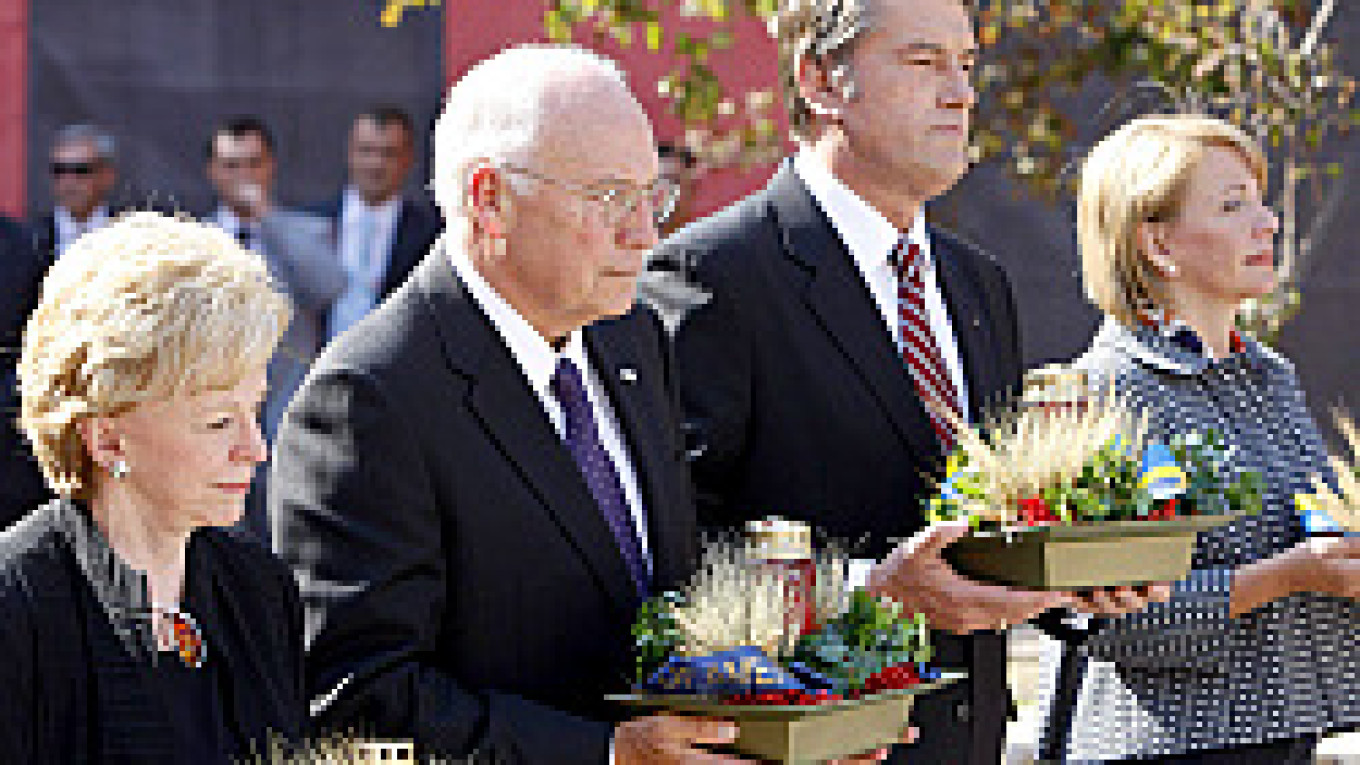
During his Friday visit to Kiev, Cheney repeated that Ukraine would eventually join NATO, despite fierce resistance from Moscow.
The Georgian war, he said, showed that that "the single, only model for a reliable defense of the territorial integrity of ... Ukraine is joining the all-European, pan-European, North Atlantic system of collective security."
The strong words signaled that the United States was intent on cultivating closer ties with Ukraine and its neighbors.
Yushchenko has pushed strongly for closer ties with the European Union and NATO, upsetting both the Kremlin and Ukraine's large Russian-speaking minority.
Konstantin Kosachyov, head of the State Duma's International Affairs Committee, accused Cheney of trying to forge an "anti-Russian axis."
"It's Cheney who was behind all recent events on the former Soviet turf," Kosachyov said Thursday.
A Message from The Moscow Times:
Dear readers,
We are facing unprecedented challenges. Russia's Prosecutor General's Office has designated The Moscow Times as an "undesirable" organization, criminalizing our work and putting our staff at risk of prosecution. This follows our earlier unjust labeling as a "foreign agent."
These actions are direct attempts to silence independent journalism in Russia. The authorities claim our work "discredits the decisions of the Russian leadership." We see things differently: we strive to provide accurate, unbiased reporting on Russia.
We, the journalists of The Moscow Times, refuse to be silenced. But to continue our work, we need your help.
Your support, no matter how small, makes a world of difference. If you can, please support us monthly starting from just $2. It's quick to set up, and every contribution makes a significant impact.
By supporting The Moscow Times, you're defending open, independent journalism in the face of repression. Thank you for standing with us.

Remind me later.