

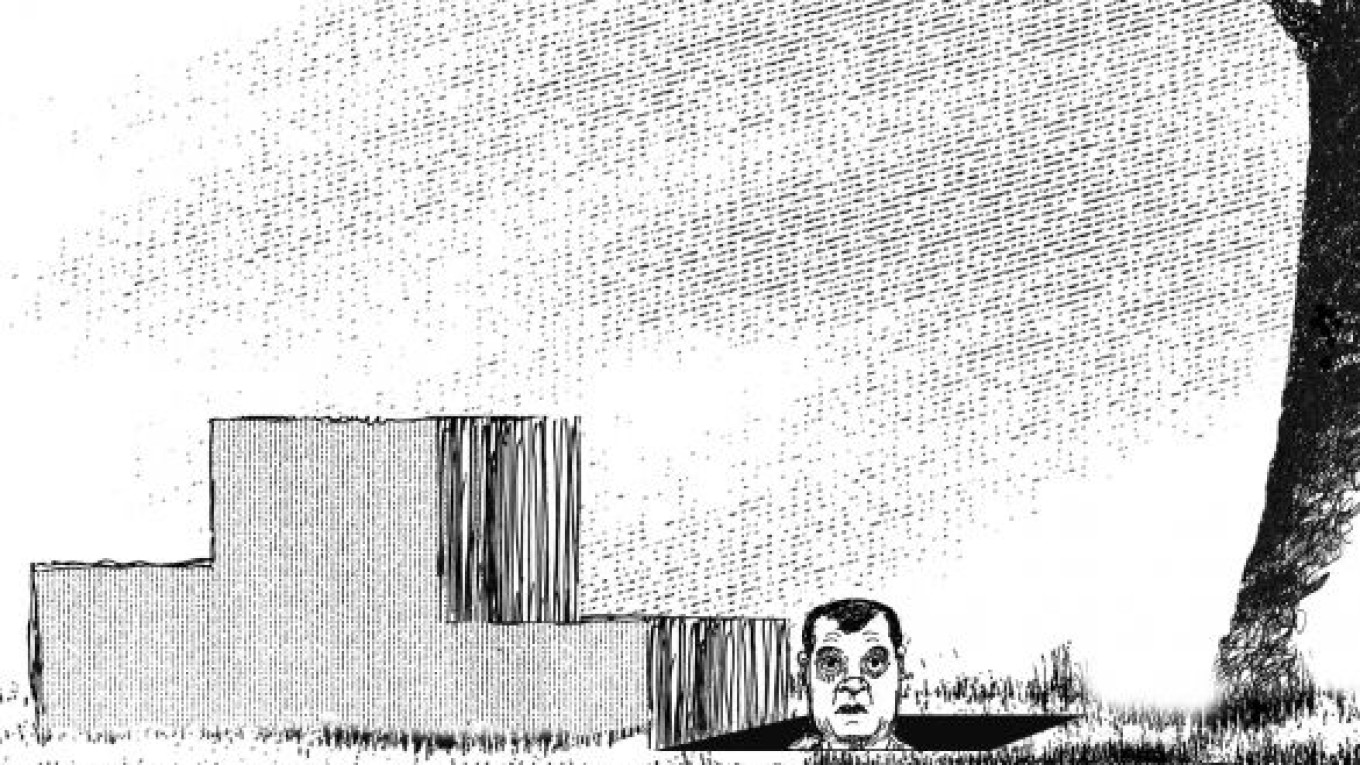
President Dmitry Medvedev was elected president two years ago on March 2, 2008, with 70 percent of the vote, and this is a good time to analyze his midterm results. In a word, they are dismal. Medvedev did the right thing in not even mentioning his anniversary. Just like when he chose not to attend the closing Olympic ceremonies in Vancouver after Russia’s miserable results, there are certain things that are certainly better left ignored.
But what is definitely worth remembering is his infamous “Four I’s” speech that he delivered at the Krasnoyarsk Economic Forum in February 2008, just weeks before he was elected president. He called for the immediate development of Russia’s “Four I’s” — institutions, infrastructure, innovation and investment. It is important to remember this speech only because it underscores the huge gap between his absolutely meaningless, empty slogans and the sorrowful state of affairs in Russia.
1. Institutions. According to the latest annual Global Competitiveness Report published by the World Economic Forum, Russia’s institutions have not only failed to improve, they have gotten worse. Of the 133 countries ranked, Russia dropped 12 slots to 63rd place. What’s more, the country’s rating based on the development of a fair and impartial judicial system — Medvedev’s pet project — dropped from 109th place to 116th. Protection of property rights — a key prerequisite for economic development — fell to an equally shameful 119th place. Moreover, Russia has turned into one of the world’s most-closed economies, ranked 109th of 121 in this category in the World Economic Forum report and falling behind even Mozambique, Kenya and Ethiopia.
According to the World Bank, conditions for doing business also worsened, with Russia dropping eight notches to 120th of 183 countries ranked. Only one country in the world had more onerous procedures for obtaining building permits — Eritrea, a dictatorship that is subjected to United Nations sanctions.
Political institutions remain in a state of coma. At the recent Krasnoyarsk Economic Forum, participants were unable to name a single state institution that functions properly.
2. Infrastructure. In 2009, Russia suffered one of its worst disasters at Sayano-Shushenskaya, the country’s largest electrical power station. Moreover, it built only 1,000 kilometers of roads, as compared with the 47,000 kilometers of roads China built in 2007. Russia has allocated 18 percent less funding for the construction of roads in 2010 than it did last year, and it plans to build only 942 kilometers of roads this year. In contrast to Russia, most other countries are trying to stimulate their economies during the crisis by allocating more money for infrastructure projects. Over the next three years, for example, China will extend its railways by 31,000 kilometers, 13,000 kilometers of which will be built for bullet trains.
At the same time, the cost of building roads in Russia remains the highest in the world, and it continues to climb by 30 percent to 40 percent annually. Although hundreds of billions of dollars were allocated for infrastructure projects, as always, only a small portion of these funds has ultimately made it to its “destination point.”
3. Innovation. According to the State Statistics Service, 30 percent of Russian firms are developing innovative products or technologies. But this is a highly deceptive figure because all it takes to be considered “innovative” is for a factory to buy a new industrial machine, for example. This is clearly an attempt by the authorities to inflate the country’s “innovation quotient,” but few people are fooled by this. The real innovation quotient, which is much closer to 1 percent or 2 percent, is evident to any Russian consumer or businessperson.
The country’s scientific rating also continues to fall. Recent findings by Thomson Reuters show that Russia now publishes fewer scholarly papers and journals than India and China. Russia is even lagging behind in Medvedev’s favorite area: information technology. The World Economic Forum’s Global Information Technology Report put Russia in 70th place in 2007, and at 74th of 134 countries in 2009. That does not mean that IT is not developing in Russia — only that it is progressing far more rapidly elsewhere.
4. Investment. The global average decrease in direct foreign investment was 39 percent in 2009 as a result of the crisis, but in Russia it totaled 41 percent. With Russia’s low quality of government institutions, aging infrastructure and high cumulative foreign debt, Russia will not see an influx of foreign investment anytime soon.
To sum up Medvedev’s Four I’s, institutions are corrupt to the core, the infrastructure is falling apart, the country’s homegrown innovators are abandoning Russia in droves, and investment is evaporating. Perhaps it would be better to redefine his Four I’s to better reflect Russian reality: illusion, inefficiency, instability and incompetence.
Vladimir Ryzhkov, a State Duma deputy from 1993 to 2007, hosts a political talk show on Ekho Moskvy radio.
A Message from The Moscow Times:
Dear readers,
We are facing unprecedented challenges. Russia's Prosecutor General's Office has designated The Moscow Times as an "undesirable" organization, criminalizing our work and putting our staff at risk of prosecution. This follows our earlier unjust labeling as a "foreign agent."
These actions are direct attempts to silence independent journalism in Russia. The authorities claim our work "discredits the decisions of the Russian leadership." We see things differently: we strive to provide accurate, unbiased reporting on Russia.
We, the journalists of The Moscow Times, refuse to be silenced. But to continue our work, we need your help.
Your support, no matter how small, makes a world of difference. If you can, please support us monthly starting from just $2. It's quick to set up, and every contribution makes a significant impact.
By supporting The Moscow Times, you're defending open, independent journalism in the face of repression. Thank you for standing with us.

Remind me later.