

The Kremlin has been caught off guard by a spike in violence in the North Caucasus over the past few months. One reason for this: The Kremlin had believed its policies in the region were successful. After canceling its anti-terrorist operations in Chechnya (largely at the insistence of Chechen President Ramzan Kadyrov), the authorities were convinced that the situation there had stabilized.
It is clear, however, that the picture is far less rosy. It has become obvious that the number of insurgents in the North Caucasus — primarily in Ingushetia, Chechnya and Dagestan — is greater than official figures have stated and that they have deep reserves and the ability to operate at a fairly professional level. The militants have also formed, if not coalitions, then at least mutual understandings with other political forces, primarily those that have suffered from the government’s fight against corruption. The result is that the daily news coming from the Caucasus sounds more like war coverage, including attacks on well-known religious figures, government ministers and even Ingush President Yunus-Bek Yevkurov.
 | |
|
To Our Readers | |
|
The Moscow Times welcomes letters to the editor. Letters for publication should be signed and bear the signatory's address and telephone number.
| |
| | |
It is no longer possible to explain the spike in violence on the seasonal factor — that insurgents are most active in the spring and summer. In Ingushetia, the policies of Yevkurov have caused fear not only among militants, but also corrupt officials who had grown fat under the republic’s previous leader. In Chechnya, the reason for the troubles is the political and human costs associated with the policies of Kadyrov, who is hated as much as he is loved by the population. What started as the Kremlin’s attempt to “Chechenize” the conflict in the republic — that is, to convert it into a domestic struggle rather than one between Russian troops and local forces — has now turned into a “Kadyrovization” of the problem, with all of its numerous drawbacks. As a result, Moscow is becoming increasingly annoyed with Kadyrov’s absolutism and the way his strong loyalty to the Kremlin is coupled with attempts to transform Chechnya into something bordering on an independent state. Neither can Russia’s leaders be too happy about the murders in Moscow and Dubai of the Yamadayev brothers, who had connections with the siloviki, or the recent killing of human rights activist Natalya Estemirova in Chechnya. All of these murders have been linked in one way or another to Kadyrov.
Finally, there is dissatisfaction in Moscow and the North Caucasus over Kadyrov’s ambitions to extend his political influence beyond Chechnya to include the entire region. His desire to impose order on neighboring Ingushetia personally — while emphatically claiming that he has President Dmitry Medvedev’s support — has caused heightened anxiety within Ingushetia. Kadyrov has also aggravated many people with his attempts to interfere in Dagestan’s internal affairs. Many blame Russia’s leadership for Kadyrov’s uncontrolled, reckless ambitions.
Since canceling the decade-long, anti-terrorist operations in April, the security situation has deteriorated to such an extent that it has been necessary to reinstate the operations in some regions. But this has turned out to be only a stopgap measure and one that is clearly inadequate.
Kremlin officials have no idea what to do next. On one hand, the direct application of force is no longer effective. Sending federal forces to the region evokes hostility among local people and only escalates tensions. On the other hand, it is unrealistic and even dangerous to give full authority to local officials to solve their own problems, given the widespread lack of trust they have among the people.
Moscow’s experiments with the powerful Kadyrov and the weak former Ingush President Murat Zyazikov demonstrated that both extremes produced similar results. Kadyrov’s excessive force proved to be just as dangerous as Zyazikov’s weak hold on power. In the first case, the local leader can break free from Moscow’s control, and in the second the president is simply unable to carry out his leadership role. The best option is somewhere in the middle, a strong but tractable president whose actions do not create additional problems for the Kremlin. But finding such a candidate is difficult, especially because that person should not simply rule with an iron fist, but he must also somehow find a common language with the people and build a consensus. This is the only way to achieve stability in the region.
That is precisely what Yevkurov tried to do in Ingushetia. Unfortunately, having attempted to earn the public’s trust by fighting corruption and the irreconcilable insurgents, he has become the Caucasus’ most tragic political figure. In late June, he was the target of a suicide bomber and is recovering from serious injuries in a Moscow hospital. Without idealizing Yevkurov in any way, I think that he is the first leader who, in the midst of an ongoing crisis, has tried to build the foundation for consensus by seeking alternatives to the use of force.
The drama surrounding Yevkurov mirrors the condition of the entire North Caucasus. Here is a person who, while striving for peace, was forced out of the political arena by a terrorist attack. In the process, the very idea of establishing a wide-ranging dialogue has effectively been lost. Now, anybody can point to Ingushetia as proof that the soft approach to resolving conflicts is ineffective. This once again strengthens the position that the use of force is the only effective way to rule in the North Caucasus.
In the meantime, the people living there continue to live according to their own laws. Blood feuds are on the rise again, and Islam is playing an increasingly central role in regulating social relations. Religion has become politicized from two sides. First, jihad remains a standard rallying cry for the Muslim opposition. Second, secular authorities frequently appeal to Islamic leaders, viewing them as convenient tools for maintaining their own authority. Even traditional Islam has become politicized in the Caucasus, and in Chechnya the mosque serves as the center of political indoctrination for the republic’s youth.
Members of both the Wahhabi opposition and the Tariqah order advocate introducing sharia into society. They simultaneously welcome the success of the Palestinians’ Hamas and support the well-known theory that the Judeo-Christian civilization is moving toward an epic clash with Muslim civilization.
The republics across the North Caucasus are experiencing an acute de-modernization. The region is extremely weak. It has few elements of a modern economy, and the system of middle school and secondary education has practically collapsed. Emigration is growing, in turn causing tensions in neighboring regions of Russia. The problems in the region have definitely become one of the Kremlin’s biggest problems.
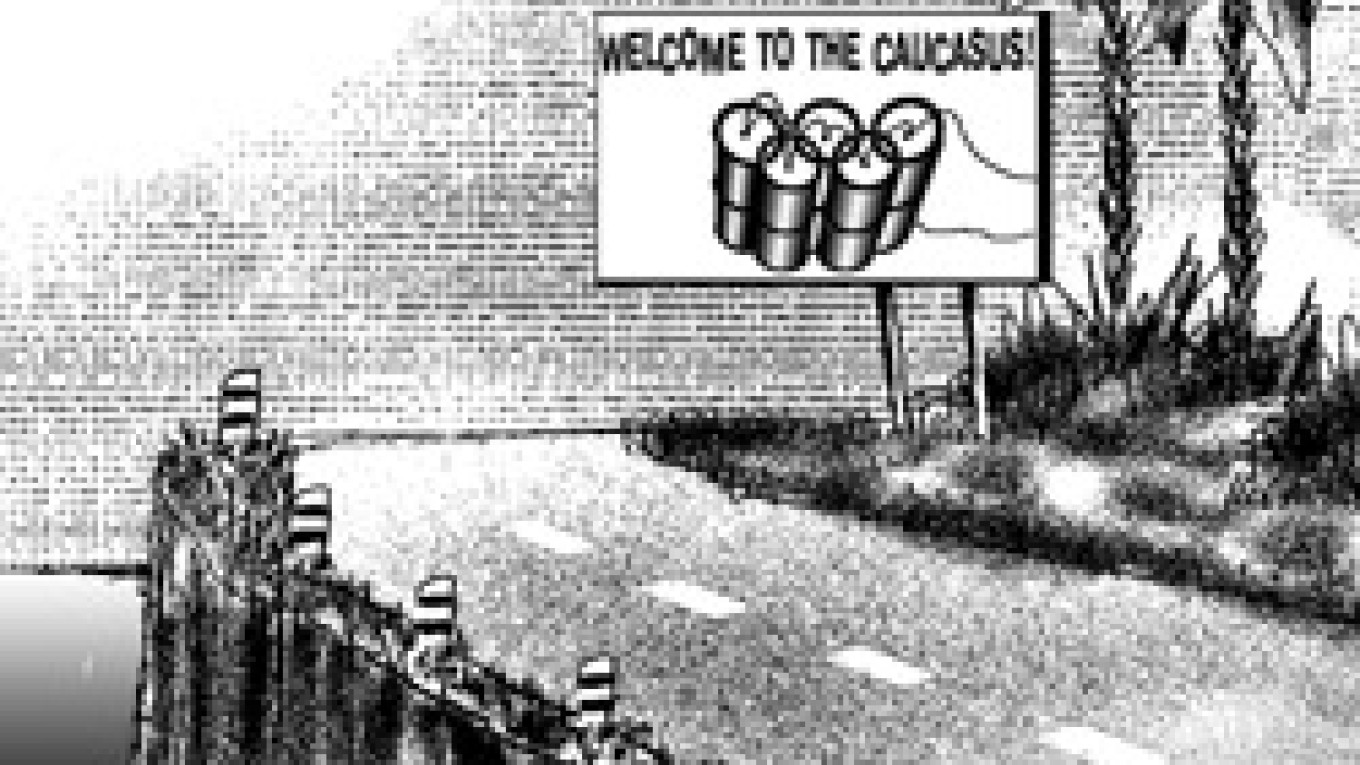
And it is precisely in the North Caucasus — in the country’s vulnerable “underbelly” — that the 2014 Winter Olympic Games will be held. True, the games might stimulate the economy of the Southern Federal District, where Sochi is located, but who can guarantee that they will be carried out without any unwanted terrorist attacks? The Sochi Games could be an excellent opportunity for Caucasus extremists to demonstrate their own importance. Vladimir Putin’s 10 years of rule as the country’s president and prime minister have not been enough to defeat extremism and instability in the region. Now, only five years remain before the Sochi Olympic Games’ opening ceremony.
Alexei Malashenko is an analyst specializing in religion and security issues at the Carnegie Moscow Center.
A Message from The Moscow Times:
Dear readers,
We are facing unprecedented challenges. Russia's Prosecutor General's Office has designated The Moscow Times as an "undesirable" organization, criminalizing our work and putting our staff at risk of prosecution. This follows our earlier unjust labeling as a "foreign agent."
These actions are direct attempts to silence independent journalism in Russia. The authorities claim our work "discredits the decisions of the Russian leadership." We see things differently: we strive to provide accurate, unbiased reporting on Russia.
We, the journalists of The Moscow Times, refuse to be silenced. But to continue our work, we need your help.
Your support, no matter how small, makes a world of difference. If you can, please support us monthly starting from just $2. It's quick to set up, and every contribution makes a significant impact.
By supporting The Moscow Times, you're defending open, independent journalism in the face of repression. Thank you for standing with us.

Remind me later.