

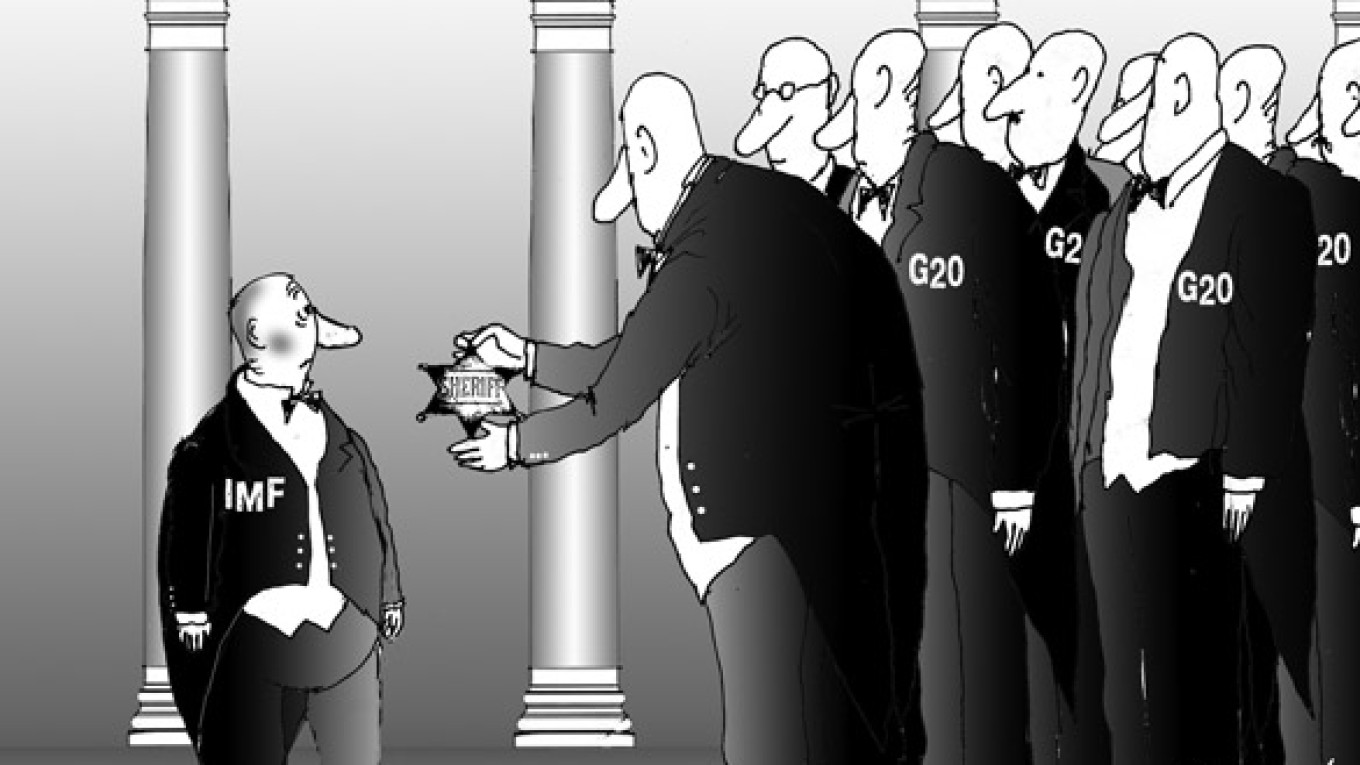
When world leaders gather in Pittsburgh for the Group of 20 summit, they will take stock of the impact of the stimulus measures undertaken so far and discuss how to coordinate an orderly exit from those measures. They will need to strengthen international guidelines for capital requirements for large multinational banks and address the perverse financial incentives that led to irresponsible risk-taking in the financial sector. But the most lasting imprint they could leave is to give the International Monetary Fund a broader mandate after this crisis is over.
The IMF’s relevance has greatly increased during the crisis. It successfully contributed to a coordinated fiscal and monetary stimulus, which helped avert a cyclical meltdown. Its resources have tripled, enabling it to come to the rescue of countries as diverse as Iceland, Pakistan, and Ukraine, which were cut off from international capital markets. And the fund has assisted low-income countries with large loans at unprecedented zero interest rates.
The G20 has shown leadership in providing the political and financial backing for these changes, and the IMF has responded swiftly. There is, however, a genuine risk that the political momentum will dissipate as the world economy slowly recovers.
It would be a big mistake to let that happen. This crisis has shown that economic interdependence has grown to such an extent that policy coordination is unavoidable. The IMF should be given a clear mandate that would give it the political clout to help prevent such crises recurring.
The G20 leaders should authorize the IMF to safeguard international financial stability. All crises of the past two decades had their origin not so much in misguided fiscal and monetary policies, nor in misaligned exchange rates, but rather in the explosive dynamics of financial markets. A strengthened role in ensuring financial stability would be a logical complement to the existing, but too narrow, mandate the IMF has for overseeing the international monetary system. The two are clearly interlinked.
A stronger financial stability role does not imply that the IMF would itself become a supervisor. Rather the fund should build on work done by the financial stability board, the multilateral rule-setting body established by the G20. This body is comprised of ministers of finance, central bankers, and supervisors from the G20 countries. The IMF can help monitor whether countries follow up on agreed undertakings in the financial stability board, and alert leaders to gaps in the regulatory framework and vulnerabilities in the financial system that need to be addressed.
But, for effective fulfillment of such a strengthened mandate, the IMF needs strong political backing that countries will follow up on its own advice as well. This has been lacking in the past, as the IMF had insufficient instruments to enforce policy action.
Moreover, G20 leaders should express their commitment to future policy coordination by, for example, organizing a peer-review process in which ministers would hold each other accountable for their economic and financial-sector policies. The IMF would contribute to this process with analysis, focusing on economic interdependencies and spillovers from one economy to another.
Such surveillance can build on the findings of the early-warning exercise, which the IMF has initiated, together with the financial stability board. This exercise alerts ministers on low-risk but high-impact events and advises them on appropriate courses of action. The IMF can monitor the follow-up that countries give to policy advice following from these exercises.
Global financial stability must be secured by a better functioning international monetary system. The IMF should analyze how to move in an orderly way from a dollar-based system to a multipolar system. The Special Drawing Right, the IMF-issued reserve currency based on a basket comprising the dollar, euro, yen and pound sterling, may play a useful role here. (The yuan should be included as soon as China makes its currency convertible.)
A multipolar system may help better address global imbalances than the current dollar-based system, which simply perpetuates large imbalances as countries pile up large dollar reserves. The need for such buildup would lessen if the IMF develops into an insurance-type of institution that has SDR credit lines readily available.
Today’s political momentum should be used to carve out a strong role for the IMF beyond the crisis. International policy coordination, which has been effective in averting a financial meltdown, should continue after the crisis, preferably in the form of a peer-review process in the G20 underpinned by IMF analysis.
But continued political support for the IMF needs to be based on fairness in the institution itself. Quotas and influence in the international financial institutions should be based on countries’ economic weight and the ability to contribute financially. Therefore, the upcoming quota review will have to give a greater weight to countries that are currently underrepresented, particularly the world’s dynamic emerging economies.
Age Bakker is executive director of the International Monetary Fund representing the Netherlands and 12 mostly Eastern European countries. ©Project Syndicate
A Message from The Moscow Times:
Dear readers,
We are facing unprecedented challenges. Russia's Prosecutor General's Office has designated The Moscow Times as an "undesirable" organization, criminalizing our work and putting our staff at risk of prosecution. This follows our earlier unjust labeling as a "foreign agent."
These actions are direct attempts to silence independent journalism in Russia. The authorities claim our work "discredits the decisions of the Russian leadership." We see things differently: we strive to provide accurate, unbiased reporting on Russia.
We, the journalists of The Moscow Times, refuse to be silenced. But to continue our work, we need your help.
Your support, no matter how small, makes a world of difference. If you can, please support us monthly starting from just $2. It's quick to set up, and every contribution makes a significant impact.
By supporting The Moscow Times, you're defending open, independent journalism in the face of repression. Thank you for standing with us.

Remind me later.