

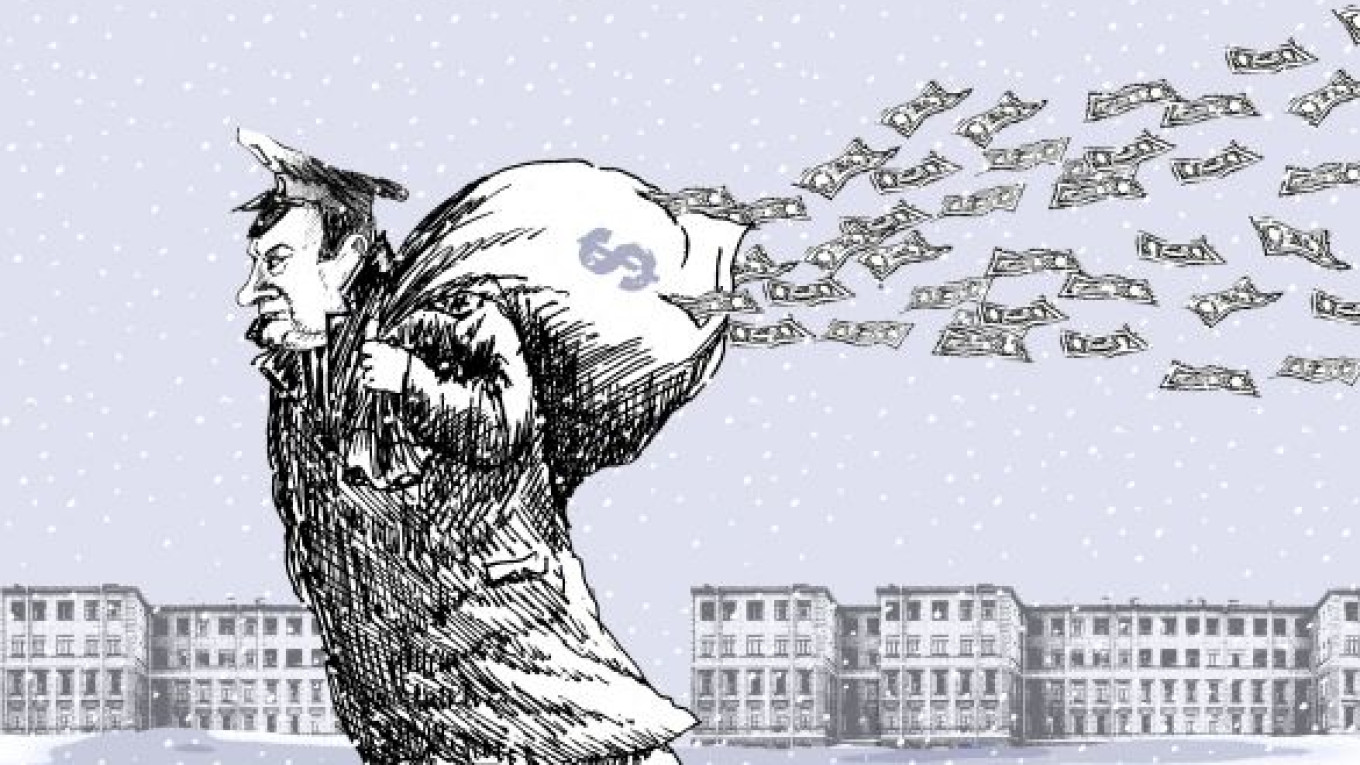
During the Krasnoyarsk economic forum over the weekend, Finance Minister Alexei Kudrin made the sensational statement that increased defense expenditures are putting a strain on the budget. Kudrin said, “Three tasks — modernizing the army, better equipping soldiers and increasing provisions for the defense industry — are expenses that did not exist before and that will require an additional 1.5 percent of gross domestic product.” Thus, the Finance Ministry becomes the first to fulfill the 1997 order by former President Boris Yeltsin that 3.5 percent of GDP be spent on defense. Until recently, defense spending had been in the range of 2.6 percent to 2.8 percent of GDP.
Had this happened several weeks ago, I would have been glad to hear the news. For more than two years, Defense Minister Anatoly Serdyukov has been carrying out the most radical military reforms of the last half century without requiring any additional funding. They began in fall 2008 with his announcement that the officer corps would be cut from 355,000 to 150,000. The plan was to reduce the ground force units by 11 times.
Until recently, the military has been firm — and, at times, even ruthless — in carrying out the reforms and reorganization plan that is so important to the country’s national security. The top brass was forced to accept the painful reality that Russia would no longer have the mass mobilization army it had enjoyed for the last 150 years.
Understandably, these painful changes sparked bitter opposition from officers and the top brass. But Serdyukov implemented the cuts with determination. To curtail the excess number of officers, the Defense Ministry stopped admitting new students to military academies, while those students who were already graduating were either demoted to the position of sergeant or simply dismissed.
Serdyukov started backtracking on his plans only when he realized that armed forces had a shortage, not an excess of officers. Following a meeting with President Dmitry Medvedev in February, Serdyukov announced plans to increase the officer corps by 70,000. His explanation for this was that these additional officers were needed to staff the planned Aerospace Defense System, but this doesn’t hold water. That system will be built on existing missile defense and early warning units. New units can only be formed as new technologies and systems are introduced, an extremely slow process at best. In no way would it justify the demand for 70,000 more officers.
What was the point of going through the painful exercise of reducing the officer corps to 200,000, only to hire 70,000 new ones? The most likely reason is that the government lacked the resources to meet its obligations to newly retired officers. In the middle of last year, it became known that the same number of officers — 70,000 — couldn’t find new jobs in the armed forces, but the state could not fire them because it did not have apartments to give them upon retirement, as the law requires. And then, last fall, that number mysteriously dropped to 40,000. But it is impossible to verify these figures. Defense Ministry officials declare whatever numbers they want to declare. Realizing its predicament, the top brass might have simply decided to keep those unneeded officers on the payroll.
Another possible reason might be that the officer jobs were cut with the intention of filling the gap with trained sergeants and civilian personnel, such as lawyers, economists and doctors. But the low salaries allocated for those jobs may not have been very attractive to qualified specialists. What’s more, the program for preparing sergeants has also run into problems. Educational centers simply cannot prepare the more than 100,000 sergeants required. This is a serious blow to reforms because officers would once again lose their status as the elite of the armed forces and be relegated to junior positions.
The last and worst possible cause for the change is that generals have managed to convince Medvedev — and, more important, Prime Minister Vladimir Putin — that Russia can only achieve military preparedness by returning to the old mass-mobilization model. If so, after the presidential election is held in 2012, the mandatory conscription service period will inevitably be increased and the whole process will have come full circle.
Whatever the reason, adding 70,000 officers will create an additional burden on Kudrin’s budget without producing any tangible benefit to national security. That, unfortunately, is another sign that military reforms have clearly gone off track.
Alexander Golts is deputy editor of the online newspaper Yezhednevny Zhurnal.
A Message from The Moscow Times:
Dear readers,
We are facing unprecedented challenges. Russia's Prosecutor General's Office has designated The Moscow Times as an "undesirable" organization, criminalizing our work and putting our staff at risk of prosecution. This follows our earlier unjust labeling as a "foreign agent."
These actions are direct attempts to silence independent journalism in Russia. The authorities claim our work "discredits the decisions of the Russian leadership." We see things differently: we strive to provide accurate, unbiased reporting on Russia.
We, the journalists of The Moscow Times, refuse to be silenced. But to continue our work, we need your help.
Your support, no matter how small, makes a world of difference. If you can, please support us monthly starting from just $2. It's quick to set up, and every contribution makes a significant impact.
By supporting The Moscow Times, you're defending open, independent journalism in the face of repression. Thank you for standing with us.

Remind me later.