

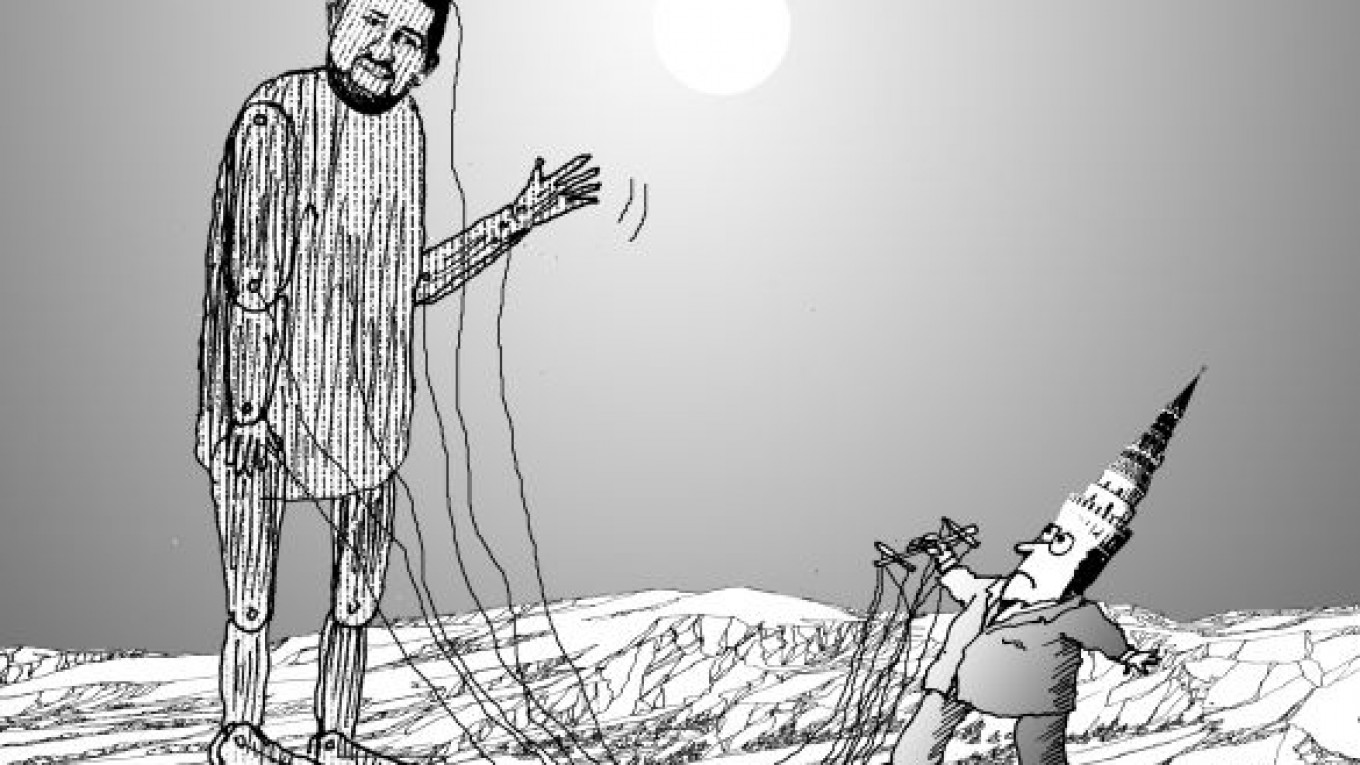
Chechen President Ramzan Kadyrov in July proposed to Akhmed Zakayev, a leader of the nationalistic and comparatively moderate Chechen opposition, that he return to Chechnya. Kadyrov promised Zakayev amnesty and various positions ranging from director of the local theater to culture minister.
Zakayev looked ready to accept the proposal. His position in the nationalist opposition was weak. There seem to be few, if any, fighters in Chechnya who recognize him as commander. His recent attempt to send an emissary to create a fighting unit directly under his command was not successful.
At the same time, Zakayev maintained rather friendly relations with Kadyrov. These relations were warmed after Zakayev implicitly acknowledged Kadyrov’s main achievement: making Chechnya “independent,” or at the very least self-ruling within the Russian Federation.
But although Zakayev was one of the most moderate members of the Chechen resistance, an amnesty for him needed the Kremlin’s approval, and he does not seem to have received it. This is probably why he refused Kadyrov’s offer. But the reason that the Kremlin balked at offering Zakayev an amnesty is unlikely to be related to him personally, but rather to Kadyrov.
The return to Chechnya of an amnestied Zakayev would have greatly increased Kadyrov’s prestige. But the Kremlin wanted to avoid this, owing to an unease with Kadyrov’s increased power and a growing Muslim elite that, while formally acknowledging Russian suzerainty, increasingly demands a redistribution of power within Russia.
For most of the past two decades, jihadists in the Caucasus and Central Asia were a major source of concern for the Kremlin. Fear of “Talibanizing” the Caucasus prompted the Kremlin’s recent announcement that the country’s Muslims should be protected from extremist propaganda from abroad and that Muslim education and spiritual life within Russia should be controlled to direct them away from extremism.
It was fear of extremism, as well as a more general increase violence, that led to the rise of the Kadyrov clan in 2004, when the Kremlin decided to engage in a “Chechenization” of the conflict. The plan implied that the Kremlin would provide the Kadyrovs — first, former Chechen President Akhmad Kadyrov and then after his death, his son Ramzan — broad autonomy and huge sums of money.
Moscow closed its eyes to Kadyrov’s amnesty of former guerrillas and their inclusion in his paramilitary units. In exchange, Kadyrov was to wage war against the remaining Islamist resistance and thus relieve Moscow of the burden of shedding Russian blood.
The plan initially worked. Kadyrov was able to create a strong force that could fight the guerrillas, basically on its own. Kadyrov’s efforts can also be credited with ending major terrorist attacks in Russia’s heartland, such as those that occurred in a Moscow theater in 2002 and in Beslan School No. 1 in 2004.
Kadyrov seemed an effective antidote to the jihadists. Still, the logical conclusion of the Kremlin’s Kadyrov policy appears to be precisely what it sought to prevent — Chechen independence — when it engaged in the first Chechen war almost a generation ago.
Receiving from the Kremlin a virtual carte blanche to do whatever he wants in Chechnya, Kadyrov made genuine efforts to transform himself into a popular leader. It is clear that he has not brought down the unemployment rate and has no intention of ending corruption. Still, he can be credited for some tangible results in bringing Chechnya a modicum of normality.
The restoration of the capital, Grozny, was one of his clear achievements. Grozny was totally destroyed during the first Chechen war; both Russian and foreign observers compared it with Stalingrad after World War II and assumed that it would be impossible to restore. It was suggested that a new Chechen capital be built. Yet, having enjoyed a huge subsidy from Moscow, Kadyrov has rebuilt Grozny and provided it with some security.
Kadyrov also catered to the spiritual aspirations of the Chechen majority. He rejected Wahhabism, the ideological framework of the jihadists, but maintained that Islam is an essential part of the Chechen tradition and presented himself as a leader who fully understood this. So he encouraged an Islamic dress code and built a huge mosque — one of the biggest in Europe.
All of this brought Kadyrov wide support among the Chechen population. Even those who dislike him sometimes conclude that he is the best of all the possible options, and he has improved his position by persistently weeding out Chechen military forces that are not directly under his command. His most recent effort was the liquidation of the Vostok battalion, despite its being an integral part of the Russian army.
It was probably inevitable that Kadyrov’s increasing power would worry the Kremlin, especially after the Kremlin itself created a precedent for secession by recognizing the independence of Abkhazia and South Ossetia after the Russia-Georgia war in 2008. Allowing Zakayev’s return would have worsened matters by increasing Kadyrov’s prestige at home, as well as his international visibility and legitimacy. That would have pushed Kadyrov even further away from Russian control at a time when the Kremlin has become increasingly unable — and now, perhaps reluctant — to purchase his loyalty.
Dmitry Shlapentokh teaches history at the University of Indiana, South Bend. © Project Syndicate
A Message from The Moscow Times:
Dear readers,
We are facing unprecedented challenges. Russia's Prosecutor General's Office has designated The Moscow Times as an "undesirable" organization, criminalizing our work and putting our staff at risk of prosecution. This follows our earlier unjust labeling as a "foreign agent."
These actions are direct attempts to silence independent journalism in Russia. The authorities claim our work "discredits the decisions of the Russian leadership." We see things differently: we strive to provide accurate, unbiased reporting on Russia.
We, the journalists of The Moscow Times, refuse to be silenced. But to continue our work, we need your help.
Your support, no matter how small, makes a world of difference. If you can, please support us monthly starting from just $2. It's quick to set up, and every contribution makes a significant impact.
By supporting The Moscow Times, you're defending open, independent journalism in the face of repression. Thank you for standing with us.

Remind me later.