

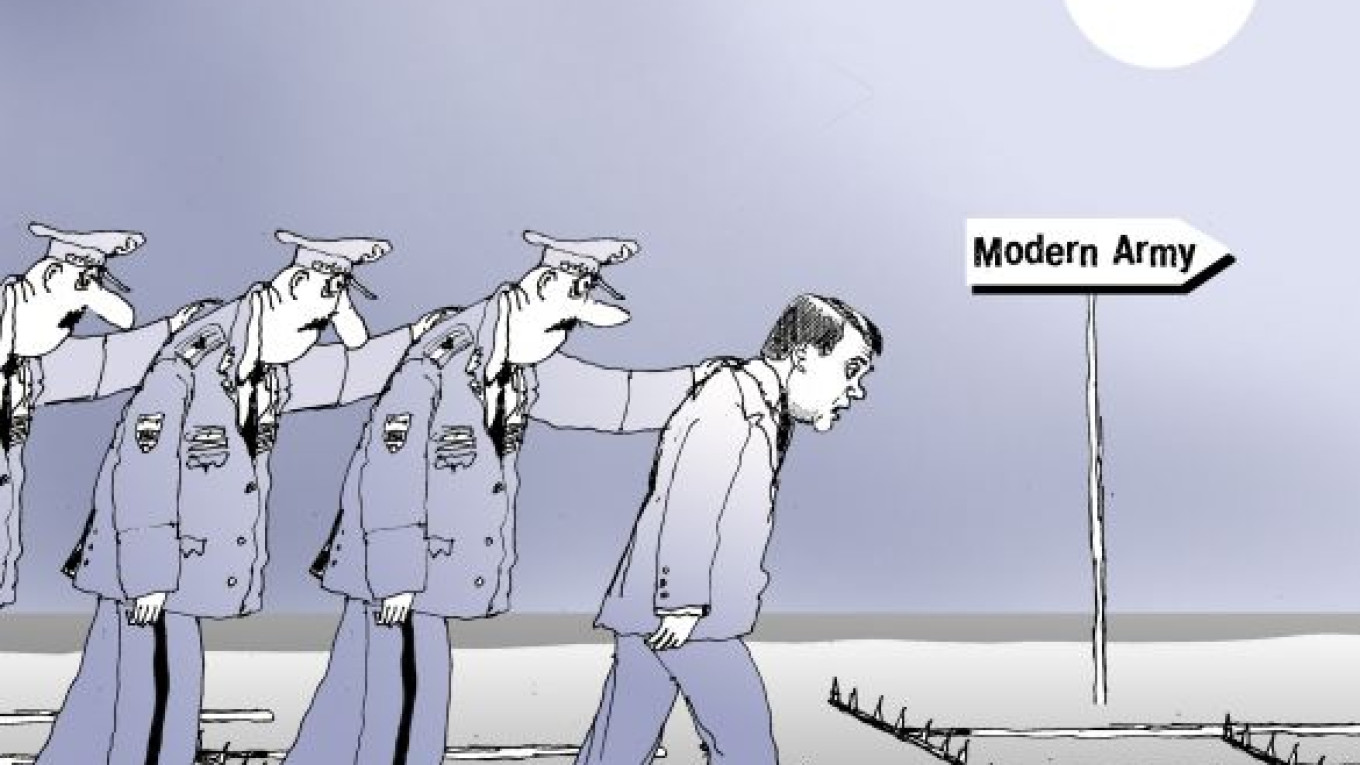
The main method by which Russia’s leaders are sometimes able to come to new understandings is by making the same mistakes over and over. President Dmitry Medvedev proved this theory on Friday during a meeting he headed at a Defense Ministry collegium when said about 20 trillion rubles? (more than $700 billion) for a new state armament program through 2020 should be implemented “in the most efficient way.”
The captains of Russia’s military-industrial complex are licking their chops over the 20 trillion ruble trough, sending high-ranking lobbyists to the Defense Ministry to secure choice pieces of the budgetary pie. The military brass has been fighting back as best it can, but yet another scandal broke just days before the collegium.
Alexander Postnikov, head of the Ground Forces, told the Federation Council that many of Russia’s weapons are seriously outmoded in comparison with other countries. Postnikov used the example of the “new” T-90 tank. He rightfully pointed out that far from being new, it is actually the 17th upgrade of the T-72 tank, first produced in the 1970s. Considering that the number designating each tank corresponds to the year it was introduced, it becomes clear that there has been no real development in the country’s tank design for almost half a century. Moreover, the general reported that the current version of the tank sells for the outlandishly high price of 118 million rubles ($4.1 million) each.
The very next day, the military-industrial complex struck back with a press release from Uralvagonzavod, the plant producing the T-90. It made the somber assertion that by choosing to modernize old tanks rather than buy new ones, the Defense Ministry was itself torpedoing any possible “technological breakthroughs.” Igor Karavayev, head of development for the defense industry at the Industry and Trade Ministry, reported that the T-90 had performed brilliantly during tests in Saudi Arabia.
Despite the hyperbole, Uralvagonzavod CEO Oleg Sienko painted a very realistic picture 18 months ago of the tanks that his factory produces. “I’m sick of it. … You can’t even crawl into one of the tanks,” he said. “At trade shows when you get into a foreign tank, it’s like sitting in a Volkswagen. But you get into one of ours and there are parts sticking out everywhere.”?
Considering that recent months have probably seen few, if any, dramatic improvements to those tanks, the Defense Ministry’s decision to refrain from purchasing what are essentially modernized versions of the T-72 seems quite reasonable.
Although Postnikov had tried to explain the basis for making such a decision, the captains of the military-industrial complex are quite unhappy about it. At the Defense Ministry collegium, Medvedev took the side of the military brass in demanding that manufacturers provide clear and transparent pricing and take greater responsibility for fulfilling state procurement contracts. The president acknowledged that some orders had been left unfulfilled and promised to hold a “debriefing” with the responsible individuals from the defense industry and state agencies. That threat was in complete accordance with Defense Minister Anatoly Serdyukov’s suggestion that defense industry directors who had violated their contractual obligations be punished with stiff fines and even administrative arrest.
Medvedev said the problem lies in the fact that industry leaders “first obtain various orders by placing unrealistically low bids and then wrongfully attempt to raise the contractual price.”
Russia’s modern defense industry is little more than a parody of the Soviet-era military-industrial complex. The industry has never undergone any radical restructuring or established the type of cooperative relationships needed for it to function efficiently. Medvedev apparently realizes that investing in such an industry is tantamount to tossing money to the wind. It is no wonder that he has complained that it would be impossible to approve the federal target program for developing the military-industrial complex. Meanwhile, budgetary funds for weapons contracts have already been allocated.
Perhaps change will come only after these trillions of rubles are spent with little or no result. The only time Russia’s leaders learn their lessons is after they get burned repeatedly — but even then, they learn the real, hard lessons only a fraction of the time.
Alexander Golts is deputy editor of the online newspaper Yezhednevny Zhurnal.
A Message from The Moscow Times:
Dear readers,
We are facing unprecedented challenges. Russia's Prosecutor General's Office has designated The Moscow Times as an "undesirable" organization, criminalizing our work and putting our staff at risk of prosecution. This follows our earlier unjust labeling as a "foreign agent."
These actions are direct attempts to silence independent journalism in Russia. The authorities claim our work "discredits the decisions of the Russian leadership." We see things differently: we strive to provide accurate, unbiased reporting on Russia.
We, the journalists of The Moscow Times, refuse to be silenced. But to continue our work, we need your help.
Your support, no matter how small, makes a world of difference. If you can, please support us monthly starting from just $2. It's quick to set up, and every contribution makes a significant impact.
By supporting The Moscow Times, you're defending open, independent journalism in the face of repression. Thank you for standing with us.

Remind me later.