

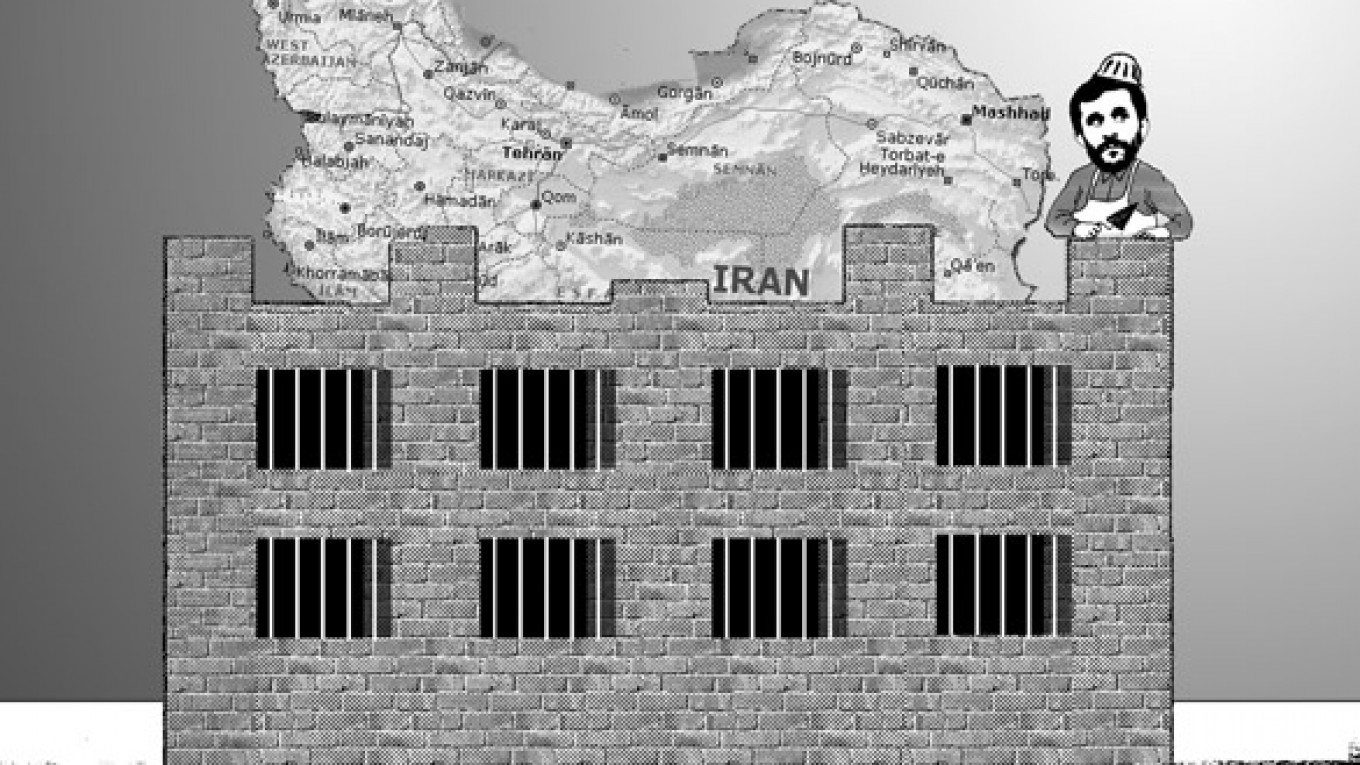
During the past two weeks, we have witnessed a series of major international events, the significance of which analysts have yet to fully grasp. There has been a real rapprochement between the United States and Russia on global security, including nuclear arms reductions, nuclear and missile nonproliferation, the struggle against international terrorism, drug trafficking and illegal arms exports. And although their positions on those questions do not always coincide, they are clearly ready to create a new system of security that pays close attention to the interests of the main foreign policy players. Washington and Moscow have also been finding a common position on reckless states that could push the world toward a nuclear catastrophe. Above all, this applies to Iran, a country that has experienced significant success in developing its nuclear and missile programs but has clearly overestimated its capabilities in the global arena and even in its own region.
Of greatest concern to the international community is Iran’s uranium program, particularly the 4,600 gas centrifuges for enriching fuel at the Natanz nuclear facility. This means Iran will soon have 8,300 gas centrifuges online, confirming statements made by Iranian President Mahmoud Ahmadinejad in April 2008 of his plans to deploy an additional 6,000 centrifuges, which is in direct violation of five separate resolutions passed by the United Nations Security Council.
As a further challenge to the international community, a second uranium enrichment plant is set to start operations within 18 months. That facility, believed to contain 3,000 gas centrifuges, was built in secret over the last two years at a military base near the city of Qom and is well protected against air strikes.
There is no economic justification for Iran’s uranium enrichment program because the country’s sole energy-producing nuclear reactor will be supplied exclusively with Russian nuclear fuel. Nor is their much credibility in Iran’s assertion that it is planning to sell its nuclear fuel abroad. Just the same, the centrifuge cascades continually yield uranium hexafluoride. As a result, by late July, Iran had 1.5 tons of low enriched uranium hexafluoride. If that material will be further enriched, it could produce enough fissionable material for two or three nuclear warheads. This is the reason the international community is justified in its questions about whether Iran’s uranium program is peaceful, especially considering its past and ongoing large-scale secret activity in this area.
In addition, Iran’s missile program is rapidly advancing along with its nuclear program. Iran already possesses missiles with a range of 2,000 to 2,300 kilometers and has the very real potential to expand it to the intercontinental range of 6,000 kilometers. The danger that poses is obvious to many — even to many in Russia, where the country’s southern territory that includes the Northern Caucasus and Astrakhan region, with a combined population of more than 20 million people, would fall within range of Iran’s mid-range Shahab-3 missile.
It is necessary to point out that the state ideology of the current Iranian leadership is orthodox Khomeinism, with its aggressive anti-Western and anti-Israeli foreign policy and its active support of radical Islamic groups. Amid the overall instability in the Middle East, Iran’s antagonism and military ambitions complicates the problem of international security and raises alarms not only for Western countries, but also for Iran’s neighbors.
If major powers, including Russia, are worried about whether they can trust Iran — a country that violated its earlier pledge to be a non-nuclear state and its participation in the Nuclear Nonproliferation Treaty by conducting research and testing in the nuclear sphere — then Arab states are openly fearful of Iran’s growing military potential for historical, political and religious reasons. What’s more, the idea of exporting the Iranian Revolution through military means has only temporarily been set aside and could be reactivated if the Islamic Republic gained the right opportunity.
Iran’s global isolation is growing. In pursuit of its ambitions to become a regional kingpin, Tehran is prepared to throw the entire Middle East into chaos. The nuclear domino effect has, in fact, already started in the region, and if we cannot prevent Iran from building a nuclear bomb, a future nuclear conflict in that part of the world is almost inevitable.
Vladimir Yevseyev is a security analyst with the Institute of Global Economy and International Affairs.
A Message from The Moscow Times:
Dear readers,
We are facing unprecedented challenges. Russia's Prosecutor General's Office has designated The Moscow Times as an "undesirable" organization, criminalizing our work and putting our staff at risk of prosecution. This follows our earlier unjust labeling as a "foreign agent."
These actions are direct attempts to silence independent journalism in Russia. The authorities claim our work "discredits the decisions of the Russian leadership." We see things differently: we strive to provide accurate, unbiased reporting on Russia.
We, the journalists of The Moscow Times, refuse to be silenced. But to continue our work, we need your help.
Your support, no matter how small, makes a world of difference. If you can, please support us monthly starting from just $2. It's quick to set up, and every contribution makes a significant impact.
By supporting The Moscow Times, you're defending open, independent journalism in the face of repression. Thank you for standing with us.

Remind me later.