

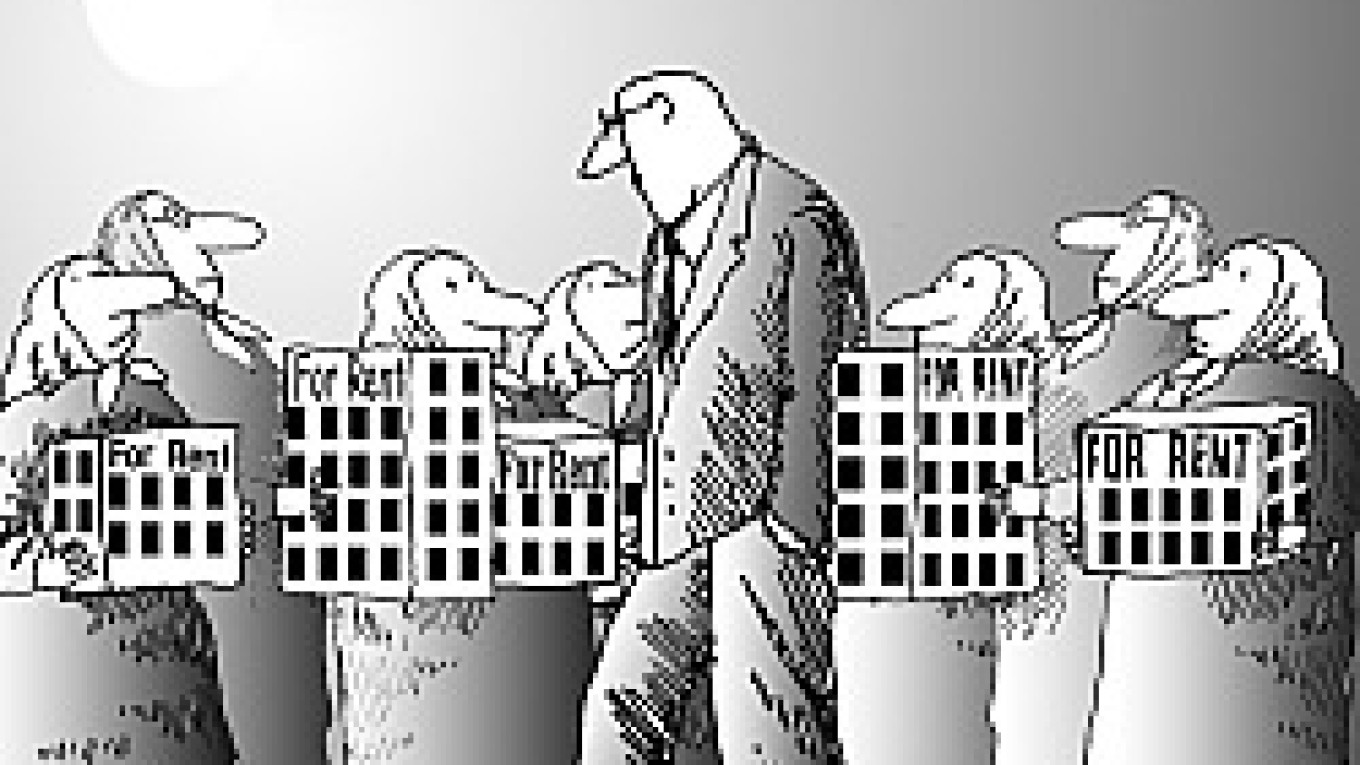
Indeed, there is pressing need to remind developers, investors and businesses that falling prices were never before a reason to panic, and they shouldn't be today either. Certainly, prices for commercial real estate -- and particularly office rents -- will continue to decline. But companies that rent office space would be doing themselves a favor by examining these reductions for what they are rather than taking them as an indicator of doom ahead.
 | To Our Readers |
The Moscow Times welcomes letters to the editor. Letters for publication should be signed and bear the signatory's address and telephone number. |
While price corrections present their set of risks, they also offer opportunities for various groups of businesses.
How can a fall in prices and rent rates be a good thing? Even in a crisis, there are always people who come out ahead. Today, many companies are giving in to the psychological pressure coming from the financial markets and are opting to "wait and see." But given the conditions we are expecting to see in the next several months, now may just be the best time to make the move.
Occupiers and businesses considering plans to expand in Moscow may find themselves in a surprisingly accommodating market in the next six months. As we see a correction of Moscow's office rents, which have been rated among the highest in the world in the past several years, companies seeking to occupy space in the capital can look forward to additional incentives from developers. If they take advantage of the short period of time in which supply will exceed demand in Moscow's office market, tenants can benefit from certain perks like more affordable rates, longer rent-free periods and partial compensation for fit-outs. More important, since Moscow still has so few quality office projects, they should move quickly so that they have the best pick of available space while it lasts.
In the short term, investors should look to take advantage of a window of opportunity. Because Russia has relatively few investment-grade properties, in the first half of 2009 investors will see a chance to buy quality projects with more attractive returns than usual. Rather than waiting, they will benefit from snatching up a limited number of good buys while they are still available.
Developers who manage to continue on with their projects and put the focus on concept quality may benefit in the long term from a less competitive market after the financial situation stabilizes. As sale prices go down, developers who respond quickly will win out by efficiently disposing of and getting access to liquidity. But a correction in rental rates will also benefit them by creating safer conditions for tenants, which will mean sustainable incomes in the future.
The Russian economy is in a good position to make a faster recovery than other European markets, given its strong fundamentals and a potential to stabilize in 2009. By taking advantage of low rents in the short term, companies may actually help speed up the recovery. Meanwhile, by the end of next year, take-up will begin to increase, compensating for a half-year lag. As demand starts recovering in the end of 2009, we expect rent stabilization followed by the start of a general recovery in 2010. By that time, companies that have already gotten into the market can focus on getting ahead.
The real estate sector occupies a special place in Russia's economy. In the boom period of the past eight years, we have been literally building the country. But as the latest trends and forecasts show, that job is far from over. The current situation presents not just an opportunity for companies to grow but a chance to turn the market around. The real estate market's next cycle will be characterized by more professional players and a new level of project quality.
Vladimir Pinayev is managing director of owner and occupier services, Russia & CIS Jones Lang LaSalle in Moscow.
A Message from The Moscow Times:
Dear readers,
We are facing unprecedented challenges. Russia's Prosecutor General's Office has designated The Moscow Times as an "undesirable" organization, criminalizing our work and putting our staff at risk of prosecution. This follows our earlier unjust labeling as a "foreign agent."
These actions are direct attempts to silence independent journalism in Russia. The authorities claim our work "discredits the decisions of the Russian leadership." We see things differently: we strive to provide accurate, unbiased reporting on Russia.
We, the journalists of The Moscow Times, refuse to be silenced. But to continue our work, we need your help.
Your support, no matter how small, makes a world of difference. If you can, please support us monthly starting from just $2. It's quick to set up, and every contribution makes a significant impact.
By supporting The Moscow Times, you're defending open, independent journalism in the face of repression. Thank you for standing with us.

Remind me later.