

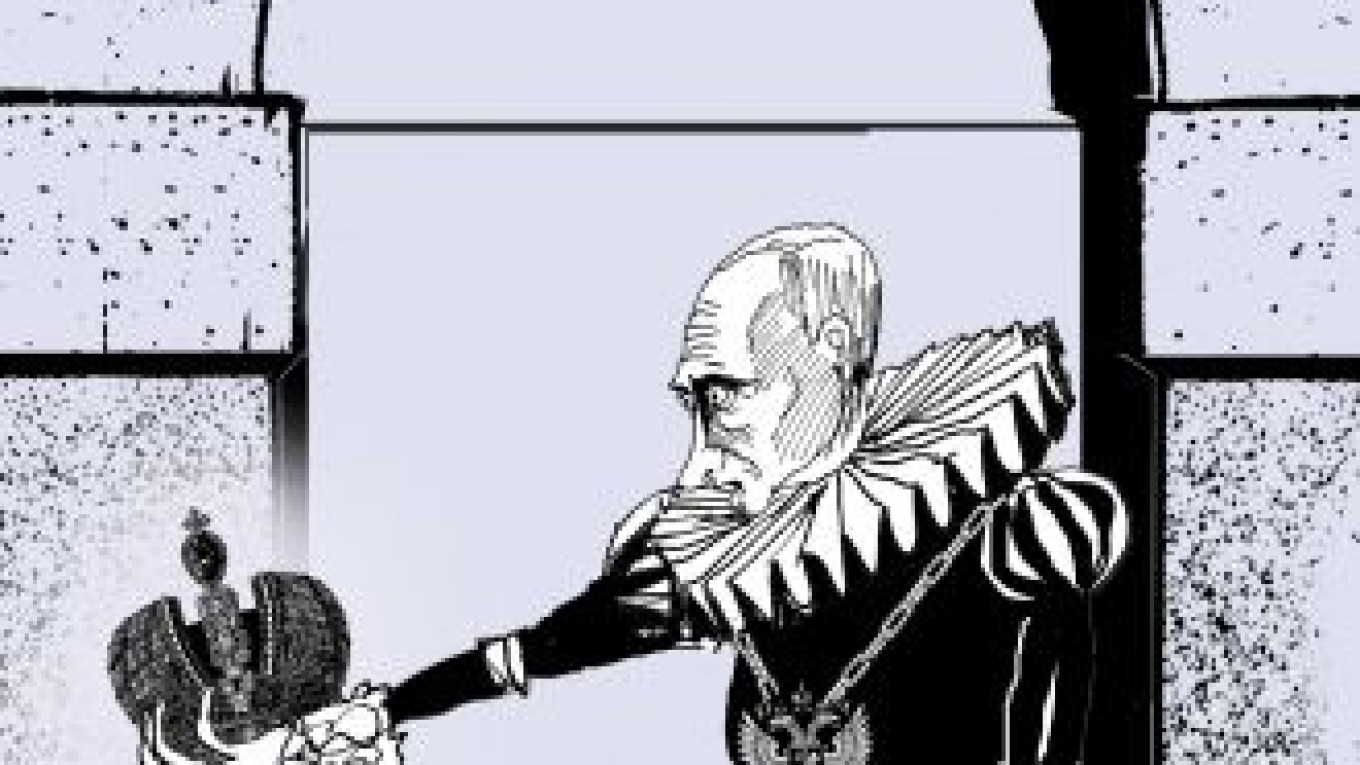
Ever since the Bolshevik Revolution nearly a century ago, all Russian leaders have faced a succession problem. It is all the more remarkable because Soviet — and now Russian — leaders tend to be absolute rulers. In the past 20 years, despite ostensibly democratic, competitive elections, the incumbents still anoint their successors. Yet, both Presidents Boris Yeltsin and Vladimir Putin had difficulty finding a replacement. The transfer of power remains a traumatic process.
In his confusing “testament,” Vladimir Lenin managed to criticize every top Communist Party leader, leaving the field open for a power struggle. It could be argued that Lenin, dying at 53, didn’t expect to be succeeded quite so soon. But Josef Stalin, who died at 72, also failed to nominate a successor. His entourage had to fight it out among themselves.
Of the seven Soviet rulers, five died in office and two were dismissed. Of the five who died in office, none knew who would take up their cause. Actually, it was the other way around. Every new Soviet leader began by attacking his immediate predecessor and erasing his name from history.
Although Stalin didn’t criticize Lenin personally, he had most of Lenin’s associates jailed or shot. Nikita Khrushchev spent his decade in power denouncing Stalin. Leonid Brezhnev vilified Khrushchev, and Yury Andropov, despite being the Soviet ruler for only 15 months, initiated an investigation into Brezhnev’s family and friends. Another short-lived general secretary, Konstantin Chernenko, canceled Andropov’s draconian reforms and returned to the stability of the Brezhnev era. After Chernenko, too, died shortly thereafter, Mikhail Gorbachev termed that era a period of stagnation and initiated his own policies of perestroika and glasnost.
The same pattern endures in post-Soviet Russia. Yeltsin was highly critical of Gorbachev. Then, once Yeltsin’s handpicked successor, Putin, came to power, the Russian media started to refer to Yeltsin’s two terms in office as “the wild and reckless ’90s.”
The succession problem has endured into post-Communist Russia, despite the fact that Yeltsin became the first Russian leader to leave power voluntarily. For all his democratic credentials, the media nicknamed Yeltsin “Tsar Boris,” and he began experimenting with an heir apparent in 1998. He quickly went through five prime ministers in a little more than a year, and then — in apparent desperation — settled on Putin. The anointment was a damning reflection on the kind of democracy Yeltsin established in Russia. The obscure former lieutenant colonel of the KGB won the presidency only six months after popping up out of nowhere.
Now Putin is grappling with a successor problem of his own. In 2007, Putin agonized over the choice of successor for several months, denying allegations that he was only looking for a temporary placeholder. Eventually, he chose the weak Medvedev over a stronger but more independent candidate, Sergei Ivanov, a member of the siloviki. But more than three years into Medvedev’s term, Putin remains the most powerful man in Russia. The latest opinion poll conducted by the Levada Center found that only 18 percent of Russians believe that Medvedev runs their country, while 24 percent think Putin calls the shots. Putin still refuses to rule out his intention to run in next year’s presidential election. But no matter who runs, the choice of who will win remains Putin’s.
As long as Medvedev remains Putin’s heir apparent, he is in a precarious position. Medvedev should remember the fate of a Stalin-era functionary, Alexei Kuznetsov. A loyal Stalinist and a Leningrad party boss since 1937, Kuznetsov was promoted to party secretary in 1946 at the age of 41. He was summoned to Moscow, where it was widely thought that Stalin was grooming him as a successor. The story, which is well described by Simon Sebag Montefiore in his book “Stalin: The Court of the Red Tsar,” ended badly. In 1949, Kuznetsov was arrested as part of the so-called Leningrad Case, and he was executed in October 1950.
Thankfully, we live in less bloody times, and Medvedev is unlikely to get executed. But he might have to keep waiting for his turn forever. Russia’s succession problem is key to understanding the larger problems in its political system, which boils down to the lack of legitimacy. Power can be transferred by a leader to a successor only if it is unquestionably his — that is, if it is based on some widely accepted legitimate social contract, such as free and fair elections.
Since 1917, Soviet and Russian rulers have not been able to legitimize their rule. This is the reason why a power transfer always becomes such a trauma and a cataclysm for the entire nation.
Alexei Bayer, a native Muscovite, is a New York-based economist.
A Message from The Moscow Times:
Dear readers,
We are facing unprecedented challenges. Russia's Prosecutor General's Office has designated The Moscow Times as an "undesirable" organization, criminalizing our work and putting our staff at risk of prosecution. This follows our earlier unjust labeling as a "foreign agent."
These actions are direct attempts to silence independent journalism in Russia. The authorities claim our work "discredits the decisions of the Russian leadership." We see things differently: we strive to provide accurate, unbiased reporting on Russia.
We, the journalists of The Moscow Times, refuse to be silenced. But to continue our work, we need your help.
Your support, no matter how small, makes a world of difference. If you can, please support us monthly starting from just $2. It's quick to set up, and every contribution makes a significant impact.
By supporting The Moscow Times, you're defending open, independent journalism in the face of repression. Thank you for standing with us.

Remind me later.