

After the Soviet collapse, the United States and Russia declared a strategic partnership and signed the NATO-Russia Founding Act of May 1997. Nonetheless, Washington still maintained that its U.S. nuclear arsenal in Europe -- about 400 warheads scattered in six NATO countries -- was needed since Russia's military potential would remain an unknown for a long time to come. In real political terms, Russia's nuclear capabilities were viewed as a threat, even as the number of its warheads decreased.
During the past 10 years, U.S.-led wars in Yugoslavia and Iraq, in addition to some key scientific breakthroughs in defense technology, set the stage for a new phase in U.S. military policy.
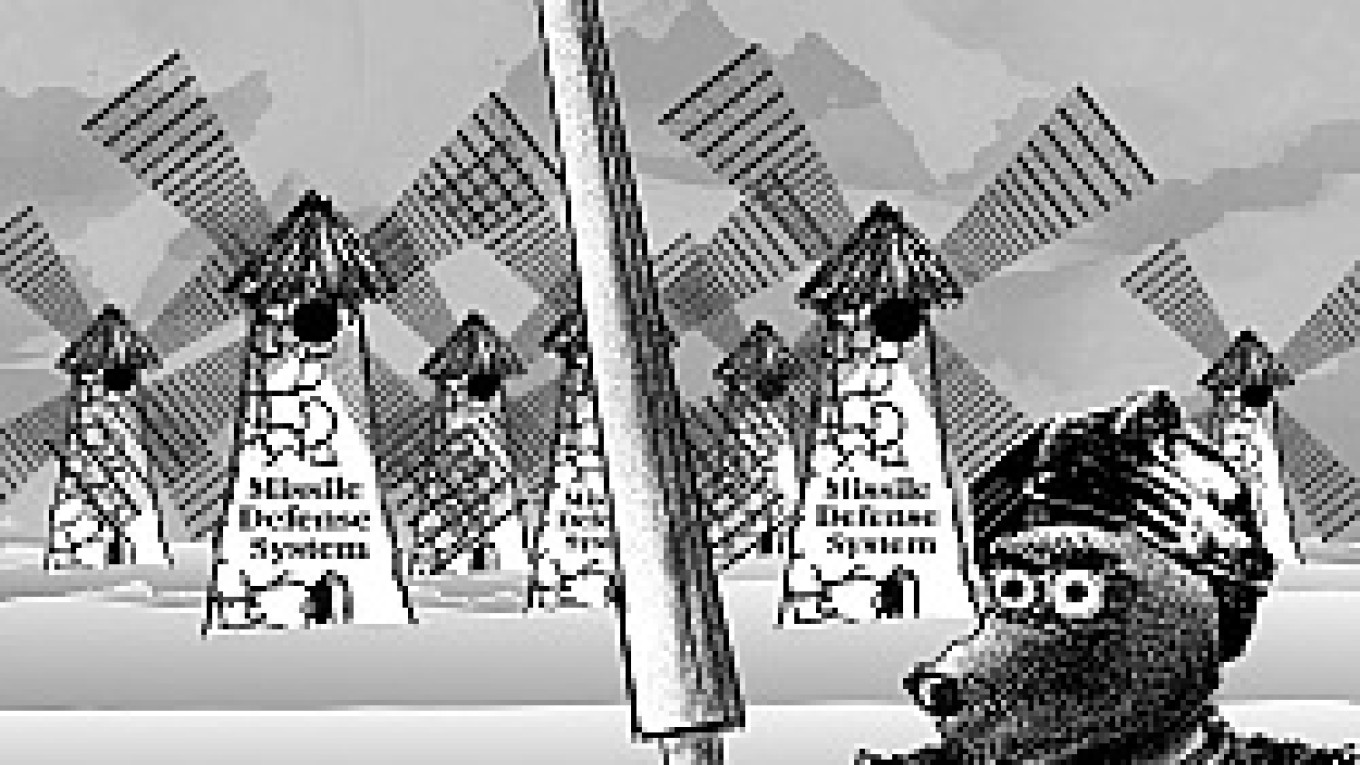
At the same time, the United States continued to modernize and strengthen its nuclear potential. As part of this modernization, the United States started building a limited missile defense system. This process started during the administration of President Bill Clinton and, for all intents and purposes, bypassed the 1972 Anti-Ballistic Missile Treaty that the United States signed with the Soviet Union. The United States' missile defense strategy was officially declared in December 2001, when then-President George W. Bush informed Russia of the U.S. withdrawal from the ABM Treaty.
 | To Our Readers |
The Moscow Times welcomes letters to the editor. Letters for publication should be signed and bear the signatory's address and telephone number. |
The withdrawal from the ABM Treaty has laid the groundwork for the United States to develop a global missile defense system that may fully undercut China's nuclear-deterrence capabilities and significantly undercut Russia's. U.S. military strength clearly surpasses that of every other country, and to make it even stronger it is attempting to create a global missile defense system that could effectively make the United States impregnable -- not only to a first strike but to a counterstrike as well.
The United States' adamant refusal to ratify the Comprehensive Test Ban Treaty underscores its desire to develop a new generation of nuclear weapons. Although the United States has observed the moratorium on underground tests, it has been able to effectively achieve the same goals through highly advanced computer simulation of nuclear tests. The U.S. National Nuclear Security Agency commissioned a supercomputer this year that is capable of carrying out 20 quadrillion operations per second -- by far the fastest in the world.
At the same time, the United States is planning to develop a huge missile defense system to be deployed on both land and ships across the globe. The U.S. missile defense technology has proven to be very effective in a series of tests since 2005. In 27 missile launches, interceptors shot down 26 of them.
In fall 2008, the Pentagon and White House planned the budget for the next financial year. With the support of Democrats in both houses of Congress, a 3 percent increase in military spending for 2009 was approved. Nevertheless, President Barack Obama will be looking for ways to cut military costs, and there is a chance that in tandem with new U.S.-Russian disarmament initiatives, Washington might reconsider its strategy for deploying a global missile defense system.
At present, the Obama administration is thoroughly evaluating the effectiveness, costs and benefits of its plans to expand missile defense systems -- both in Poland and the Czech Republic and beyond. During this evaluation process, Washington will be negotiating with Moscow and at the same time using all of its reconnaissance tools available to determine the exact strength of Russia's nuclear forces and what will be required, in terms of missile defense, to undermine them.
When speaking about missile defense, the difference between an offensive and defensive weapons system becomes blurred. The danger of shifting the strategic balance of power was reflected in a joint declaration made by President Dmitry Medvedev and Obama on April 1.
It is clear that difficult negotiations are required to settle the thorny issues on the U.S.-Russian agenda. Every country in the world has an interest in seeing these negotiations result in a firm commitment by the United States to preserve the global balance of power.
Yevgeny Kozhokin is a professor at Moscow State University and a member of the presidium of the Council for Foreign and Defense Policy.
A Message from The Moscow Times:
Dear readers,
We are facing unprecedented challenges. Russia's Prosecutor General's Office has designated The Moscow Times as an "undesirable" organization, criminalizing our work and putting our staff at risk of prosecution. This follows our earlier unjust labeling as a "foreign agent."
These actions are direct attempts to silence independent journalism in Russia. The authorities claim our work "discredits the decisions of the Russian leadership." We see things differently: we strive to provide accurate, unbiased reporting on Russia.
We, the journalists of The Moscow Times, refuse to be silenced. But to continue our work, we need your help.
Your support, no matter how small, makes a world of difference. If you can, please support us monthly starting from just $2. It's quick to set up, and every contribution makes a significant impact.
By supporting The Moscow Times, you're defending open, independent journalism in the face of repression. Thank you for standing with us.

Remind me later.