

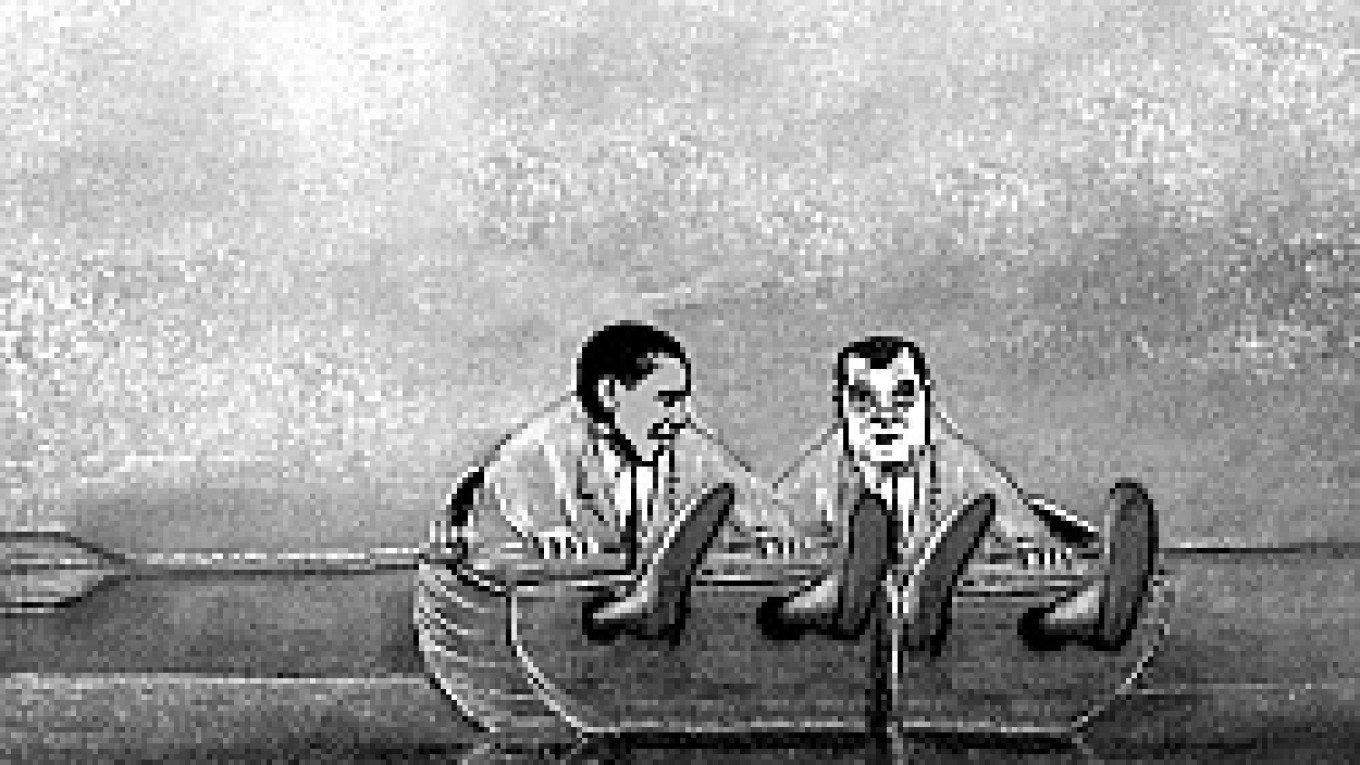
This opens up new possibilities for finding solutions for Iran and North Korea, the fight against terrorism, the preservation of the Earth's climate and for a revival of trust in the United States as a global leader. Another cause for confidence is that the Democrats have solid control over both chambers in Congress. This will help Obama push additional anti-financial crisis measures through quickly.
European Commission President Manuel Barrosso congratulated Obama on behalf of the European Union and expressed hope for the strengthening of U.S.-European ties. There is no doubt that the Obama administration will be able to repair the battered relations with several European countries and help develop a common approach to the world's pressing problems.
Of course, Obama inherited a slew of thorny problems on the foreign policy front -- above all, a very unstable Iraq and a worsening situation in Afghanistan. But overall, we can expect a general improvement in the U.S. position and a global resurgence of trust in Washington -- with one large exception: Russia.
Russia is the one country with which improved relations are unlikely. Obama's administration will have to face the same divisive issues that confronted President George W. Bush. First, Obama has not definitively rejected U.S. plans to deploy elements of a missile-defense system in Poland and the Czech Republic. Second, he supports the U.S. military presence in Central Asia and the expansion of NATO. Third, Obama's position on Georgia differs little from his rival John McCain's, and he will look just as unfavorably at any attempts by Moscow to increase its influence in the former Soviet republics. Fourth, energy resources and pipelines remain a source of constant rivalry as the United States seeks to circumvent Russia by sponsoring alternative oil and gas delivery routes from the Caucasus and Central Asia to the West. Finally, it is safe to say the hawkish advisers in Obama's campaign team -- namely, former Secretary of State Madeleine Albright, former U.S. Ambassador to the United Nations Richard Holbrooke and former National Security Adviser Zbigniew Brzezinski -- probably didn't paint Russia in the most positive terms.
 | To Our Readers |
The Moscow Times welcomes letters to the editor. Letters for publication should be signed and bear the signatory's address and telephone number. |
But amid all of this gloom, there might also be some good news for the Kremlin. If Obama and his economic advisers -- in cooperation with the leading industrial powers -- are able to quickly turn the global financial crisis around and get credit flowing again, this will revive global economic growth and, most important for Russia, raise global demand and prices for oil and gas. Once this happens, Russia can return to its energy-based boom.
What is critical for Prime Minister Vladimir Putin in the short term is to avoid a default on the nearly $500 billion debt held by the country's corporations. The Kremlin also needs to avoid at all costs the political consequences of possibly running a budget deficit as a result of falling oil prices.
Whether the Kremlin would like to admit it or not, the truth is that the political fate of Putin and Medvedev will depend largely on how quickly the Obama administration can pull the United States out of its financial crisis.
Vladimir Ryzhkov, a State Duma deputy from 1993 to 2007, hosts a political talk show on Ekho Moskvy.
A Message from The Moscow Times:
Dear readers,
We are facing unprecedented challenges. Russia's Prosecutor General's Office has designated The Moscow Times as an "undesirable" organization, criminalizing our work and putting our staff at risk of prosecution. This follows our earlier unjust labeling as a "foreign agent."
These actions are direct attempts to silence independent journalism in Russia. The authorities claim our work "discredits the decisions of the Russian leadership." We see things differently: we strive to provide accurate, unbiased reporting on Russia.
We, the journalists of The Moscow Times, refuse to be silenced. But to continue our work, we need your help.
Your support, no matter how small, makes a world of difference. If you can, please support us monthly starting from just $2. It's quick to set up, and every contribution makes a significant impact.
By supporting The Moscow Times, you're defending open, independent journalism in the face of repression. Thank you for standing with us.

Remind me later.