

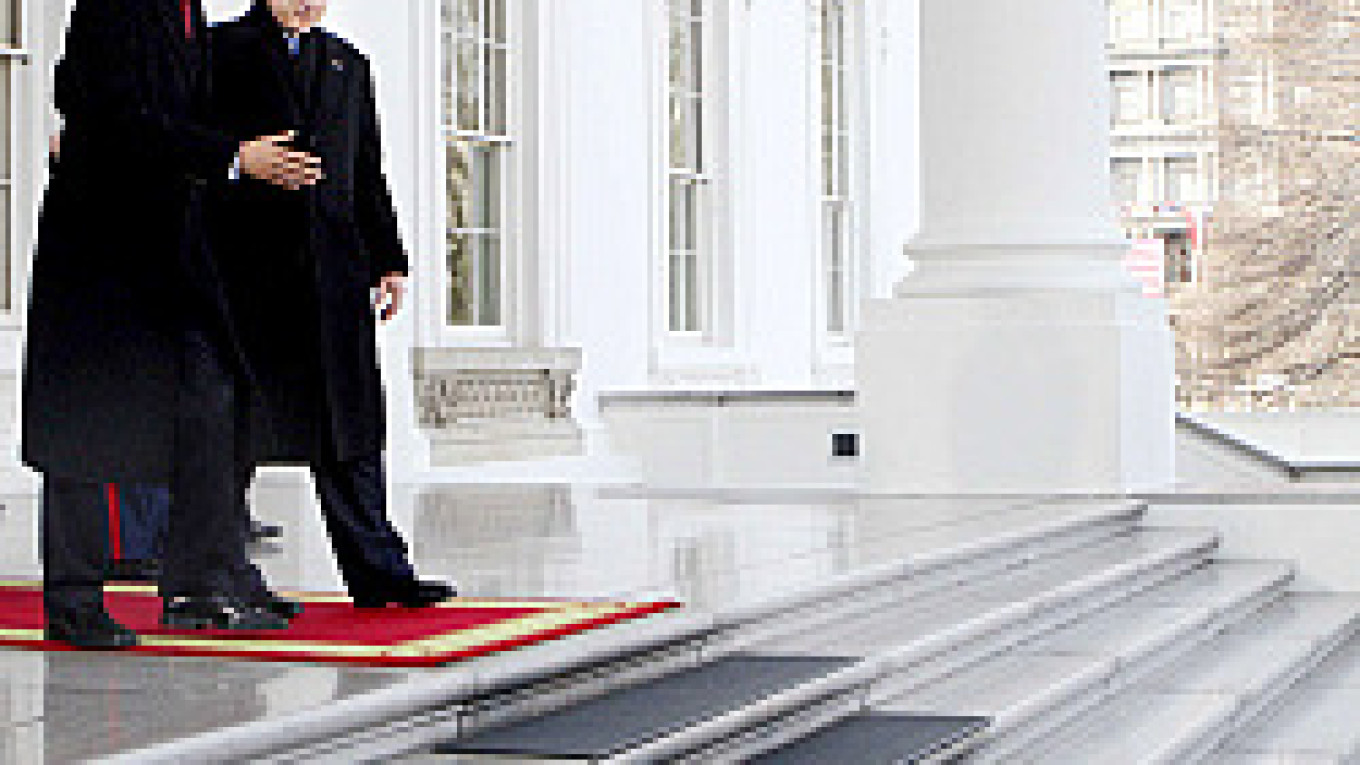
Obama was sworn in Tuesday as the 44th U.S. president before a sea of people. He made no mention of Russia in his first speech to the United States as its new leader.
Deputy Foreign Minister Sergei Ryabkov said the policy of former President George W. Bush had destabilized Ukraine and helped spark last summer's war in the breakaway Georgian region of South Ossetia.
"I would like to hope that the new people in the White House will learn from the mistakes of their predecessors," Ryabkov said in an interview published by his ministry this week.
European states led by Germany and France blocked a U.S. drive at a NATO summit last year to grant Ukraine and Georgia a road map to membership. Officials said neither country was ready and that membership would unnecessarily provoke Moscow, which considers the former Soviet republics to be part of its zone of influence.
"We are not against bilateral relations between the United States and ... Ukraine and Georgia," Ryabkov said. "But at the same time we do not intend to close our eyes to a situation in which the vector of such ties begins to negatively influence Russian interests in the area of national security. ... This relates in full to the essentially anti-Russian advancement of the policy of speedy NATO accession for Kiev and Tbilisi."
Ryabkov said the costs of speedy accession "are well-known to everyone," citing the "destabilization" of Ukraine and Georgia's attack on South Ossetia.
Russian officials say that U.S. military aid to Georgia was taken by President Mikheil Saakashvili as a sign of encouragement ahead of its attack last summer on South Ossetia, which was repelled by Russian forces. Georgia argues that it acted in self-defense.
A Message from The Moscow Times:
Dear readers,
We are facing unprecedented challenges. Russia's Prosecutor General's Office has designated The Moscow Times as an "undesirable" organization, criminalizing our work and putting our staff at risk of prosecution. This follows our earlier unjust labeling as a "foreign agent."
These actions are direct attempts to silence independent journalism in Russia. The authorities claim our work "discredits the decisions of the Russian leadership." We see things differently: we strive to provide accurate, unbiased reporting on Russia.
We, the journalists of The Moscow Times, refuse to be silenced. But to continue our work, we need your help.
Your support, no matter how small, makes a world of difference. If you can, please support us monthly starting from just $2. It's quick to set up, and every contribution makes a significant impact.
By supporting The Moscow Times, you're defending open, independent journalism in the face of repression. Thank you for standing with us.

Remind me later.