

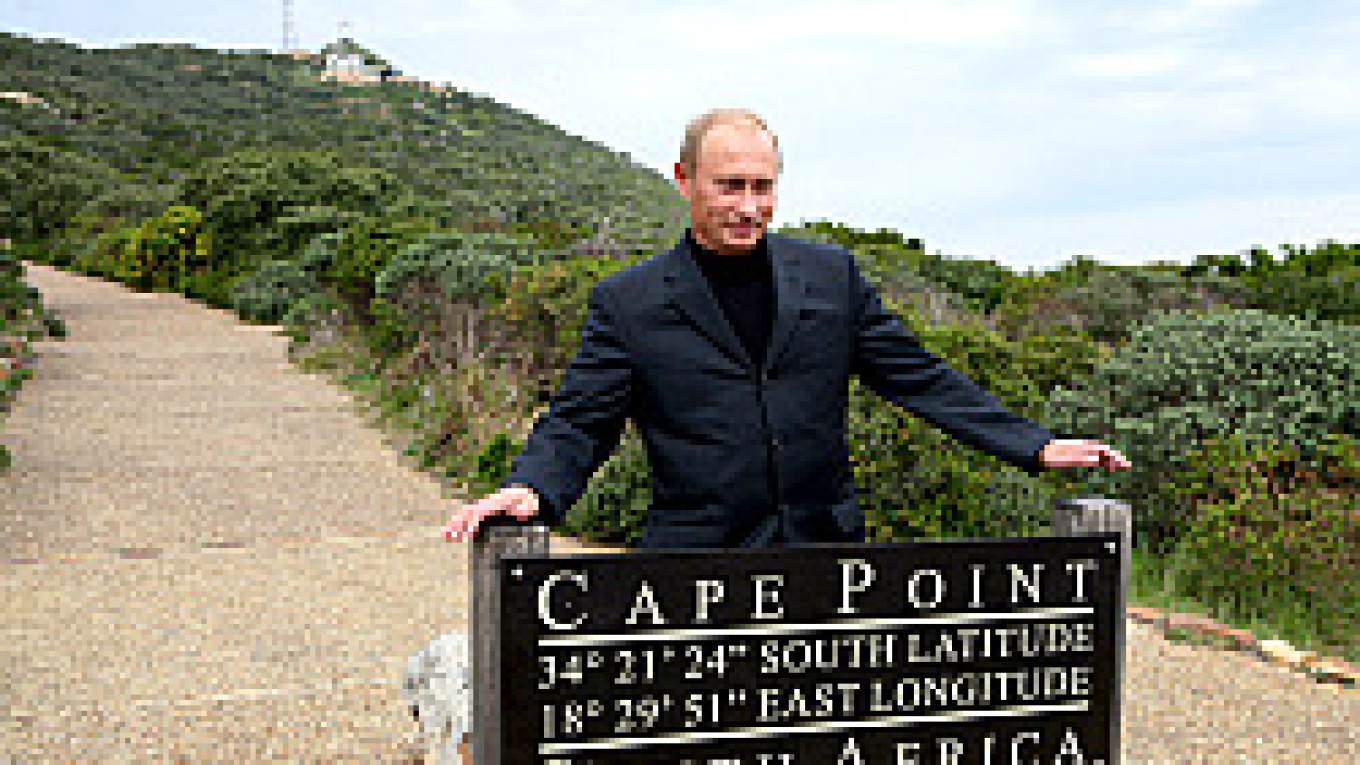
Russian firms say the goal is to diversify energy interests and secure raw materials for a fast-growing economy, but the companies are also seen as tools of an increasingly assertive Kremlin foreign policy.
Africa is already an important alternative energy source for European countries reliant on Russia.
The fact that Russian firms have made little dramatic progress in Africa has not assuaged Western concerns, particularly since Russia's intervention in Georgia raised new questions over energy supplies from the east.
"Quietly, but with rising amounts of panic, we're hearing officials from major European governments complain about what the Russians are doing," said Jon Marks, editorial director of industry newsletter Africa Energy.
Russia's African push goes beyond traditional allies that it supplied with weapons and money during the Cold War.
One of its biggest trading partners in Africa is staunch U.S. ally Morocco, which supplies it with mineral phosphates consumed in large quantities by Russian farms.
But Russia showed that it wanted to keep strong ties with former ally and Moroccan rival Algeria in 2006, when it agreed to write off $4.7 billion on Cold War debt in exchange for a deal to sell the country combat jets, submarines, warships and missiles.
Russian firms, like counterparts from Asia and other Asian countries, are spending billions of dollars for better access to the mineral wealth of countries across the continent.
Such interest in Africa is particularly welcome to those governments that balk at conditions on democracy, human rights and reform that can be attached to dealings with Americans or Europeans.
The big concern in Western Europe is that Russia's tentative deals with African OPEC members are an attempt to get a stranglehold on Europe's gas supplies. Gazprom, which already provides one-quarter of Europe's gas, agreed with Algerian oil company Sonatrach to seek out and commercialize gas together after a visit to Algiers by then-President Vladimir Putin last year.
Sonatrach is the European Union's third-biggest supplier of gas.
A deadline for a Russian gas-exploration deal with Nigeria passed in May, but Gazprom said in April that it was in talks to take part in a multibillion-dollar project to pipe Nigerian gas to Europe across the Sahara.
Gazprom said in July that it could build a pipeline to pump Libyan gas to Europe. Libya has also agreed to sell some of its oil and gas to Russia.
"There is a distinct strategy here. Gazprom doesn't necessarily get a controlling stake, but the Russians are getting a place at the table," said Marks, of Africa Energy.
He said a deal Italy signed this weekend to compensate Libya for misdeeds during its colonial rule was partly designed to maintain its critical energy relationship with Libya.
Elsewhere in Africa, LUKoil plans to explore for hydrocarbons in Ghana and Ivory Coast, while Sintezneftegaz has acquired oil exploration rights off Namibia.
But interest in Africa goes well beyond the energy sector.
United Company RusAl acquired a majority stake in Aluminum Smelter Company of Nigeria last year.
RusAl has deepened an already strong presence in Guinea, saying in February that it would build a bauxite-alumina complex with capacity of 2.8 million tons per year in partnership with China Power Investment Corporation.
Russian businessmen have taken big stakes in mines in South Africa, whose African National Congress -- now governing the country -- relied on Soviet support during the apartheid era.
Russian oil officials have said their push into Africa makes economic sense, as it means money earned in Russia can be used to earn them even more abroad.
But analysts say it could be a while before Russia's energy deals in Africa begin to pay off.
"They have signed bits of paper with everyone ... but I don't expect anything very quick to happen here," said Jonathan Stern, director of gas research at the Oxford Institute of Energy Studies.
"Obviously, what the Russians would love to do is buy up loads of oil and gas and only use it for their own purposes, but they are not going to be allowed to do that."
A Message from The Moscow Times:
Dear readers,
We are facing unprecedented challenges. Russia's Prosecutor General's Office has designated The Moscow Times as an "undesirable" organization, criminalizing our work and putting our staff at risk of prosecution. This follows our earlier unjust labeling as a "foreign agent."
These actions are direct attempts to silence independent journalism in Russia. The authorities claim our work "discredits the decisions of the Russian leadership." We see things differently: we strive to provide accurate, unbiased reporting on Russia.
We, the journalists of The Moscow Times, refuse to be silenced. But to continue our work, we need your help.
Your support, no matter how small, makes a world of difference. If you can, please support us monthly starting from just $2. It's quick to set up, and every contribution makes a significant impact.
By supporting The Moscow Times, you're defending open, independent journalism in the face of repression. Thank you for standing with us.

Remind me later.