

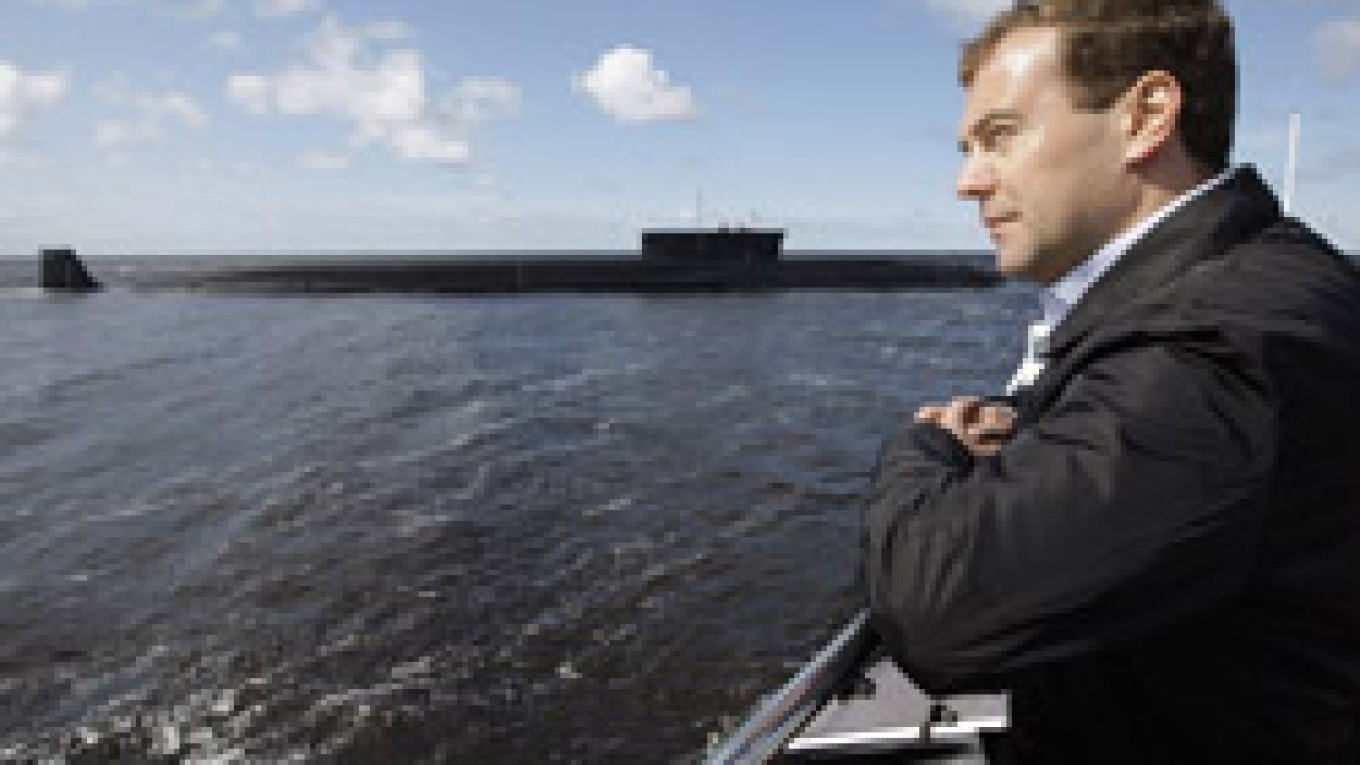
SEVERODVINSK, Arkhangelsk Region — President Dmitry Medvedev on Thursday lashed out at shipbuilder Sevmash for delays on a landmark contract with India to refurbish a Soviet-era aircraft carrier.
Arms exports, which exceeded $8 billion last year, are a key source of revenue for Russia, with India and China accounting for the bulk of its sales.
In a $1.6 billion deal signed in 2004, Russia was to modernize the Admiral Gorshkov at Sevmash, in the northern port of Severodvinsk, and deliver the aircraft carrier by 2008. The modernization deal was expected to lead to other lucrative contracts, including for tanks, aircraft and warships.
After Russian delays, delivery was pushed back to 2012 and its price nearly doubled to $2.8 billion. The contract has been a sore issue in India-Russia ties.
“Now we all have to make excuses,” Medvedev told Sevmash general director Nikolai Kalistratov. “You have to make excuses to me, I have to make excuses to our Indian partners,” a visibly irritated Medvedev added.
The ship, already renamed the INS Vikramaditya, was launched in 1982 and decommissioned in 1996. Smaller than U.S. carriers and powered by steam engines rather than nuclear reactors, it originally carried helicopters and vertical takeoff and landing aircraft.
Russian engineers have had to lengthen the runway and build a proper springboard to allow conventional warplanes to reach takeoff speed.
“We have failed to assess correctly the scale and the complexity of the work,” Sevmash’s Kalistratov told Medvedev. “We in Russia are doing this for the first time.”
He said the ship would be handed over to India in late 2012. “We can’t make it earlier than that,” he said.
“Let’s consider this the first and most difficult experience,” Medvedev said. “You need to complete [the ship] and hand it over our partners. Otherwise, there will be grave consequences.”
A Message from The Moscow Times:
Dear readers,
We are facing unprecedented challenges. Russia's Prosecutor General's Office has designated The Moscow Times as an "undesirable" organization, criminalizing our work and putting our staff at risk of prosecution. This follows our earlier unjust labeling as a "foreign agent."
These actions are direct attempts to silence independent journalism in Russia. The authorities claim our work "discredits the decisions of the Russian leadership." We see things differently: we strive to provide accurate, unbiased reporting on Russia.
We, the journalists of The Moscow Times, refuse to be silenced. But to continue our work, we need your help.
Your support, no matter how small, makes a world of difference. If you can, please support us monthly starting from just $2. It's quick to set up, and every contribution makes a significant impact.
By supporting The Moscow Times, you're defending open, independent journalism in the face of repression. Thank you for standing with us.

Remind me later.