

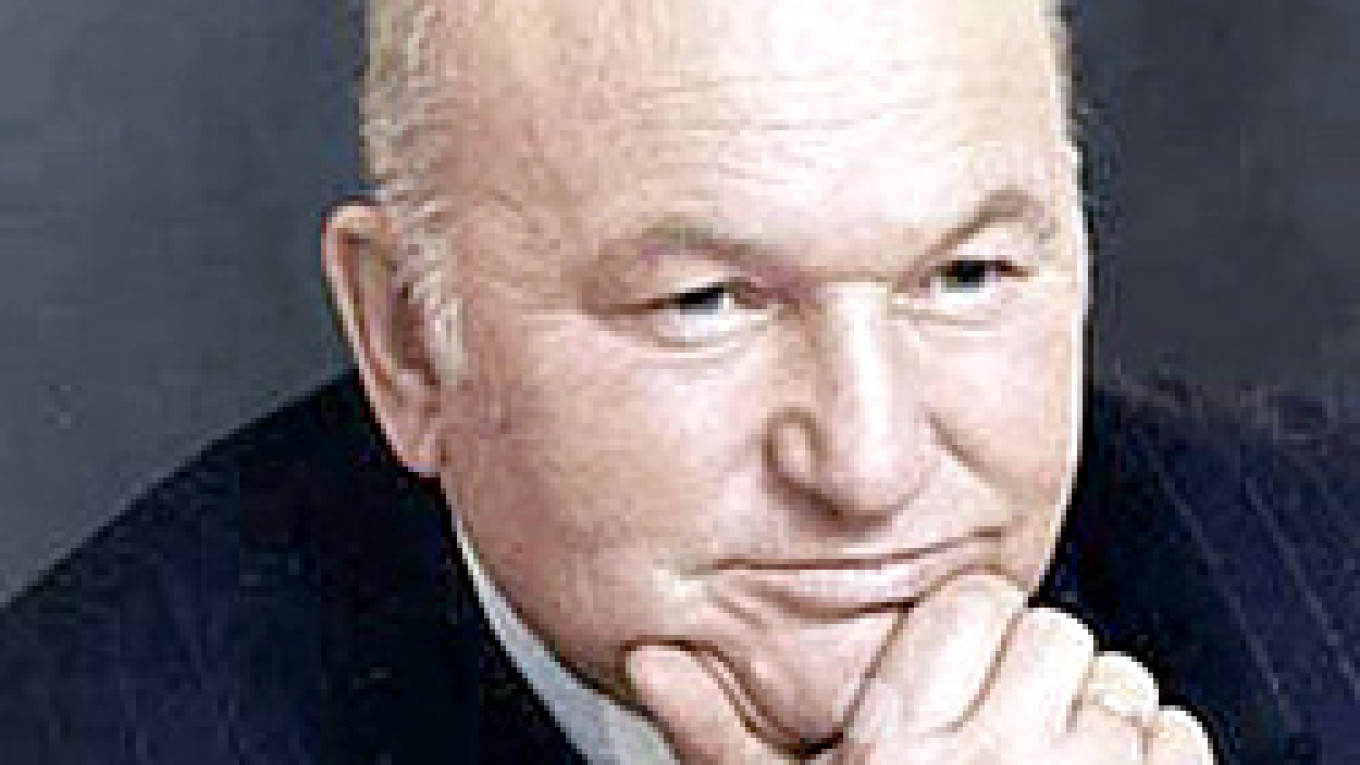
Luzhkov, like many Russian politicians before him, has a thing for literature. He has published almost a dozen books on various social and historical topics. One of them was "The Development of Capitalism in Russia," which criticized Russia's course of development in the post-Soviet era; another was "The Way to an Efficient State," a detailed proposal for refurbishing the Russian government. Somewhat more interesting for the general reader may be "The Mayor and About the Mayor," co-written by Luzhkov with his biographer, Mikhail Shcherbachenko. Besides the usual facts and interviews, the book contains three short stories by the mayor -- apparently his first public foray into fiction.
Luzhkov has also been the subject of several books. Some of them came out in the late 1990s, when he was considered a potential successor to then-President Boris Yeltsin. Newer volumes have been more critical, and thus more informative. In 2005, the historian Roy Medvedev released "Yury Luzhkov's Moscow Model," an attempt to explain the mayor's complex relationship with the city, while political analyst Alexei Mukhin gave us "Yury Luzhkov and the System of Moscow Oligarchs," a kind of who's who about business and political life in the Russian capital.
While Luzhkov is no longer seen as a serious contender in national politics, his grip on Moscow remains firm, and "On Love..." is a sign of his independence. The gist of the book is that the current crisis in Russian-Georgian relations is just a glitch. Our two nations have always loved and respected each other; it's the politicians who squabble, while regular people still love Georgian food and folk songs. To emphasize the point, the book was translated into Georgian and issued as a bilingual edition, with pictures by the Georgian artist Niko Pirosmani as illustrations.
It's hard to know what to make of "On Love..." It might be a disguised apology on behalf of the federal authorities, a face-saving gesture of sorts; but the fact that Luzhkov is serving as its vehicle, and the even stranger fact that he delivered his message through literature, both show how difficult it is to make clear political interpretations these days.
A Message from The Moscow Times:
Dear readers,
We are facing unprecedented challenges. Russia's Prosecutor General's Office has designated The Moscow Times as an "undesirable" organization, criminalizing our work and putting our staff at risk of prosecution. This follows our earlier unjust labeling as a "foreign agent."
These actions are direct attempts to silence independent journalism in Russia. The authorities claim our work "discredits the decisions of the Russian leadership." We see things differently: we strive to provide accurate, unbiased reporting on Russia.
We, the journalists of The Moscow Times, refuse to be silenced. But to continue our work, we need your help.
Your support, no matter how small, makes a world of difference. If you can, please support us monthly starting from just $2. It's quick to set up, and every contribution makes a significant impact.
By supporting The Moscow Times, you're defending open, independent journalism in the face of repression. Thank you for standing with us.

Remind me later.