

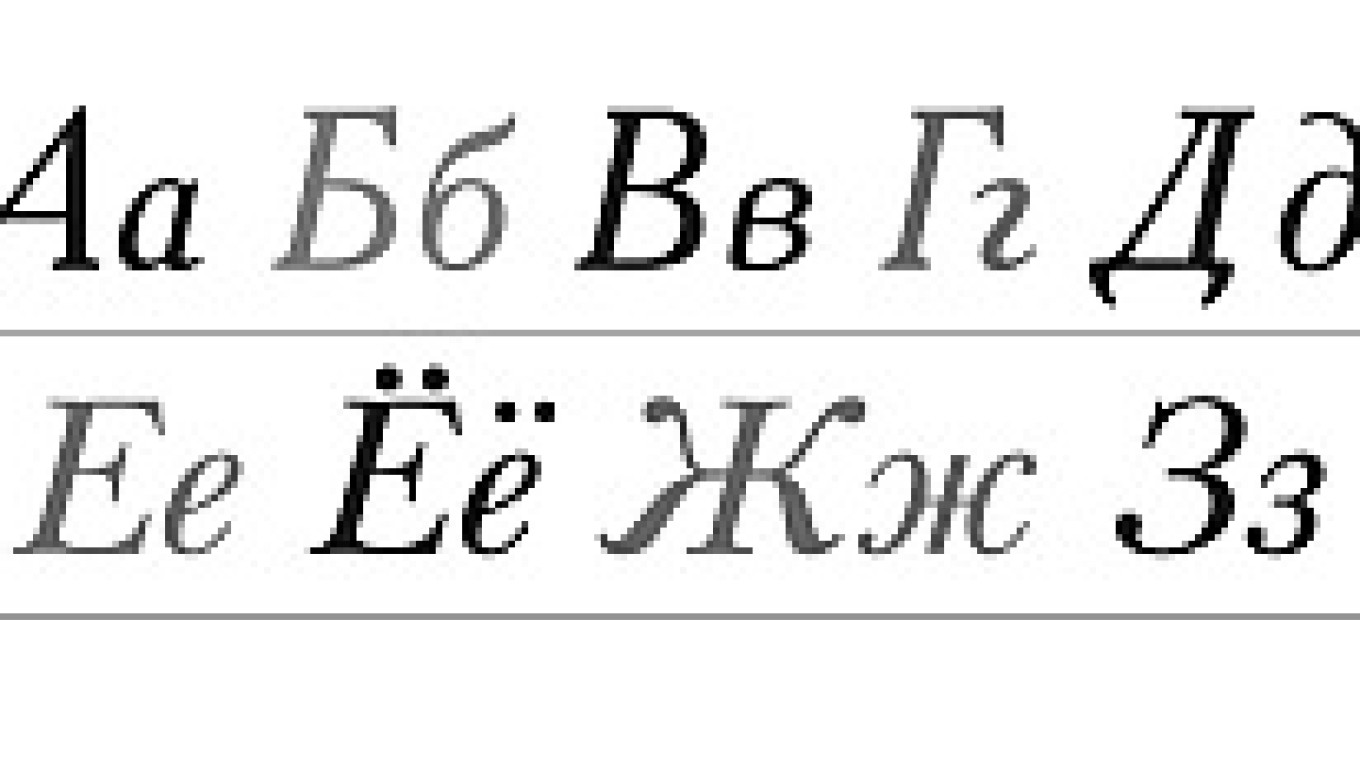
I have always been baffled by the problems Westerners seem to have with Cyrillic. More than once, I've heard confessions to the effect that "I wanted to learn Russian, but then remembered that it used Cyrillic, and it freaked me out." Perhaps Russians are cured from ABC-phobia of the opposite kind by early exposure to Latin letters, if not in foreign languages, then at least in mathematical equations. Latin and Cyrillic, sharing common roots, differ very little, especially compared with other alphabet-based languages, such as Georgian, Armenian, Hebrew or Arabic. And if you look at modern car license plates in Russia, you'll notice that they don't have any of the "freakish" Cyrillic letters, being limited to the rather numerous signs that the two alphabets have in common.
That being said, Russia is not very friendly to Cyrillic-challenged visitors, even in large cities like Moscow or St. Petersburg. English translations on Moscow's street signs are inconsistent and sometimes misleading, and most signs on the Moscow Ring Road do not have any Latin letters at all, which makes it practically impossible for a foreign motorist to navigate (I can make out Greek letters, but I had a similar problem in Greece, because reading semi-familiar script at 100 kilometers per hour is not exactly a breeze). Sometimes, officials do not have English versions of their business cards, which makes the whole thing rather decorative for their guests from abroad.
Russians differ in their degree of attachment to the Cyrillic alphabet. Ten years ago, when the Internet was in its infancy, I used to correspond via e-mail with my Russian friends abroad in fluent Latin-based Russian, since Cyrillic text would often get garbled on its way. Some people found this preposterous and turned to stilted English instead, which, in turn, seemed preposterous to me. I still write text messages on my cell phone in Latin letters, even though it's fully Cyrillic-enabled -- I just don't see any significant difference. It's only a script.
For Western visitors coming to a "Cyrillic" country -- namely, Russia, Ukraine, Belarus, Serbia, Macedonia, Montenegro, Bulgaria or the Central Asian nations, where the alphabet is a leftover from Soviet days -- I would recommend spending a couple of days to master the script. Apart from steeping oneself in a millennium-long tradition, it will make the practical aspects of getting around and finding one's way a good deal easier.
A Message from The Moscow Times:
Dear readers,
We are facing unprecedented challenges. Russia's Prosecutor General's Office has designated The Moscow Times as an "undesirable" organization, criminalizing our work and putting our staff at risk of prosecution. This follows our earlier unjust labeling as a "foreign agent."
These actions are direct attempts to silence independent journalism in Russia. The authorities claim our work "discredits the decisions of the Russian leadership." We see things differently: we strive to provide accurate, unbiased reporting on Russia.
We, the journalists of The Moscow Times, refuse to be silenced. But to continue our work, we need your help.
Your support, no matter how small, makes a world of difference. If you can, please support us monthly starting from just $2. It's quick to set up, and every contribution makes a significant impact.
By supporting The Moscow Times, you're defending open, independent journalism in the face of repression. Thank you for standing with us.

Remind me later.