

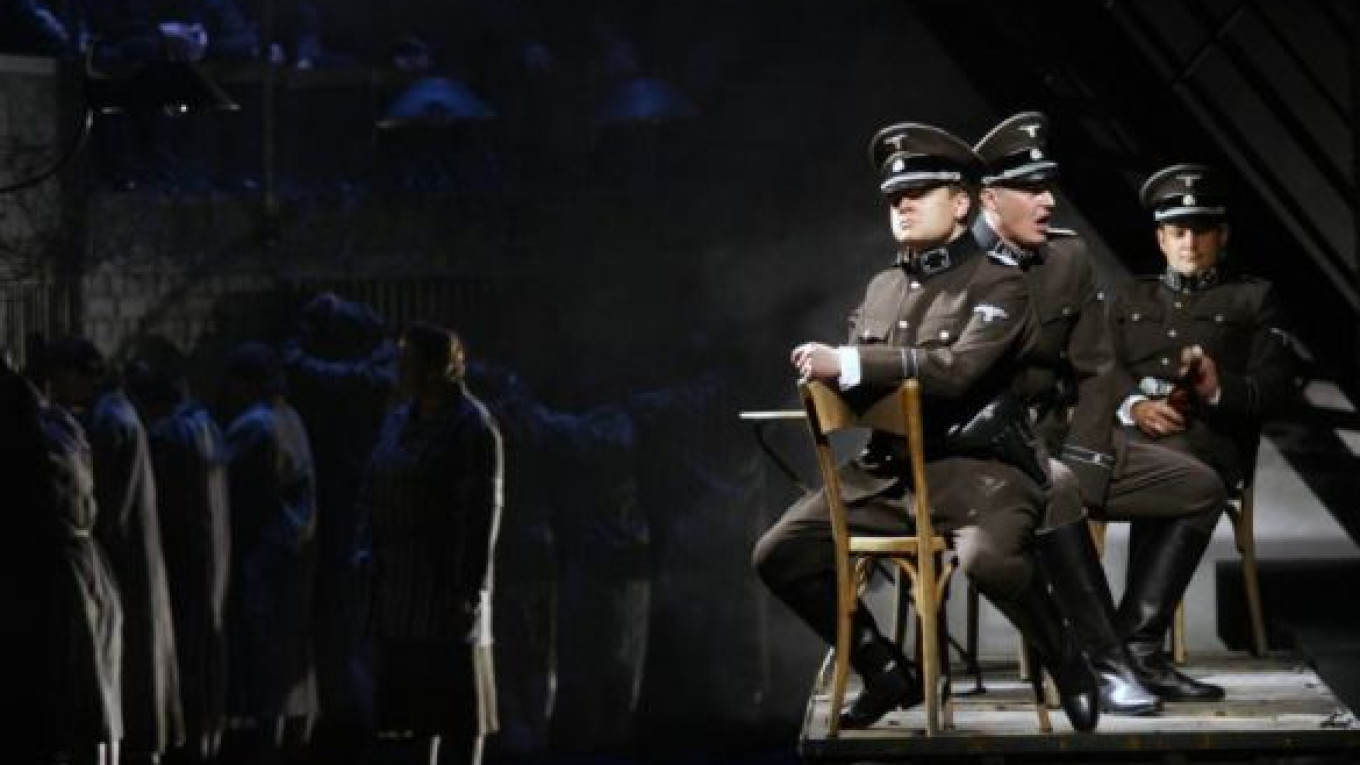
Austria’s annual music festival in Bregenz recently hosted a premiere of renowned Soviet composer Mieczyslaw Weinberg’s rarely staged opera “The Passenger,” about a former German guard at the Auschwitz concentration camp.
The highlight of the Bregenz festival has traditionally been the famous “opera on the lake,” where up to 7,000 spectators seated in the lake’s amphitheater can enjoy the show on water. “Aida” was again chosen for this year’s festival grandstand performance, but just as important was the attention given to Weinberg, as an international symposium was organized in memory of the Soviet composer.
Born in Warsaw, Weinberg ended up in the Soviet Union after fleeing Poland in 1939 following the Nazi invasion. His father was the director of the Jewish Theater in Poland, and most of his family died in the Holocaust. He has been described as the third great Soviet composer, after Shostakovich and Prokofiev.
Indeed, Shostakovich was one of Weinberg’s close friends and once admitted that he would have been happy if he had written “The Passenger.”
A series of concerts of Weinberg’s symphonic and chamber music was performed at Bregenz as well as his opera “Portrait,” based on a Gogol story, but the main event was without doubt “The Passenger,” based on Polish journalist Zofia Posmyz’s novel of the same title.
In 1960, onboard a ship sailing to South America, Lisa, the wife of a German diplomat (played by South African mezzo-soprano Michelle Breedt) and a former SS servicewoman, meets her shadow from the past — an Auschwitz prisoner named Marta (played by Elena Kelessidi, a Greek born in Kazakhstan). Her attempts to explain her past to her husband (German-born Italian Roberto Sacca) are presented through choir music and scenes from prison life.
“The Passenger” was written in the late 1960s, but had little chance of being shown in the Soviet Union because it depicts the controversial subjects of “execution” and “victims,” which Russians so rarely speak about. It was staged for the first time only in 2006 in Moscow.
Before the show, Weinberg’s librettist Alexander Medvedev met up with Posmyz and even traveled with her to Auschwitz, where she was held captive for three years. Weinberg’s co-author also met with British director David Pountney during rehearsals.
Initially, Posmyz never believed that it would be possible to portray Auschwitz through musical drama. However, South African artist Johan Engels creatively devised a flexible stage to effectively switch between the ship and the prison camp, by splitting up the two settings horizontally on a black-and-white plane. The passengers on the white ocean liner above were thus contrasted with the SS guards and inmates within the gloomy world of the concentration camp below. Both settings were united by the chorus, seated on the roof of a boxcar.
Pountney, who is generally known for his personal adaptations of literary works, decided not to greatly alter this opera’s script, simply translating the work into German.
Shortly before his death, Weinberg jokingly told his librettist that he had never actually seen any of their collaborative works staged. Medvedev then promised to watch the premiere of their opera “for the both of them.” Unfortunately, he too passed away — in Moscow, at the age of 84 — just before the Austrian premiere of “The Passenger.”
A Message from The Moscow Times:
Dear readers,
We are facing unprecedented challenges. Russia's Prosecutor General's Office has designated The Moscow Times as an "undesirable" organization, criminalizing our work and putting our staff at risk of prosecution. This follows our earlier unjust labeling as a "foreign agent."
These actions are direct attempts to silence independent journalism in Russia. The authorities claim our work "discredits the decisions of the Russian leadership." We see things differently: we strive to provide accurate, unbiased reporting on Russia.
We, the journalists of The Moscow Times, refuse to be silenced. But to continue our work, we need your help.
Your support, no matter how small, makes a world of difference. If you can, please support us monthly starting from just $2. It's quick to set up, and every contribution makes a significant impact.
By supporting The Moscow Times, you're defending open, independent journalism in the face of repression. Thank you for standing with us.

Remind me later.