

Drama in the last decade has steadily held its position as the most experimental and challenging of all the art forms in Russia. Topics are raised and forms are explored that no other genres are willing or able to take on.
Yet there are places where even the upstarts of Russian drama have not gone.
Enter Mikhail Ugarov and Teatr.doc, where a team of actors and directors has staged the boldest production I may have seen in my 22 years in Russia.
“One Hour Eighteen” is a brief, understated look at one of the Russian government’s most shameful incidents of the last year — the death in prison of lawyer Sergei Magnitsky last November.
Ugarov, who supervised the creation of “One Hour” and compiled the text from documentary sources with Yelena Gremina, told me a week before the opener that the play would “name names and blame perpetrators.”
“Let them sue us if they want,” he added.
Ugarov added that everyone working on the production did so for free. No fees, no salaries were paid. The theater charges no admission for the performances.
“This way no one can accuse us of doing anyone’s bidding,” Ugarov explained.
Magnitsky, a 37-year-old attorney, was being held in Moscow’s Butyrka prison pending his trial on charges of tax fraud. His arrest came after he had, for an extended period, made declarations about tax irregularities involving government officials. And his mysterious death took place just days before, by law, the state was obliged either to open his trial or release him.
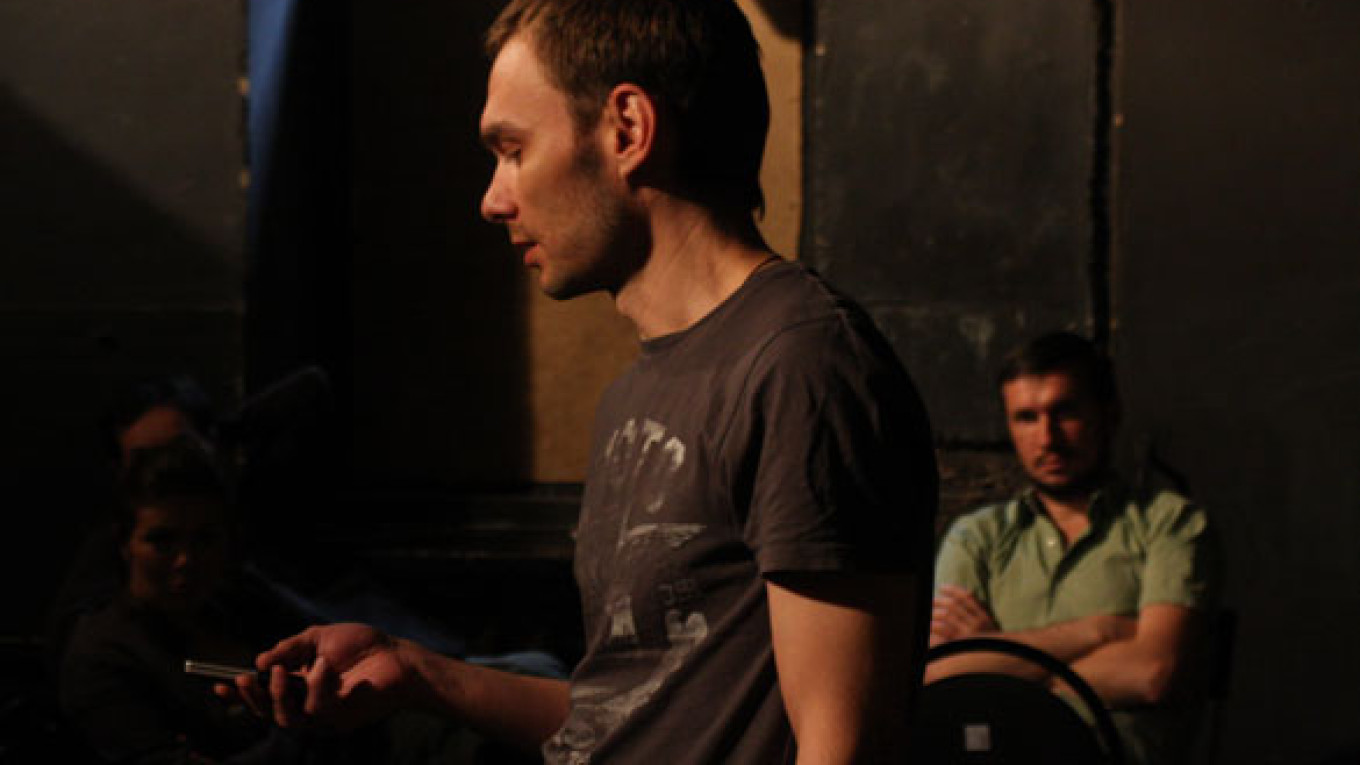
Ugarov spread 10 monologues among nine actors playing Magnitsky’s mother, doctors, a detective, judges and other participants and bystanders.
Only one has the opportunity to speak twice — Judge Alexei Krivoruchko, who once refused to let Magnitsky have a cup of hot water because “it was not his job” to do so. In Ugarov’s vision, this judge after death finds himself in need of a cup of hot water, too. But when he appeals for help to the audience, no one responds.
“One Hour Eighteen” — that is the amount of time that Magnitsky was left alone by doctors to die — is only minimally theatrical. There are the scenes of Krivoruchko in “the other world,” and there is the device of having each character, upon taking the stage, demand that the audience read instructions to the performance that were handed out in advance.
Probably the subtlest theatrical twist is Ugarov’s use of the audience. Repeatedly characters appeal to spectators for help and understanding, and repeatedly, of course, they receive nothing but stone cold gazes.
But most of the show involves people merely telling their side of the story.
The narrative of Magnitsky’s incarceration and death is a matter of public record. It is one of few such scandalous events to actually get attention from the Kremlin.
President Dmitry Medvedev ordered an official investigation, and an independent committee also researched the case. Consequences included 20 officials losing their jobs and the institution of a new law protecting suspects of tax evasion.
But as “One Hour Eighteen” suggests, the horror of Magnitsky’s case goes beyond state incompetence or even criminal culpability. More important, it involves the total indifference of individual human beings when confronted with the suffering of a fellow human.
Krivoruchko refused to give a sick man a glass of hot water. Throughout Magnitsky’s 12 months in prison, detective Oleg Silchenko refused to let the prisoner have proper medical attention.
But what about the doctor who discovered that Magnitsky was suffering from pancreatitis, but instead of ordering treatment, left him to eight prison guards who handcuffed him and put him in isolation?
What about the young woman in the ambulance that transported Magnitsky from the Butyrka prison to the Matrosskaya Tishina prison while it is possible that the prisoner was in the process of dying?
She blithely assures us that she knew nothing and none of this has anything to do with her.
That, of course, is the crux of Ugarov’s production. He wants to ask us — and anyone within earshot — do you, too, have nothing to do with this heinous event? What have you been silent about recently?
The premiere of “One Hour Eighteen” comes at an auspicious time. Two weeks ago, rock musician Yury Shevchuk took the opportunity at a meeting with Prime Minister Vladimir Putin to ask some hard, public questions.
Now Mikhail Ugarov and Teatr.doc have posed the harshest, most pointed questions I remember encountering in a Russian theater.
“One Hour Eighteen” (Chas Vosemnadtsat) plays Fri. at 8 p.m. and Sat. at 7 p.m. at Teatr.doc, located at 11/13 Tryokhprudny Pereulok. Metro Pushkinskaya. To reserve seats, call 8 (926) 018-4468. Running time: 45 minutes.
A Message from The Moscow Times:
Dear readers,
We are facing unprecedented challenges. Russia's Prosecutor General's Office has designated The Moscow Times as an "undesirable" organization, criminalizing our work and putting our staff at risk of prosecution. This follows our earlier unjust labeling as a "foreign agent."
These actions are direct attempts to silence independent journalism in Russia. The authorities claim our work "discredits the decisions of the Russian leadership." We see things differently: we strive to provide accurate, unbiased reporting on Russia.
We, the journalists of The Moscow Times, refuse to be silenced. But to continue our work, we need your help.
Your support, no matter how small, makes a world of difference. If you can, please support us monthly starting from just $2. It's quick to set up, and every contribution makes a significant impact.
By supporting The Moscow Times, you're defending open, independent journalism in the face of repression. Thank you for standing with us.

Remind me later.