

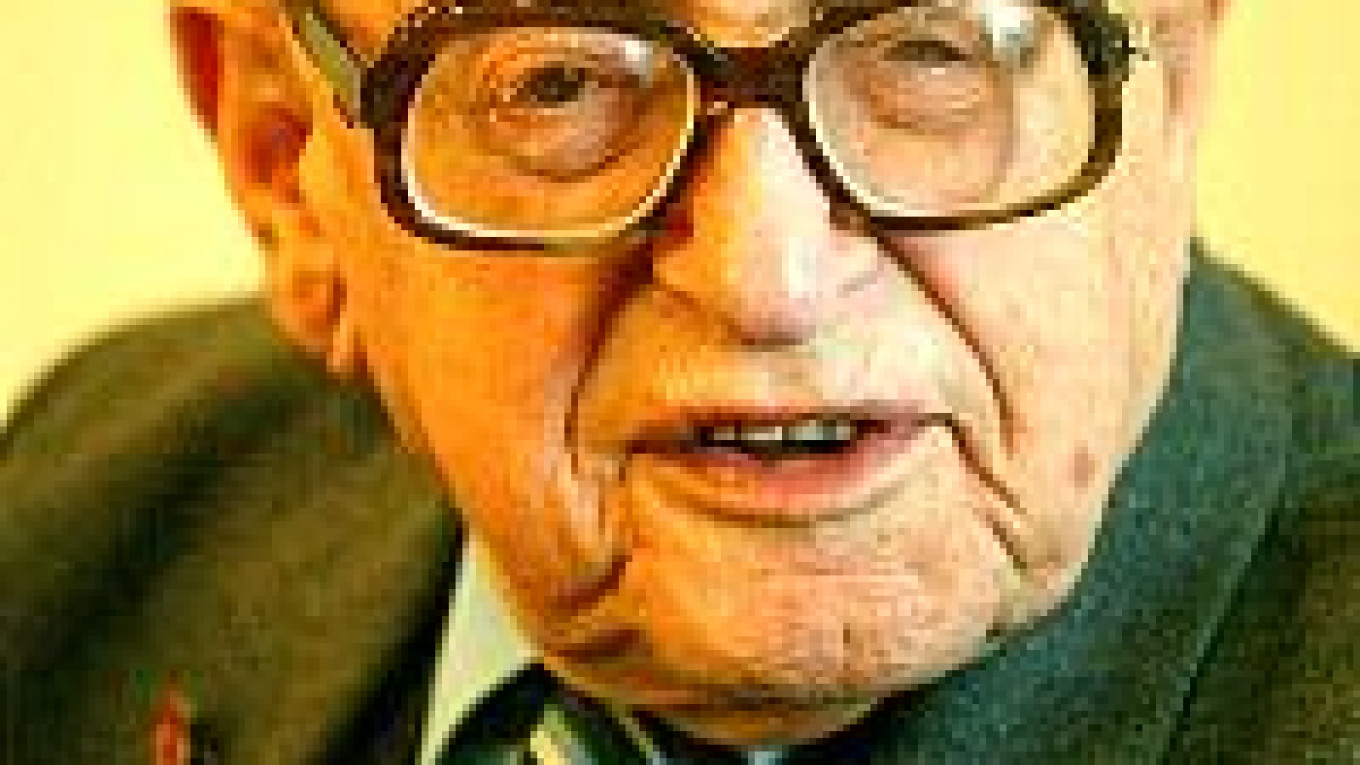
Yefimov, the Soviet Union's most celebrated political cartoonist, had a front seat on the roller coaster of the 20th century. No wonder he thanked God when he opened his eyes on his 102nd birthday Saturday.
At a news conference Friday, the spry, diminutive Yefimov gleefully recounted how he fought the Nazis with laughter and fired irony at the Americans during the Cold War. He paid tribute to the memory of his brother, journalist Mikhail Koltsov, who was shot by a firing squad during Stalin's Terror. And he lamented the death of his art in an increasingly chaotic world, where enemies are harder to define and thus harder to mock.
Peppering his stories with a poem and a song performed in his booming voice, Yefimov made it clear that after more than a century he is still enchanted by the business of living. As to the secret of his longevity, he said he has no idea -- though the former atheist admitted that lately he has taken to crediting a higher power.
"Every day when I get up, I thank God," he said.
A Jew and a supporter of Stalin's enemy Leon Trotsky, Yefimov might have shared his brother's fate were it not for Stalin's appreciation of his art. His first encounter with the leader came in 1937, at the height of the purges.
On Friday, he recalled a late-night call from Pravda editor Lev Mekhlis.
Mekhlis asked him to come in to the office so he could give him a message "from him."
"There was no need to say which 'he,"' Yefimov said. "There was only one 'he' with a capital 'h."'
At a meeting the next day, Mekhlis conveyed Stalin's concern.
"'He noticed that when you draw Japanese samurai, you always draw them with big teeth sticking out,"' Yefimov quoted Mekhlis as saying. "'Well, he said you shouldn't do that because it insults the dignity of every Japanese person.'
"I said, 'OK, no more teeth.'"
Ten years later, the phone rang again. This time it was the Communist Party's Central Committee, instructing him to come in to see Politburo member Andrei Zhdanov.
Zhdanov described a cartoon Stalin wanted as one of the first strikes in the Cold War. In Stalin's vision, U.S. General Dwight Eisenhower arrives at the North Pole with an army. An ordinary American asks, "What's going on, General? Why such military activity in such a peaceful place?" Eisenhower answers, "Can't you see the Russian threat is looming here?"
The following afternoon, as Yefimov was working on the assignment, he got another call. It was Stalin himself, wanting to make sure that Eisenhower was depicted "armed to the teeth." He then asked when the cartoon would be finished. Before Yefimov could answer, Stalin said, "We need it today by 6 o'clock," and hung up.
"And I still had a whole day's worth of work to do on it. I thought, that's it. I'm dead," Yefimov recalled. "But miracles happen, and can you imagine, I finished it at 6 o'clock on the dot."
Yefimov has acknowledged ambivalence about his role as a dictator's helper, but expresses great pride in the historic role of his profession.
"To a certain extent, cartoons were weapons," he said.
But those days are gone. "It's a new era, my dear comrades," Yefimov said. "The situation in the world and in our country is too complicated to approach it so primitively."
Cartoons of Osama bin Laden would not work the way a World War II caricature of Adolf Hitler did, Yefimov said. "He's not the kind of figure you can hurt with cartoons. He would just laugh at us: 'I throw bombs at them, and they answer with cartoons.'"
In some ways, life in modern Russia exceeds all the terrors of the last century, Yefimov said.
"In the worst time of Stalin's Terror, when ... no one could be sure that they wouldn't come for you during the night and you would disappear without a trace -- even then at least when you woke up in the morning and nobody had come for you, you knew you were safe."
But even bad times are worth living through, Yefimov said. "I won't say that it's pleasant, but a person should experience everything. It's not good to always be lucky."
A Message from The Moscow Times:
Dear readers,
We are facing unprecedented challenges. Russia's Prosecutor General's Office has designated The Moscow Times as an "undesirable" organization, criminalizing our work and putting our staff at risk of prosecution. This follows our earlier unjust labeling as a "foreign agent."
These actions are direct attempts to silence independent journalism in Russia. The authorities claim our work "discredits the decisions of the Russian leadership." We see things differently: we strive to provide accurate, unbiased reporting on Russia.
We, the journalists of The Moscow Times, refuse to be silenced. But to continue our work, we need your help.
Your support, no matter how small, makes a world of difference. If you can, please support us monthly starting from just $2. It's quick to set up, and every contribution makes a significant impact.
By supporting The Moscow Times, you're defending open, independent journalism in the face of repression. Thank you for standing with us.

Remind me later.