

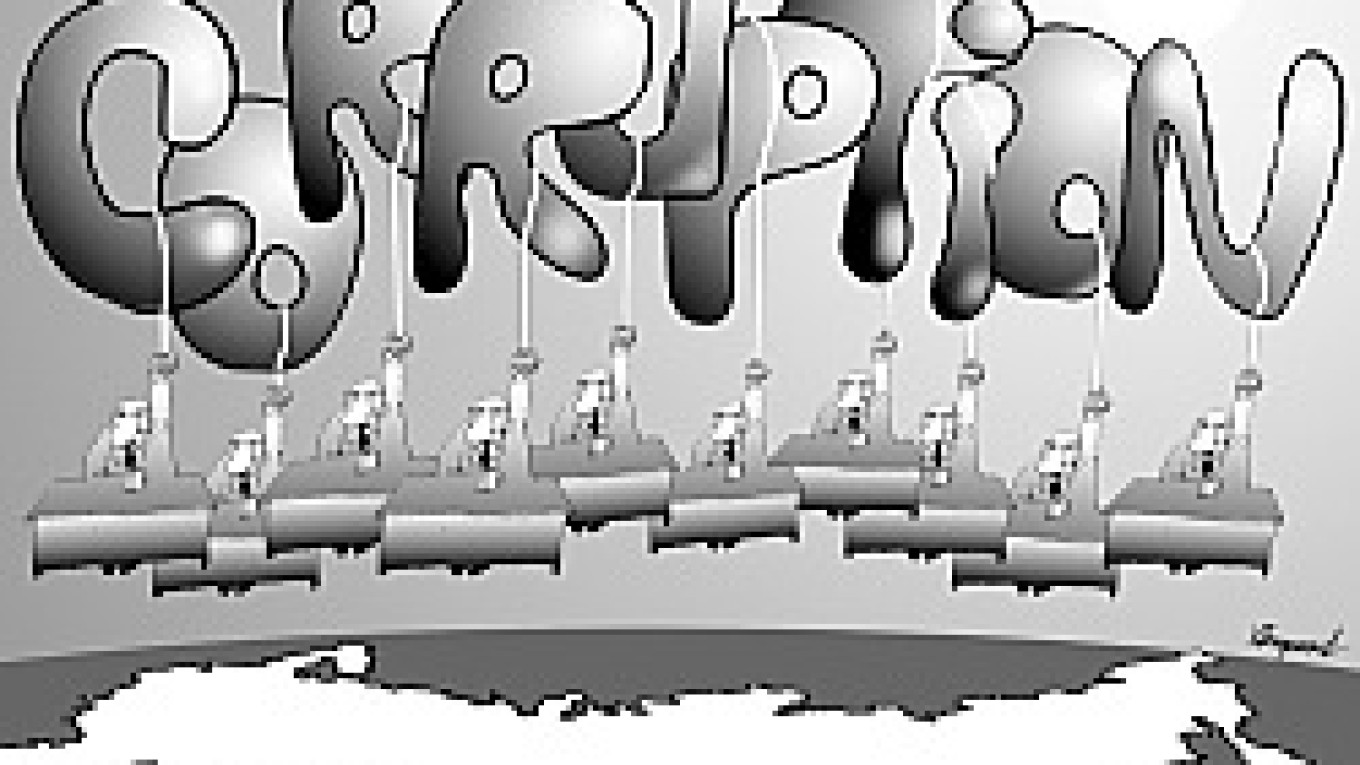
As part of his anti-corruption program, President Dmitry Medvedev introduced a number of bills to the State Duma in late 2008. According to the original plan, the law was supposed to come into force in 2009, but instead it has been extended to 2010 (perhaps to give top bureaucrats enough time to organize the transfer of assets to offshore locations?). Unfortunately, this extension shows that the country's privileged class of bureaucrats is quite effective in lobbying their interests to the president.
In March, Medvedev submitted a public declaration of his personal income and property as well as those of his family members. It goes without saying that other top officials were bound to follow suit. Members of the government, the president's administration and regional governors also submitted declarations. This is an important first step in the anti-corruption campaign.
 | To Our Readers |
The Moscow Times welcomes letters to the editor. Letters for publication should be signed and bear the signatory's address and telephone number. |
There is a large loophole, however, that needs to be addressed. According to Medvedev's anti-corruption plan, officials only need to declare the income and property of themselves, their wives and their underage children. They don't have to declare the income or property of their adult children -- to whom they can easily transfer ownership of their assets.
Another problem in the declarations that we have seen so far is that public officials clearly did not declare all of their wealth. After all, many of them are directors of leading state-owned companies and receive bonuses that alone are valued at millions of dollars. These officials, who earn salaries on a par with Russia's most successful businesspeople, are "oligarchs" in the public perception. This is one reason why the public reacted to these declarations with sarcasm and a sense of hopelessness. Most saw Medvedev's move as a deceptive PR attempt to create the impression that leaders are fighting corruption.
For Medvedev's declaration campaign to work, he needs to institute a strict audit system and impose punishments for false reporting. Of course, everyone understands that such a mechanism can work only if there political competition and an active civil society.
An active independent media is also a very important weapon in the anti-corruption battle. Recall Decree No. 810, which President Boris Yeltsin signed in 1996. The decree mandated that after a media outlet submitted a corruption allegation to the Prosecutor General's Office, an investigation had to be completed within 10 working days with a full written report returned to the media outlet that initiated the claim. Unfortunately, then-President Vladimir Putin annulled this decree in 2001. As a result, investigative journalists today can still largely write about corruption cases, but they have little power to pressure law enforcement agencies to prosecute corrupt officials. This is one reason that there is no risk to the reputation of bureaucrats who engage in corruption.
Many Russians believe that there is no hope of ever curbing corruption in the bureaucracy, mistakenly attributing it to an incorrigible national character. But I don't agree with this assertion. Take, for example, Finland, which was part of the Russian Empire for nearly a century. If this cultural explanation were correct, Russia's "culture of corruption" would have infected Finland as well. But according to ratings by Transparency International, Finland has consistently been at the top of the organization's rankings in terms of the least corrupt countries in the world.
Since 1991, small and medium-size businesses have been complaining about how corruption suffocates their enterprises. Even the economic crisis has not decreased the level of bureaucratic corruption. But this is not sufficient for small businesses to unite to promote their interests in a civilized way. Instead, they hope that someone else should fight bureaucracy on their behalf.
Society needs to support Medvedev's anti-corruption initiatives regardless of their initial imperfections. To his credit, the president made an important step when he published his own income and property declaration.
Russian society has no choice but to use the chance it has been given. If corruption continues to grow at the same pace it has for the past eight years, Russia's basic government institutions and civil society will soon be completely destroyed.
Kirill Kabanov is chairman of the National Anti-Corruption Committee, a Moscow-based nongovernmental organization.
A Message from The Moscow Times:
Dear readers,
We are facing unprecedented challenges. Russia's Prosecutor General's Office has designated The Moscow Times as an "undesirable" organization, criminalizing our work and putting our staff at risk of prosecution. This follows our earlier unjust labeling as a "foreign agent."
These actions are direct attempts to silence independent journalism in Russia. The authorities claim our work "discredits the decisions of the Russian leadership." We see things differently: we strive to provide accurate, unbiased reporting on Russia.
We, the journalists of The Moscow Times, refuse to be silenced. But to continue our work, we need your help.
Your support, no matter how small, makes a world of difference. If you can, please support us monthly starting from just $2. It's quick to set up, and every contribution makes a significant impact.
By supporting The Moscow Times, you're defending open, independent journalism in the face of repression. Thank you for standing with us.

Remind me later.