

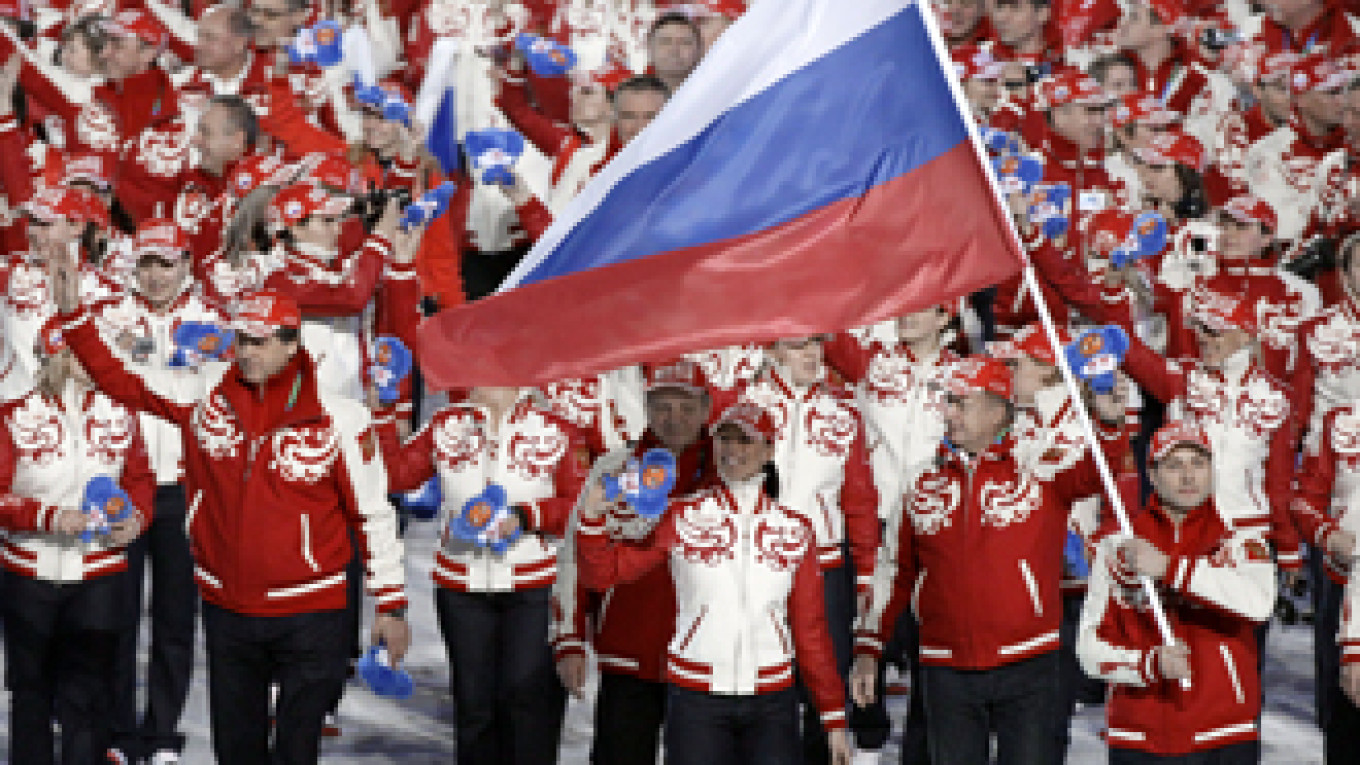
Russia expects to take home at least 30 medals from the Vancouver Winter Olympics, but its athletes, whose cash incentive has tripled this year, may face doping scandals during and after the games.
Prime Minister Vladimir Putin was scheduled to address the Olympic team Thursday night from Sochi, which is preparing to host the next Winter Games, in 2014. The opening ceremony starts at 5 a.m. Saturday in Moscow, which is 11 hours ahead of Vancouver.
"Unlike in Turin, we have a wider competitive advantage — we have 179 athletes, compared with [178] in Turin. We will participate in 77 of the 86 events, and we will compete for top places in 30 to 35 events," Vitaly Mutko, minister of sports, tourism and youth policy, said Wednesday. "Our forecast is to occupy positions from 1 to 5 in 30 events."
He declined to be any more specific. But the Izvestia newspaper reported last week that sports officials wanted to capture 30 medals, including seven to 11 golds.
"These obligations were made by sports federations, not by us," Vladimir Vasin, vice president of the Russian Olympic Committee, told Vedomosti last week. "They would be the one to ask about which medals they want to win. We can only guess."
The Russian team placed fourth in the gold-medal count during the 2006 Winter Olympics in Turin, Italy, with eight golds, as well as six silver and eight bronze medals. The top three gold-medal finishers were Germany (11), the United States and Austria (nine each). Germany also won the total count, with 29 medals, trailed by the United States (25), Canada (24), Austria (23) and Russia (22).
Leonid Tyagachyov, president of the Russian Olympic Committee, told the Rossia television channel last week that the team would improve on its result in Vancouver.
"Every sports federation … has its own goals," he said. "We think that 50 athletes from our team showed that they're ready to compete for medals based on their results in European and world cups."
The team is expected to win an average of 28 medals, according to a survey released by the Levada Center on Tuesday, which also found that 43 percent of the 1,600 polled believe that Russian athletes face prejudice at international competitions.
Seventy percent of Russians will watch the Olympics, according to another recent poll by VTsIOM, slightly higher than the 66 percent who said they were planning to watch the Turin Olympics.
Bookmakers are already taking bets on Russia's gold-medal haul, said Yury Kapus, manager of the FON bookmaking office. He said he was expecting six golds for Russia
The favorite winter sports for betting will be hockey and the biathlon, he said, adding that the time difference would mean a lot less betting this year.
Russian athletes will also be seeking to cash in on their performances like never before.
Gold medalists will get 100,000 euros ($137,000), while silver and bronze medalists will get 60,000 euros and 40,000 euros, respectively.
Tyagachyov said athletes could end up taking home in excess of $1 million, given contributions from other sources.
"If an athlete wins two gold medals during the Olympics, he will get a total of $1 million from the government, the sports federation, governors and companies," he said.
Russian champs will also get cars, said Alexander Abramov, an aide to President Dmitry Medvedev and vice chairman of the Support Foundation for Russian Olympians, which awards the main cash prizes. He would not specify the models.
In 2006, male champs got Toyota Land Cruisers and women were awarded Lexus SUVs. After the Beijing Summer Olympics, male and female winners got BMW X5s and BMW X3s, respectively.
Vasily Shestakov, who sits on the State Duma's Physical Fitness and Sport Committee, said that while Russia should do well in its traditional strengths — hockey, figure skating and the biathlon — the country needed to get serious about training a new generation of athletes.
“Officials have to work for a long time to achieve the level of the Soviet era," he said. “There are still trainers in children’s sports who are working for pennies. … Our sports officials should not just report how many medals we are going to get, but also face the problems more seriously."
The country is also dealing with major doping problems, even drawing criticism from International Olympic Committee chief Jacques Rogge earlier this week.
"We have alerted the Russian authorities, and we expect them to comply," Rogge told reporters. "I understand that people are worried by the numbers. It is absolutely legitimate to be worried. It is now important for the Russian authorities to respond with strong anti-doping actions."
All of Russia's Olympic athletes have passed doping tests, Alexander Derevoyedov, deputy head of national anti-doping regulator RUSADA, said Thursday. He said some athletes were tested five and even 10 times, especially those performing in the so-called "risk" events such as the biathlon, skiing and skating.
A scandal broke last week when Dave Wood, head coach of the Canadian cross-country ski team, said he wanted Russia banned from world cups and championships until its doping problem is solved.
Three-time Olympic champion Yulia Chepalova, as well as Turin winner Yevgeny Dementyev and another national team member, Nina Rysina, failed doping tests in January 2009.
Skier Alyona Sidko, a Turin bronze-medal winner, was disqualified for Vancouver last month after failing a test, and female hockey player Svetlana Tkachyova was facing disqualification for using a nasal spray with prohibited substances, but was later cleared of charges.
A total of thirty athletes from around the world will miss the Olympics for doping violations, World Anti-Doping Agency spokesperson Mark Adams said Thursday.
Doctors at the Federal Biomedical Agency, which carries out Russian doping tests on a national level, said last month that some athletes might fail tests once in Canada.
"Unfortunately, judging by the previous Olympics, you can't be sure that athletes who left this country clean behave properly there," Igor Vykhodets, an official with the agency, told RIA-Novosti last month.
Shestakov said Russia should work more closely with the World Anti-Doping Agency, particularly over paperwork. “When our sportsmen have a high level of hemoglobin, they often don’t have medical documentation, unlike athletes from other countries, and that creates problems,” he said.
Staff writer Alexander Bratersky contributed to this report.
A Message from The Moscow Times:
Dear readers,
We are facing unprecedented challenges. Russia's Prosecutor General's Office has designated The Moscow Times as an "undesirable" organization, criminalizing our work and putting our staff at risk of prosecution. This follows our earlier unjust labeling as a "foreign agent."
These actions are direct attempts to silence independent journalism in Russia. The authorities claim our work "discredits the decisions of the Russian leadership." We see things differently: we strive to provide accurate, unbiased reporting on Russia.
We, the journalists of The Moscow Times, refuse to be silenced. But to continue our work, we need your help.
Your support, no matter how small, makes a world of difference. If you can, please support us monthly starting from just $2. It's quick to set up, and every contribution makes a significant impact.
By supporting The Moscow Times, you're defending open, independent journalism in the face of repression. Thank you for standing with us.

Remind me later.