

Russia took 131st place out of 140 countries on the Global Peace Index, just below Colombia and above Lebanon, says the study, released late Monday. Iceland was named the most peaceful country, while Iraq came in last.
Several Moscow-based defense analysts questioned the objectivity of the study.
Russia scored low because of its high military spending, booming arms sales and poor relations with its neighbors, said the study, the brainchild of Steve Killelea, an Australian philanthropist and entrepreneur.
Also hitting Russia's ranking were "high scores for homicides, jailed population, distrust among citizens, violent crime" and a lack of respect for human rights, it said.
The study, which uses 24 criteria, was prepared by Killelea's Institute of Economics and Peace and the Economist Intelligence Unit.
While the study noted "increased stability in Chechnya," it pointed to Russia's "moderately tense" relations with its neighbors and extremely high arms exports.
"I am sure it's quite possible for Russia to improve," Killelea said by telephone from London, noting that Russia's ranking had improved a notch from last year, when the country ranked 118th out of 121 countries in the first-ever study.
Vladimir Filonov / MT
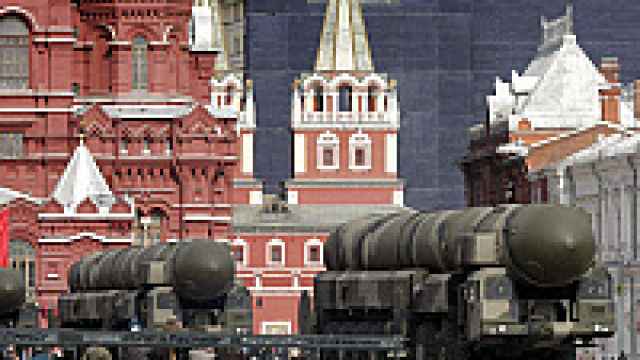
Missiles crossing Red Square on May 9. The index includes arms spending.
|  |
| |
Of the other global "military-diplomatic powers," two others also received poor marks, with the United States ranked at 97th and China at 67th, the report said. While European Union members each received a separate ranking, the EU collectively was ranked fourth, tying with New Zealand. Killelea said the poor U.S. ranking had caused "a lot of controversy" in the United States.
Defense analysts took issue with the study's conclusions. "There exists a huge number of misconceptions about Russia and other countries, and they are reflected here," said Ruslan Pukhov, director of the Center for Analysis of Strategies and Technologies, a think tank that tracks security challenges and Russia's arms trade. "There is no doubt that this ranking reflects an Anglo-Saxon outlook on things."
| ||||||||||||||||||||||||||||||||||||||||
Alexander Khramchikhin, a senior researcher at the Institute for Political and Military Analysis, said the methodology of these kind of studies baffled him.
"This has nothing to do with science," he said. "It has to do with ideology."
Russia tends to rank poorly in similar international studies, including in democracy, transparency, the environment and media freedom, to name a few.
Russian government officials have repeatedly complained that the studies are biased against Russia and do not reflect reality.
Russia's ties with its former Soviet neighbors have grown more strained in recent years, and the country has showed off its increased military might. During the Victory Day parade on May 9, tanks and nuclear-missile launchers rumbled over Red Square for the first time since the Soviet collapse, triggering suggestions of Russian saber-rattling.
Killelea rejected any accusation of bias in the latest report, saying the authors had used independent data and methodology.
He added that he had never visited Russia but that it was among the countries he hoped to see one day.
A Message from The Moscow Times:
Dear readers,
We are facing unprecedented challenges. Russia's Prosecutor General's Office has designated The Moscow Times as an "undesirable" organization, criminalizing our work and putting our staff at risk of prosecution. This follows our earlier unjust labeling as a "foreign agent."
These actions are direct attempts to silence independent journalism in Russia. The authorities claim our work "discredits the decisions of the Russian leadership." We see things differently: we strive to provide accurate, unbiased reporting on Russia.
We, the journalists of The Moscow Times, refuse to be silenced. But to continue our work, we need your help.
Your support, no matter how small, makes a world of difference. If you can, please support us monthly starting from just $2. It's quick to set up, and every contribution makes a significant impact.
By supporting The Moscow Times, you're defending open, independent journalism in the face of repression. Thank you for standing with us.

Remind me later.