

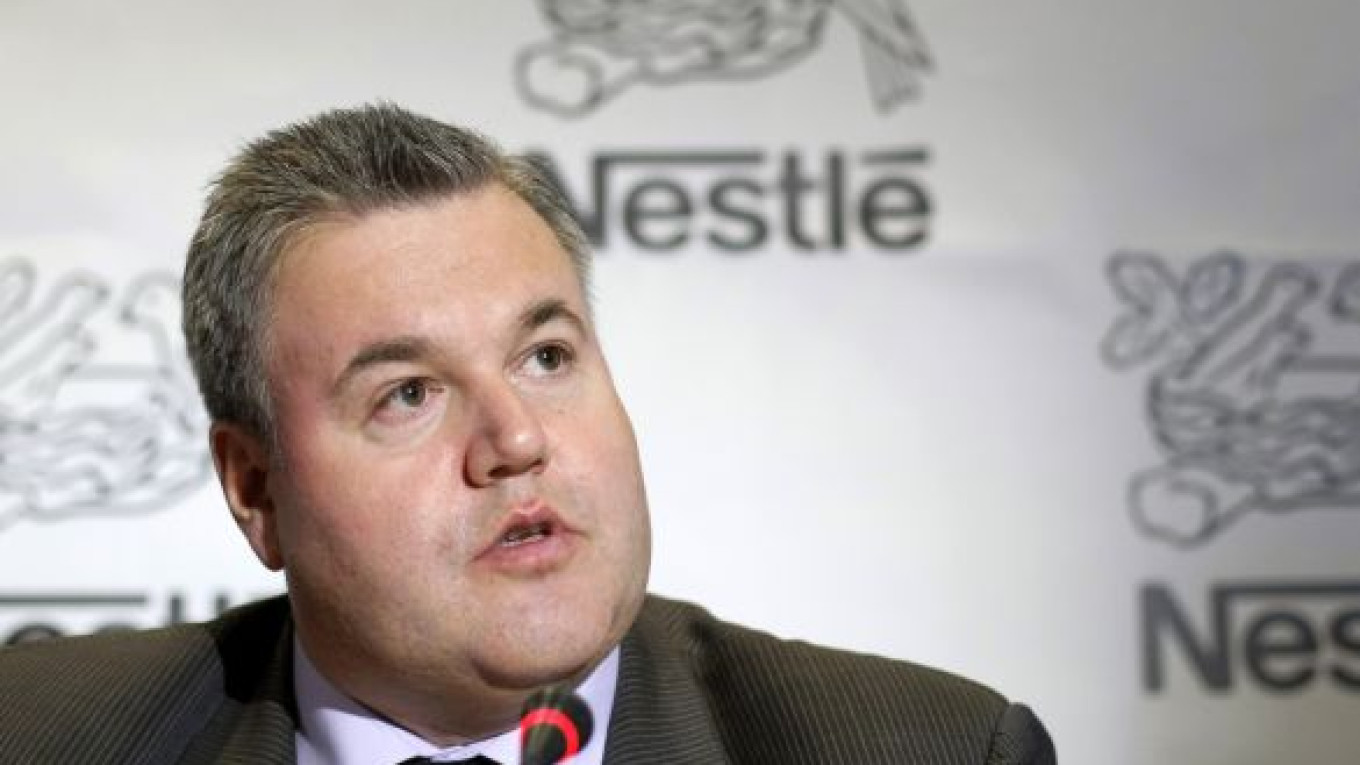
Nestle, the world’s largest food producer, saw its sales in Russia shoot up 12 percent last year despite a steep drop off in the food market, Stefan de Loecker, the company’s regional head, said Wednesday.
The Russian division's sales rose 12 percent in 2009 to 57 billion rubles ($1.9 billion), while sales in the Russia-Eurasia region reached 62.8 billion rubles, de Loecker told The Moscow Times.
As the company increases its presence on the Russian market, it is also pushing to further localize its production, he said in an interview.
“Ninety percent of the products we sell here are manufactured in Russia, and the remaining 10 percent are a large part of the focus for us,” he said in an interview. “Coffee factories are a big part of that, [and expanding our coffee capacities] will allow us to sell coffee produced in Russia and not import it any more.”
A coffee factory in the Krasnodar region, which will become the company's largest worldwide, will be finished in 2011, he said. Construction began last year on the factory, located near an existing one in Timashevsk, and will cost up to 7 billion rubles — the biggest project for the company since it entered the Russian market in 1994.
De Loecker forecast a partial recovery for sales in the food sector this year, which dropped off dramatically last year as cash-strapped consumers economized at the grocery store.
“My expectation is that the market is not going to be tougher than in 2009. This year is going to be a stabilization period,” he said. “I do not see factors why consumer demand will dramatically go up this year or why it will dramatically go down,” he said.
Nestle's Russian market share is 40 percent in the coffee segment, 25 percent in baby food, 50 percent in breakfast cereal and 43 percent in delicatessen. It currently operates 30 factories and nine sales offices countrywide, employing about 10,000 people.
The company is hoping to boost all of those numbers, however, as it focuses on extending existing production to keep up with the demand and investigates possibilities in other sectors, he said.
Last September, Nestle launched a new facility in the Kaluga region to produce Friskies pet food and inaugurated a factory to make breakfast cereals in Perm, spending a total of 2 billion rubles on both projects.
The company also expanded its Bystrov instant porridge production line, relocating it from St. Petersburg to Vologda, which cost more than 150 million rubles.
To consolidate the food giant's chocolate production, it will relocate its confectionery factory from Tuchkovo in the Moscow region to existing factories in Saratov and Perm by year-end, Nestle announced earlier this month.
“Obviously, the confectionary market has been affected in 2009, and there have been shifts in the product portfolio as such, and therefore we came up with a streamline to optimize the production in order to continue to have a developing business,” he said. “That’s why we decided to concentrate on two chocolate production sites instead of three.”
Nestle retained its 19 percent market share in the Russian chocolate market in 2009 as the segment shrank 9 percent countrywide, according to research by Business Analytica.
The future of the Tuchkovo site has not yet been decided on, but the factory's nearly 700 employees will get new jobs, he said.
The company grabbed headlines in October when regulators in the Samara region said a local Nestle factory was insolvent and demanded its liquidation.
The charges were dropped last December and Vyacheslav Koshin, head of the region's tax service, was charged last month with hindering legal entrepreneurial activities.
"We are obviously happy that the situation was cleared very quickly and we could continue with our operations," he said. “We were acting within the Russian legislation. The basis of the charge was a temporary issue due to currency volatility and not due to real threat to the operation."
A Message from The Moscow Times:
Dear readers,
We are facing unprecedented challenges. Russia's Prosecutor General's Office has designated The Moscow Times as an "undesirable" organization, criminalizing our work and putting our staff at risk of prosecution. This follows our earlier unjust labeling as a "foreign agent."
These actions are direct attempts to silence independent journalism in Russia. The authorities claim our work "discredits the decisions of the Russian leadership." We see things differently: we strive to provide accurate, unbiased reporting on Russia.
We, the journalists of The Moscow Times, refuse to be silenced. But to continue our work, we need your help.
Your support, no matter how small, makes a world of difference. If you can, please support us monthly starting from just $2. It's quick to set up, and every contribution makes a significant impact.
By supporting The Moscow Times, you're defending open, independent journalism in the face of repression. Thank you for standing with us.

Remind me later.