

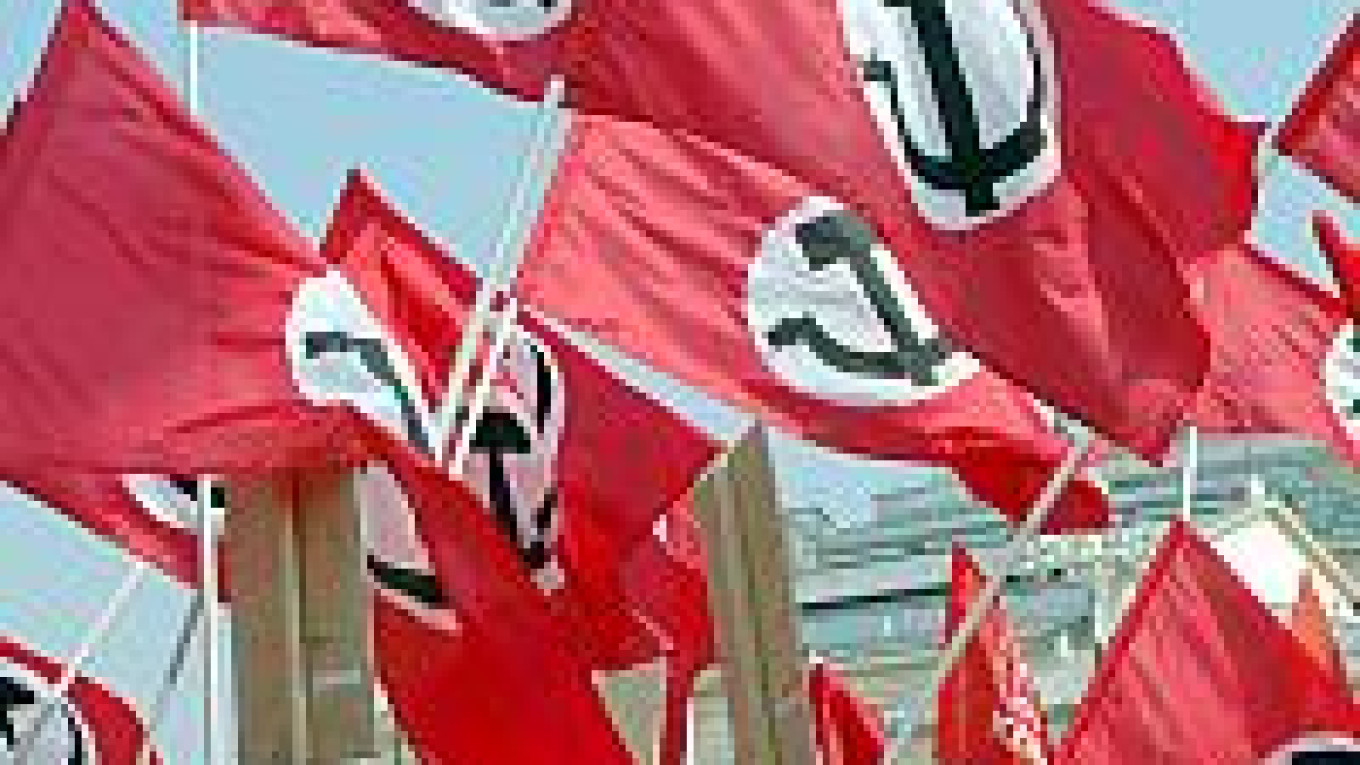
The court upheld a complaint by the Moscow region prosecutor's office, which cited several of the organization's documents and the fact that dozens of its members have been arrested and convicted on various charges in recent years as evidence that the group was extremist.
Prosecutors also accused the National Bolshevik Party of improperly representing itself as a political party, noting that the Justice Ministry had repeatedly refused to register it as a party.
National Bolshevik Party leader Eduard Limonov told the court during 15 months of hearings that the organization had asked the Justice Ministry to remove the word "party" from its name several times but the ministry refused on the grounds that there were mistakes in the documents that the group submitted.
Limonov said Wednesday that the verdict was the first time in 20 years that a political organization had been banned in Russia and that the organization would not disband. "We will work as before, and we intend to ignore the court decision because it contradicts the Constitution," he said, Interfax reported.
The National Bolshevik Party has earned notoriety for its audacious escapades directed against the authorities. Members have thrown food at senior officials, tried to seize federal buildings, and have hung huge posters on buildings in Moscow and St. Petersburg calling on President Vladimir Putin to resign.
Human rights activists and others have called the authorities' response excessive -- members are routinely beaten by police and, when prosecuted, handed maximum prison sentences.
Limonov told the court that 48 members were in custody as of mid-June. Limonov himself spent 2 1/2 years in prison on weapons charges.
Thirty-nine members are to go on trial Thursday on charges linked to the brief seizure of a presidential administration office in central Moscow in December. Earlier this month, police forcibly evicted the organization from its headquarters in southwestern Moscow.
Political analysts said the crackdown appeared to have the backing of the Kremlin, which is increasingly looking for the support of young people.
But the Kremlin, following Soviet-style organizational blueprints, is failing to attract young people into organizations such as Nashi, while Limonov, a controversial writer and talented speaker, has little problem finding youths eager to participate in his organization's theatrical-style activities, said Tatyana Stanovaya, an analyst with the Center for Political Technologies.
"Banning the National Bolshevik Party will backfire on the authorities," said Yury Korgunyuk, a political analyst with Indem. "As an underground organization, it will become even more attractive for politicized youth. It is also likely to become more radical."
A Message from The Moscow Times:
Dear readers,
We are facing unprecedented challenges. Russia's Prosecutor General's Office has designated The Moscow Times as an "undesirable" organization, criminalizing our work and putting our staff at risk of prosecution. This follows our earlier unjust labeling as a "foreign agent."
These actions are direct attempts to silence independent journalism in Russia. The authorities claim our work "discredits the decisions of the Russian leadership." We see things differently: we strive to provide accurate, unbiased reporting on Russia.
We, the journalists of The Moscow Times, refuse to be silenced. But to continue our work, we need your help.
Your support, no matter how small, makes a world of difference. If you can, please support us monthly starting from just $2. It's quick to set up, and every contribution makes a significant impact.
By supporting The Moscow Times, you're defending open, independent journalism in the face of repression. Thank you for standing with us.

Remind me later.