

MOSCOW / TBILISI, Georgia ?€”President Dmitry Medvedev ordered a halt to the Russian military operation in Georgia on Tuesday, saying troops had accomplished their mission of restoring safety to civilians and its peacekeeping forces in Georgia's breakaway republics of South Ossetia and Abkhazia.
Abkhaz separatists announced that they had taken the Kodor Gorge, the only district of Abkhazia under Georgian control.
In Tbilisi, Georgian President Mikheil Saakashvili painted the setbacks as a victory and told tens of thousands of rallying supporters that Georgia would leave the Commonwealth of Independent States.
Also, Georgia filed a lawsuit against Russia at the International Court of Justice for ethnic cleansing, and the prosecutor for the International Criminal Court said he was considering an investigation into the South Ossetia conflict.
Medvedev ordered Russian troops to step down just before a meeting with French President Nicolas Sarkozy, who flew to Moscow to mediate peace talks.
"I have decided to cease the operation to force Georgian authorities toward peace," Medvedev told Defense Minister Anatoly Serdyukov and the head of the armed forces' General Staff, Nikolai Makarov. "The safety of our peacekeeping forces and of the civilian population has been restored," Medvedev said.
Medvedev said Georgian military had suffered "very considerable losses" and "were disorganized." But he added that the Russian military would destroy any Georgian pockets of resistance in South Ossetia and act to undercut "other aggressive ambitions."
Georgia said Russian fighter jets carried out airstrikes against two Georgian villages outside South Ossetia after Medvedev ordered the attacks to stop, a charge denied by Moscow.
The Russian military, which moved into South Ossetia and Abkhazia after Tbilisi attempted to reclaim South Ossetia by force, had been fighting Georgian troops and destroying military infrastructure in Georgia proper for five days.
Anatoly Nogovitsyn, deputy head of the armed forces' General Staff, told reporters in Moscow that the Russian troops had sought to "cut the military capacity of the aggressor to a level that would not allow it to even think of repeating an attempt to attack this or that territory again."
"This is international practice. Probably, in this case, it is essential in regard to Georgia," Nogovitsyn said. "This is my opinion as a military man."
He said Georgia's military actions in South Ossetia had been well planned, adding that some of Georgia's experience had been gleaned from joint exercises with the U.S. military. He said, however, that he had no information about the U.S. military participating in the South Ossetia conflict.
Units from the 58th Army will leave South Ossetia after both sides reach a truce, Nogovitsyn said.
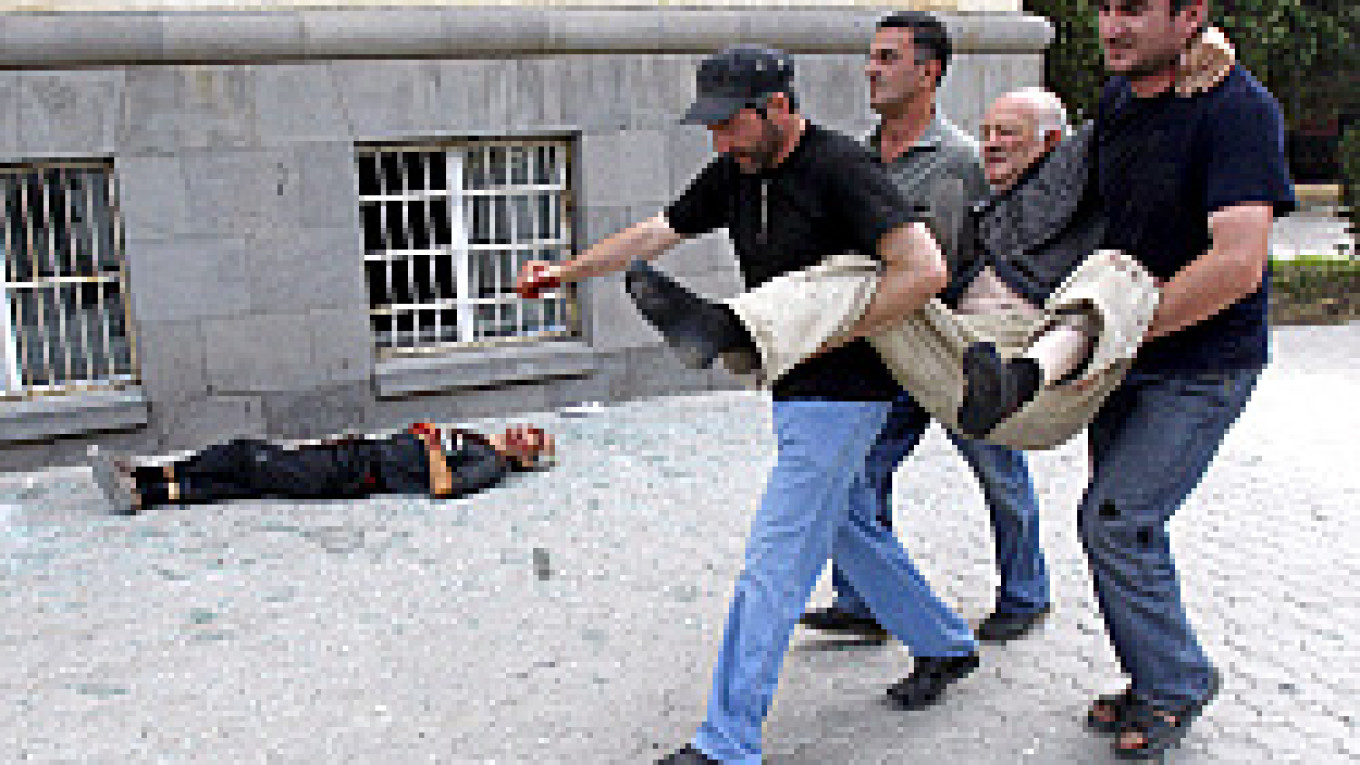
Earlier Tuesday, Russian warplanes bombed Gori, where the Georgian military is entrenched. At least five civilians were killed, including Dutch cameraman Stan Storimans.
Russian forces also led Abkhaz forces on a military offensive against Georgian troops in the Kodor Gorge, which Georgia brought under its control in 2006.
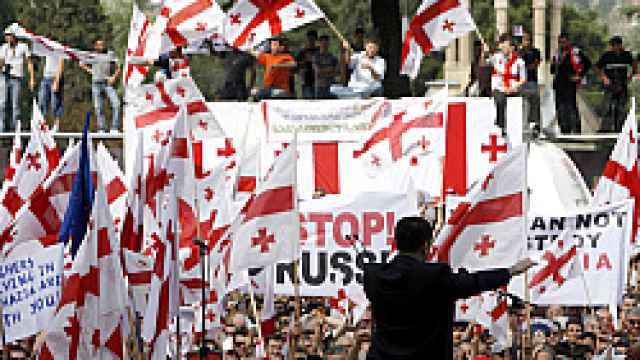 David Mdzinarishvili / Reuters Saakashvili speaking to cheering Georgians at a rally in Tbilisi on Tuesday. |  |
| |
Abkhaz separatists said late Tuesday that they had squeezed the last Georgian units out of the gorge. They promised not to cross over into Georgia proper.
Late Monday, Russian troops returned to Abkhazia from the Georgian military base in Senaki, which they seized earlier in the day.
Saakashvili told a roaring crowd of more than 30,000 people outside the parliament building on Tbilisi's Rustaveli Avenue that Georgia would withdraw from the CIS, a largely toothless body of 12 former Soviet republics founded in late 1991.
"Georgia will never kneel down before Russia, therefore we made the decision to leave the commonwealth in order to finally bid farewell to our Soviet past," he told the cheering crowd.
Since Saakashvili rose to power in 2003, he has repeatedly threatened to quit the CIS. He said Tuesday that he had issued the relevant decree.
The withdrawal could affect the status of Russian peacekeepers in Abkhazia, who have been stationed there since 1994 under a CIS mandate known as the Moscow Treaty. Georgia agreed at the time to pull its troops out of Abkhazia in favor of a CIS peacekeeping force.
Georgia's withdrawal from the CIS does not mean the simultaneous denunciation of the Moscow Treaty, but it will strongly undercut the legitimacy of the presence of the CIS peacekeepers in Abkhazia, said Nikolai Silayev, an analyst with the Center of Caucasus Studies at the Moscow State Institute of Foreign Relations. "But this isn't bothering Moscow at the moment," he said.
Georgian Security Council chief Kakha Lomaia said Georgia filed a lawsuit against Russia on Tuesday to the International Court of Justice "because of ethnic cleansing conducted in Georgia by Russia in 1993 to 2008," Reuters reported. The court, based at The Hague, rules on nation versus nation disputes.
Also, the chief prosecutor of the International Criminal Court, Luis Moreno-Ocampo, said he was considering requests to investigate the South Ossetia conflict, Reuters reported.
Saakashvili also said in his speech that Tbilisi would redefine Georgia's separatist provinces as occupied territories. "We will declare South Ossetia and Abkhazia as territories occupied by the Russian armed forces," he said.
Many participants of the rally, which happened to coincide with the Didgori anniversary, a patriotic remembrance of a medieval Georgian victorious battle against the Seljuk Turks, had tears in their eyes. Most were unanimous in their opinion that Moscow was to blame for the war.
"Today is a feast day because we have won back our freedom," said Gena Miminoshvili, 52, a factory worker from the western town of Abasha. Asked about the years of tensions in South Ossetia, he said it was merely a dispute between "brothers."
"The real enemy is Russia," he said.
"[Moscow] programmed everything and carefully planned provocations," said a woman, who would only give her first name, Ia. "Why did the West not come to help us? Because the Russians never obey the law and always do what they want. They are afraid of that."
"Russia wants a Georgia without Georgians," added Leri Kavteladze, an elderly man who said he fought in the civil war against the country's first elected president, Zviad Gamsakhurdia.
But dissent was strong among people who did not attend Saakashvili's speech. Nino Dzandzava, 24, a film critic, said she did not believe that Russia was to blame. "This is a tragedy for Georgia, and I blame the government because it should have known that this attack would have dire consequences," she said, referring to the Georgian onslaught on Tskhinvali late last week. "It is totally senseless to fight the Ossetians. They are being used by the Russians."
Yet Tbilisi appeared joyous and calm Monday evening, and residents said the high tension that threatened to turn into panic over the weekend had all but vanished.
Government supporters of all ages were milling around the city center, many of them draped in the country's red-crossed flag, introduced by Saakashvili after he assumed power in the 2003 Rose Revolution.
Many expatriates who had been advised by their embassies to leave the country were rethinking their plans. Some even decided to head back after arriving at the border with Armenia early afternoon, when the news of Medvedev endorsing the cease-fire reached them via cell phone.
Leaders of Ukraine, Poland and the three Baltic republics were on their way to Tbilisi to show support for Saakashvili, Interfax reported late Tuesday. The five leaders flew to an Azeri town and then drove in a motorcade across the border into Georgia, it said.
Russia cannot wage an all-out war in Georgia after achieving its immediate goals in South Ossetia and Abkhazia, said Alexander Khramchikhin, a senior researcher at the Institute of Political and Military Analysis.
"Russian troops risk facing fierce guerrilla resistance if they remain in Georgia proper, and the diplomatic cost of waging war there will grow for Russia tremendously with every passing hour," he said.
Medvedev's decision to announce the halt of the military operation before his meeting with Sarkozy was an attempt to save face under increasing criticism from the West, Khramchikhin added.
"Agreeing to stop the military actions after the talks would look like Medvedev bent under pressure from Europe," he said.
The United Nations' refugee agency said Tuesday that 100,000 people ?€” divided nearly equally between Georgians and South Ossetians ?€” have been driven from their homes by the fighting in Georgia over the past five days.
Staff Writer Nabi Abdullaev reported from Moscow, and Staff Writer Nikolaus von Twickel reported from Tbilisi, Georgia.
A Message from The Moscow Times:
Dear readers,
We are facing unprecedented challenges. Russia's Prosecutor General's Office has designated The Moscow Times as an "undesirable" organization, criminalizing our work and putting our staff at risk of prosecution. This follows our earlier unjust labeling as a "foreign agent."
These actions are direct attempts to silence independent journalism in Russia. The authorities claim our work "discredits the decisions of the Russian leadership." We see things differently: we strive to provide accurate, unbiased reporting on Russia.
We, the journalists of The Moscow Times, refuse to be silenced. But to continue our work, we need your help.
Your support, no matter how small, makes a world of difference. If you can, please support us monthly starting from just $2. It's quick to set up, and every contribution makes a significant impact.
By supporting The Moscow Times, you're defending open, independent journalism in the face of repression. Thank you for standing with us.

Remind me later.