

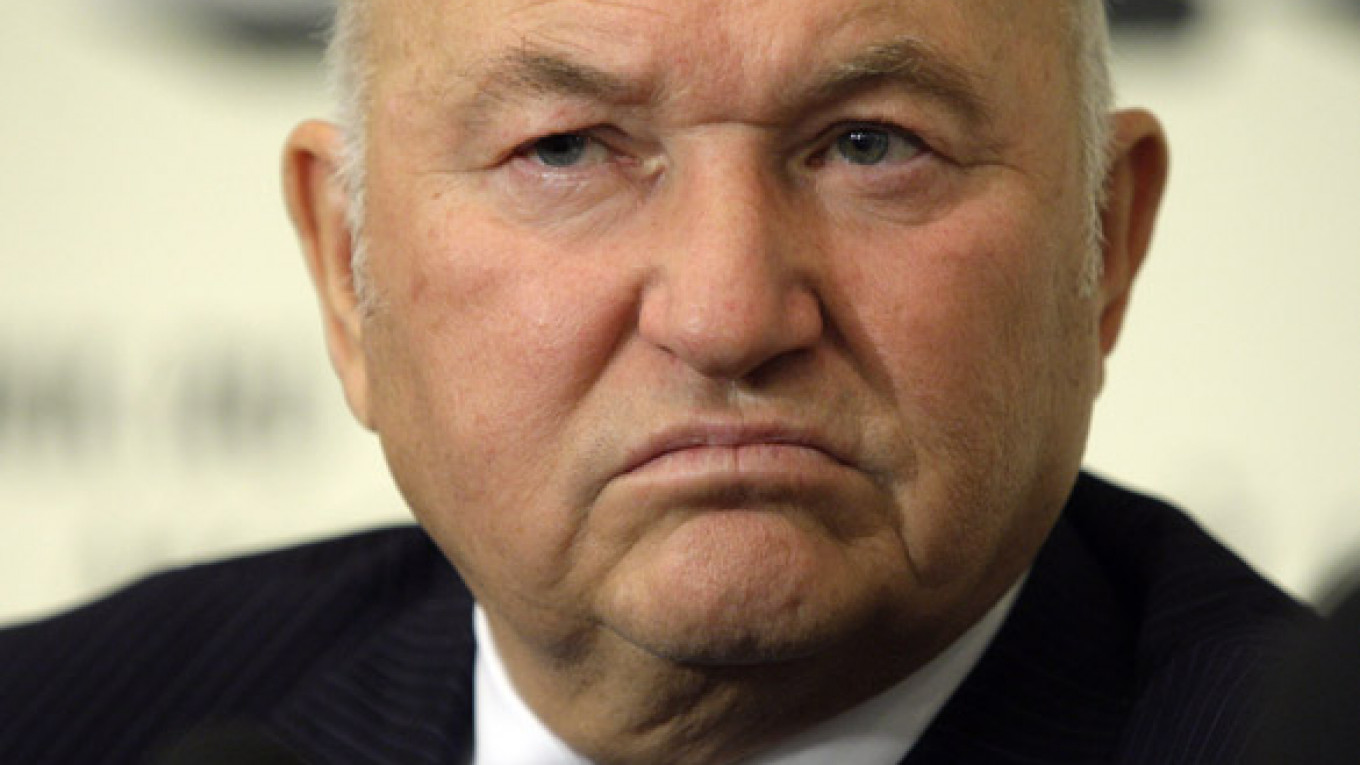
Mayor Yury Luzhkov and his wife, Yelena Baturina, said Friday that they were suing opposition politician Boris Nemtsov for claiming that the success of Baturina’s real estate development company Inteko was directly linked to her marriage to Luzhkov.
Nemtsov released a report titled “Luzhkov, Conclusions” on Sept. 8 that criticizes the mayor for failing to handle problems like crime, traffic, corruption and pollution in Moscow. The biggest section, however, is dedicated to exploring the relationship between Baturina’s success in Inteko and the Moscow city government.
Baturina, who is ranked by Forbes magazine as Russia’s richest woman with a fortune of $900 million, has filed a defamation lawsuit in the Moscow Arbitration Court for 200,000 rubles ($6,630) based on a calculation of 1 ruble for each copy of the report that was published, Inteko said in a statement. Luzhkov said he was also suing Nemtsov over the report.
“The leaflet is full of lies and I have filed a suit against Boris Nemtsov for defamation. I am certain the supposed facts in the leaflet are false,” Luzhkov said at a news conference, titled “Coming out of the crisis — to act and not to wait.”
Inteko said Baturina was suing because the report contained “clear lies” and distorted the image of Inteko. “This attempt to show that Inteko can only work effectively in Moscow is absurd. The company is realizing large-scale investment development projects in other regions and abroad,” it said.
Nemtsov’s spokeswoman at the Solidarity opposition group, Olga Shorina, said she had not seen the lawsuit yet and Nemtsov was traveling and unavailable for comment Friday.
But Nemtsov wrote on his LiveJournal blog that he would be “glad” to meet the couple in court. “We will try to make the process as open as possible,” he said. “We have irrefutable proof that [Luzhkov] favored Inteko while signing decrees for commercial development, making [Baturina] the richest woman in Russia and Eastern Europe.
“Although we understand the way the Moscow courts operate, they have never ruled against the Moscow mayor and his wife,” Nemtsov added.
Luzhkov, however, has lost a handful of Moscow cases, including a lawsuit in June against an artist who created the anagram “nimble thief” by mixing up the letters of his first and last names at a performance four years ago. (But the same court ordered Kommersant and one of its reporters to pay damages to Luzhkov for printing the anagram.)
Luzhkov successfully sued another opposition leader, Eduard Limonov, in November 2007 after Limonov said he controlled the Moscow courts. Luzhkov filed a defamation lawsuit against Right Cause party leader Leonid Gozman late last month after Gozman said the mayor should be held responsible for corruption in Moscow.
“I’m sure I will win the lawsuit” against Nemtsov, Luzhkov said Friday.
He said he had never counted the number of lawsuits that he had filed but estimated 10 court cases per year for the past 17 years. “It’s an impressive figure,” he said.
At the news conference, Luzhkov gave few details on anti-crisis strategies for Moscow, but he threw out ideas like changing companies’ working hours to decrease rush hour traffic. Such a measure would turn “Mt. Everest” into “little mounds,” he said, Interfax reported.
He also lashed out against the U.S. dollar, calling it “a piece of paper with no marked value.” “One needs to be careful with the dollar,” he said.
The mayor also criticized Finance Minister Alexei Kudrin’s policy of fiscal restraint, saying bigger spending would ease the pain of the economic crisis.
Giving a large news conference is not typical for Luzhkov and should be seen in the context of Moscow City Duma elections on Oct. 11, said Rostislav Turovsky, a political analyst with the Center for Political Technologies. Luzhkov, 73, is leading the United Russia ticket for the elections, even though he is not expected to take a seat.
“Luzhkov’s style is to go around visiting city locations, not building an image of a public politician,” Turovsky said. “Now he’s being pressured, and his family has been directly accused, so he’s switching tactics from ignoring the report to fighting back.”
A Message from The Moscow Times:
Dear readers,
We are facing unprecedented challenges. Russia's Prosecutor General's Office has designated The Moscow Times as an "undesirable" organization, criminalizing our work and putting our staff at risk of prosecution. This follows our earlier unjust labeling as a "foreign agent."
These actions are direct attempts to silence independent journalism in Russia. The authorities claim our work "discredits the decisions of the Russian leadership." We see things differently: we strive to provide accurate, unbiased reporting on Russia.
We, the journalists of The Moscow Times, refuse to be silenced. But to continue our work, we need your help.
Your support, no matter how small, makes a world of difference. If you can, please support us monthly starting from just $2. It's quick to set up, and every contribution makes a significant impact.
By supporting The Moscow Times, you're defending open, independent journalism in the face of repression. Thank you for standing with us.

Remind me later.