

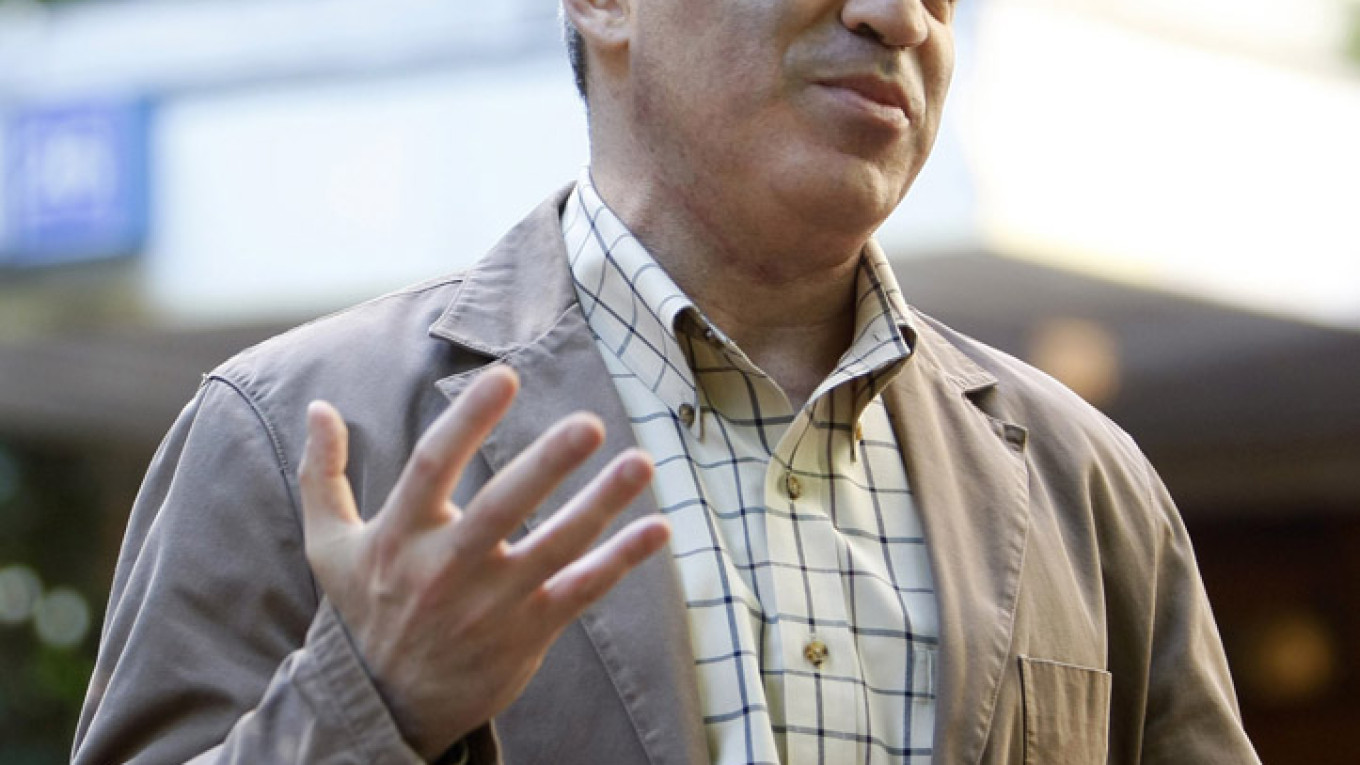
U.S. President Barack Obama’s decision to meet Kremlin critics while visiting Russia shows that Washington is no longer willing to ignore democracy and human rights to cut deals with Moscow, opposition leader Garry Kasparov said.
Obama will meet representatives of nongovernmental organizations during his trip to Moscow, and he will also see opposition figures including Kasparov, a former chess champion who has become one of the Kremlin’s harshest critics.
“I think the fact of the meeting is more important than anything else,” Kasparov said in an interview Friday.
“It sends a signal the [U.S.] administration is probably ready to end this application of double standards which has been used for Putin’s Russia by foreign leaders for many years,” Kasparov said.
Kremlin critics say Western leaders have at times toned down criticism of Russia’s human rights violations, its poor record on democracy and its government-dominated media landscape to pursue lucrative business deals and win Moscow’s cooperation.
“What we always wanted is for America and other Western countries not to support Putin’s regime by pretending that Putin’s regime was democratic,” Kasparov said.
Kasparov heads The Other Russia movement, which relies mainly on street protests — often broken up by police — and online campaigning to get its message across. State-controlled media ignore him.
Kasparov will meet Obama along with Communist leader Gennady Zyuganov and two other leaders of small pro-Western opposition parties — Boris Nemtsov of Solidarity and Sergei Mitrokhin from Yabloko. Obama has no meeting scheduled with Boris Gryzlov, the parliamentary leader of the main pro-Kremlin party, United Russia.
Kasparov predicted that the worsening economic crisis in Russia would lead to a change in power and that the opposition would gather more support.
Russians were willing to live without democracy when the country was awash with money from oil and gas revenues, Kasparov said. But they are becoming increasingly angry now that the country is mired in a deep recession.
“Probably within the next 12 months, the political landscape will look very different. … I think that eventually the regime will crunch under the pressure of civil protest,” he said, declining to describe specific political changes.
A Message from The Moscow Times:
Dear readers,
We are facing unprecedented challenges. Russia's Prosecutor General's Office has designated The Moscow Times as an "undesirable" organization, criminalizing our work and putting our staff at risk of prosecution. This follows our earlier unjust labeling as a "foreign agent."
These actions are direct attempts to silence independent journalism in Russia. The authorities claim our work "discredits the decisions of the Russian leadership." We see things differently: we strive to provide accurate, unbiased reporting on Russia.
We, the journalists of The Moscow Times, refuse to be silenced. But to continue our work, we need your help.
Your support, no matter how small, makes a world of difference. If you can, please support us monthly starting from just $2. It's quick to set up, and every contribution makes a significant impact.
By supporting The Moscow Times, you're defending open, independent journalism in the face of repression. Thank you for standing with us.

Remind me later.