

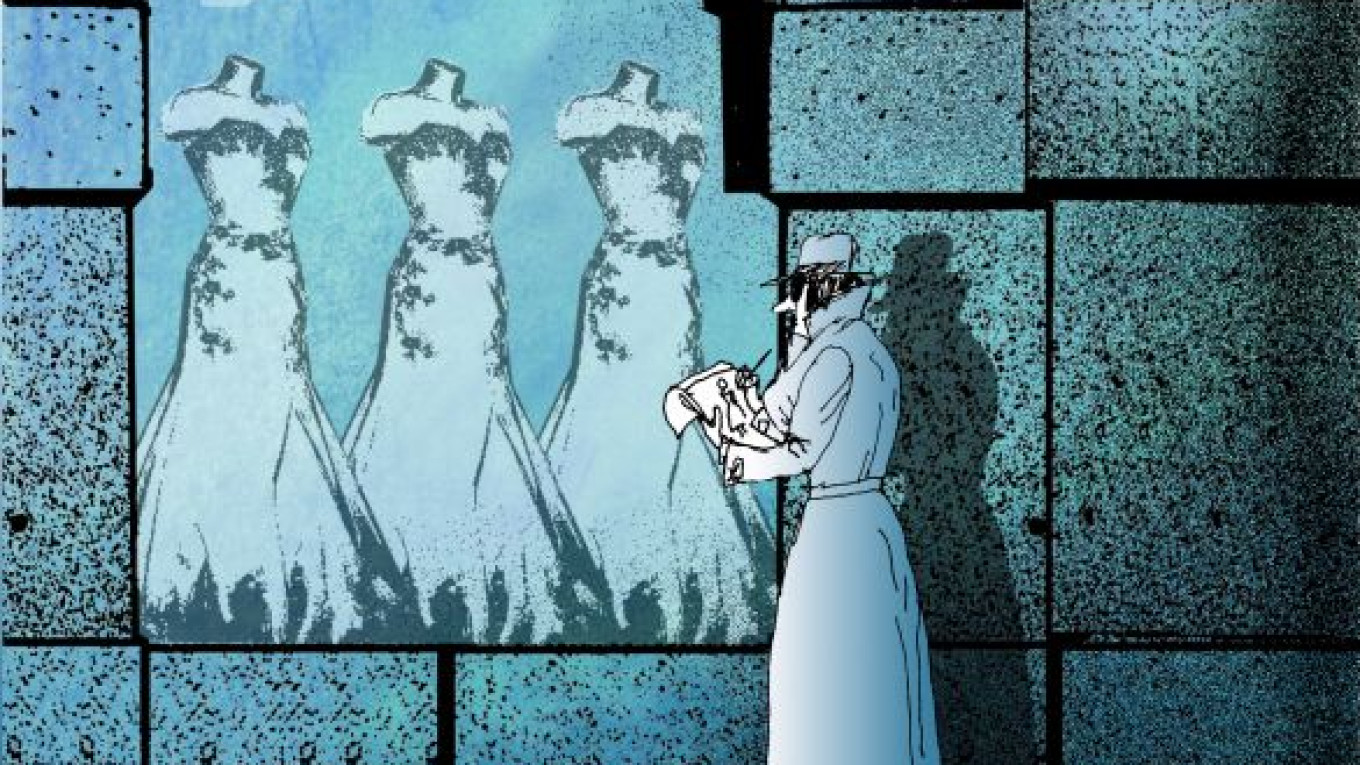
This week, talk has only been of the spy scandal, which has an unreal air to it, with reporters gaining most of their information from Facebook and the Russian equivalent, Odnoklassniki, and spinning out the details as far as they could go.
The focus has been on Anna Chapman, 28, who was immediately dubbed a “flame-haired femme fatale” by Western journalists, even if her hair color seems to fluctuate in photographs. Poor Anna did not have time to shut off access to her Odnoklassniki account, which gave journalists access to compromising photographs of her dubious fashion sense as she posed in appliqued jeans and waved a cigarette in a leopard-skin dress.
In a leering pun, the British Sun described her as having a “Victoria’s Secret body.”
The Sun embarrassingly got the wrong end of the stick and wrote that Chapman was actually born in Odnoklassniki, mistaking the social networking site for an oddly named Russian town.
Komsomolskaya Pravda called Chapman a “newfound Mata Hari” and wrote that she grew up in Volgograd with her grandmother — which sounds like a somewhat harsh deal, considering that her parents moved to Moscow and her father, a diplomat, also worked at the Russian Embassy in Kenya. She studied at the Peoples’ Friendship University in Moscow — notorious for turning out such unfriendly figures as Carlos the Jackal.
A reporter went to her parents’ home in a concrete tower block in Ramenki, a suburb in southwest Moscow — which did not even have a concierge, the tabloid sniffed. But it got nothing out of the trip except some gossip from neighbors who said they had not seen Anna for a long time and her family kept to themselves.
At least KP had an excuse to drag out an old joke about spies and their would-be enigmatic passwords. An agent whispers, “The elephants have gone to their drinking water.” “Ah, you’ll be wanting the spy Ivanov. He’s on the floor above.”
Tvoi Den suggested in an attempt at humor that Moscow should exchange Mayor Yury Luzhkov for the 11 spies, for the flimsy reason that he failed to ban the annual Fourth of July U.S. Independence Day celebration at
Kuskovo Park. In TD’s cartoon, Luzhkov was pictured admiring himself in the mirror, swapping his usual flat cap for a stars-and-stripes top hat.
Spies are not what they used to be, Moskovsky Komsomolets complained, saying revelations of the spies’ “pathetic” results blew away their mystique. “It’s as if James Bond finally opened his box of tricks and revealed a pair of socks and some fried chicken,” it said.
“They sent reports, of course, but of such a quality that after seven years of being followed, there wasn’t enough for a decent charge of espionage,” it sneered.
Spies used to work for the principle, not for the money, the author of the MK opinion piece wrote, saying her friend is a Russian agent in a “faraway country” who had to eke out his salary in the 1990s by selling dates.
Nowadays, spies expect nice houses and flower beds, the author wrote. “No one works for an ideal anymore.”
A retired KGB colonel told the newspaper that the reports made it sound as if the group of “amateurs” had got their ideas for spy techniques from “not very clever books.”
“The kind of thing you read when you’re waiting for the fish to bite, and even then not more than two pages,” he said.
The newspaper joked about the confused national identities of the accused with a cartoon playing on the difference between razvedchik, or agent, which means someone on Russia’s side, and shpion, or spy, used for foreigners.
A man in a vest dithers between vodka and whisky. “I can’t decide who I am today: a razvedchik or a shpion,” he says.
A Message from The Moscow Times:
Dear readers,
We are facing unprecedented challenges. Russia's Prosecutor General's Office has designated The Moscow Times as an "undesirable" organization, criminalizing our work and putting our staff at risk of prosecution. This follows our earlier unjust labeling as a "foreign agent."
These actions are direct attempts to silence independent journalism in Russia. The authorities claim our work "discredits the decisions of the Russian leadership." We see things differently: we strive to provide accurate, unbiased reporting on Russia.
We, the journalists of The Moscow Times, refuse to be silenced. But to continue our work, we need your help.
Your support, no matter how small, makes a world of difference. If you can, please support us monthly starting from just $2. It's quick to set up, and every contribution makes a significant impact.
By supporting The Moscow Times, you're defending open, independent journalism in the face of repression. Thank you for standing with us.

Remind me later.