

At the heart of this tangled corporate web lies a low-profile businessman named Mikhail Rakhimkulov and a joint-stock company called Interprocom, which he registered in Budapest, Hungary, on June 15, 1989 ?€” the same day former Soviet leader Mikhail Gorbachev was in Germany talking about tearing down the Berlin Wall.
Some 500 pages of documents, originally acquired over the course of a five-week investigation by the German national daily Frankfurter Rundschau, detail how Interprocom got the assets, including:
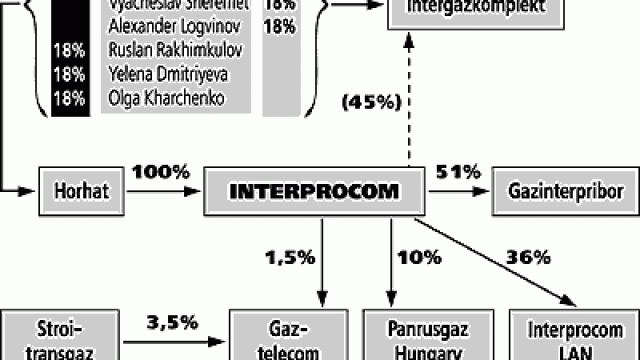
Along the way, Interprocom went from being a partly state-owned enterprise to a fully private company, with a majority stake owned by Rakhimkulov, a former Soviet gas executive, and his deputy Oleg Veinorov.
On Oct. 15, 1997, Rakhimkulov and Veinorov summoned the handful of remaining shareholders to a meeting in Moscow and transferred ?€” free of charge ?€” 100 percent ownership of Interprocom to a company called Horhat (Khorkhat), according to Moscow Registration Chamber documents.
The nominal owners of Horhat, registered in Moscow in 1991, were Rakhimkulov's wife, Galina, and a woman named Irina Kravtsova, who was registered as living in the same apartment as Veinorov.
A year later, on Nov. 2, 1998, five people ?€” including the sons of Rakhimkulov (Ruslan Rakhimkulov) and former Prime Minister Viktor Chernomyrdin (Vitaly Chernomyrdin), and the daughters of Gazprom boss Rem Vyahkhirev (Tatyana Dedikova) and his deputy Vyacheslav Sheremet (Yelena Dmitriyeva) ?€” each paid 8.1 rubles for an 18 percent stake of Horhat, the documents show.
In all, 90 percent of Horhat, which owns 100 percent of Interprocom, was sold for a total of 40.5 rubles, or about $2.50 at the then exchange rate. The remaining 10 percent was kept by Kravtsova, who got the stake for free.
Outspoken Gazprom board member and critic Boris Fyodorov, a former finance minister, said that by his estimation some "$2 billion to $3 billion disappears from Gazprom each year through corruption, nepotism and simple theft."
He was quoted by Itar-Tass as saying in Washington this week that when he first demanded an independent audit of Gazprom last year, Gazprom management threatened to throw him in jail.
The story of Interprocom is not unique. The case of Intergazkomplekt follows a similar pattern. When it was established in 1992 as an importer of gas distribution equipment, Gazprom owned more than a third of the company. As Gazprom's stake in the company decreased Interprocom's increased.
By the end of 1997, Intergazkomplekt belonged completely to Interprocom and Gayar Rakhimkulov, presumably the Interprocom founder's relative.
On Nov. 2, 1998 ?€” the same day Horhat bought Interprocom ?€” Gayar Rakhimkulov sold 18 percent of Intergazkomplekt to Timur Rakhimkulov, another son of Mikhail. The price: 1,620 rubles, or about $100. Again, Chernomyrdin's son and the daughters of Vyakhirev and Sheremet got the same deal, according to the terms of the sales contracts.
Mikhail Rakhimkulov is also a central figure in another series of murky deals, this time involving one of Hungary's fastest-growing banks.
As Russia and Hungary laid the groundwork for their crucial 1996 gas deal, Rakhimkulov was named general manager of both Panruzgas ?€” the joint venture set up for the deal ?€” and Altalanos Ertekforgalmi Bank, which Gazprombank bought 100 percent of in 1996.
Gazprom chief Vyakhirev apparently left nothing to chance and sent his son, Yury, to be Rakhimkulov's right-hand man as deputy general manager of Panruzgas during the critical initial phase between January 1995 and November 1996. Yury Vyakhirev today heads Gazprom's export arm, Gazpromexport.
Under Rakhimkulov and the younger Vyakhirev's watch, not only did Gazprom inexplicably give 10 percent of its 50-50 share in Panruzgas to Interprocom, it later transferred another 9 percent to AEB.
Gazprombank head Viktor Tarasov and Sergei Dubinin, Gazprom's chief financial officer and a former Central Bank chairman, were on AEB's board of directors at the time, as they still are today.
When Gazprom bought it, AEB was a loss-maker. But within a year it was turning a profit and posted a $31 million profit in 2000.
The secret of its success? AEB handles all payments for Gazprom's gas exports to Central and Eastern Europe. In the last year alone, AEB handled $2.3 billion in payments to Gazprom.
Kent Moors, who has studied Russian capital flight for years as the head of the East European investment consultancy Asida, which is based in the United States, says that AEB is one of the ways Gazprom management move their cash out of Russia.
"AEB is a small part of a widely distributed system of offshore companies and foreign partners, with whom the Gazprom managers shift their cash abroad or park it there," Moors said.
Which may explain why the more profit AEB makes the more stakes Gazprombank sells to obscure holding companies ?€” and to Rakhimkulov. Gazprombank has now parted with three-quarters of its original 100-percent stake in AEB.
Hungary's official financial watchdog, PSZAF, said that Gazprombank in May 1997 held only half of AEB ?€” 20 percent belonged to the Singapore-registered holding company ACMA Investments and its subsidiary Citycom.
At the same time, the companies Interenergo and Intergazprom Invest, which belongs to the British Virgin Islands-registered Undall, each held a 10 percent stake.
In May 1999 another 10 percent stake went to IGM Kereskedelmi, which is owned by Cubbaren Ltd., registered on the Isle of Man.
Rakhimkulov has also become an AEB shareholder after Gazprombank sold him an 8.5 percent stake on Dec. 21, 2000, according to PSZAF.
Rakhimkulov would not reply to questions asking how much he paid for the stake.
Rakhimkulov continues to be a controversial point man for Gazprom in Hungary ?€” and his activities have gone beyond AEB and Panrusgaz.
Last fall, the banker showed up as a representative of the Dublin, Ireland-registered Milford Holdings. According to a document obtained from the Dublin Company Registration Office, Milford's nominal owners are Limassol, Cyprus-registered companies Greepeak Consulting and Outbreak Consulting.
Despite its share capital being registered as 2 Irish pounds, Milford declared a pretax profit of 33 million Irish pounds and a bank balance of $184 million in 1999, according to the Irish Independent. When it became known in Budapest that this unknown company had secretly bought up a quarter of BorsodChem, Hungary's second-largest chemical concern, Rakhimkulov admitted at the end of October 2000 that Milford is "in Gazprom's sphere of the influence."
Neither Gazprom or any of its subsidiaries or employees would respond to questions for this article.
A Message from The Moscow Times:
Dear readers,
We are facing unprecedented challenges. Russia's Prosecutor General's Office has designated The Moscow Times as an "undesirable" organization, criminalizing our work and putting our staff at risk of prosecution. This follows our earlier unjust labeling as a "foreign agent."
These actions are direct attempts to silence independent journalism in Russia. The authorities claim our work "discredits the decisions of the Russian leadership." We see things differently: we strive to provide accurate, unbiased reporting on Russia.
We, the journalists of The Moscow Times, refuse to be silenced. But to continue our work, we need your help.
Your support, no matter how small, makes a world of difference. If you can, please support us monthly starting from just $2. It's quick to set up, and every contribution makes a significant impact.
By supporting The Moscow Times, you're defending open, independent journalism in the face of repression. Thank you for standing with us.

Remind me later.