

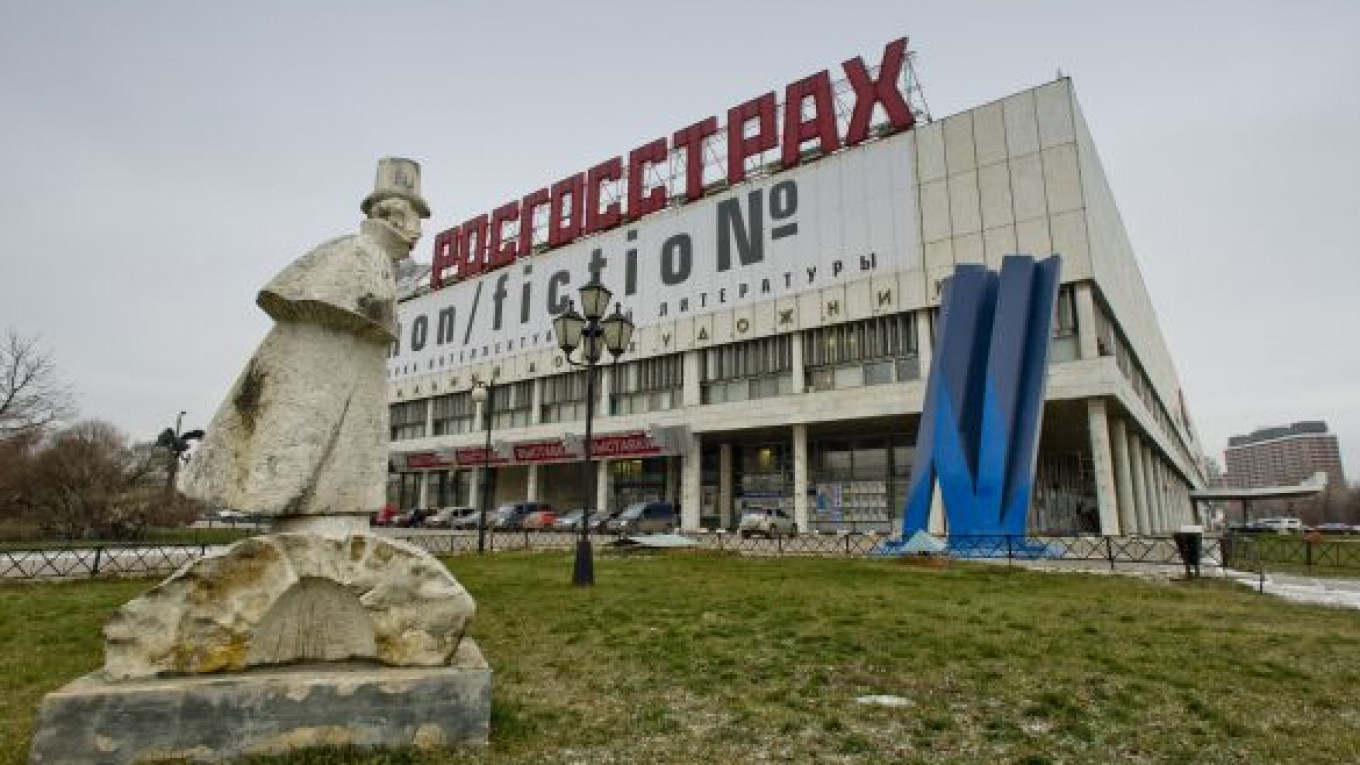
The building housing the New Tretyakov Gallery and the Central House of Artists will be torn down and its tenants forced to relocate following a government directive.
The fate of the exhibition space, which houses 20th-century art, has hung in the balance since plans were announced last year to construct an ambitious Norman Foster-designed project in its place.
The New Tretyakov Gallery and the Central House of Artists share a 61,000-square-meter building on prime riverside real estate that includes a sculpture park adjacent to the Krymsky Val section of the Garden Ring.
The gallery has an indefinite lease on 60 percent of the space from the Federal Property Management Agency. The artists’ confederation owns the rest of the building and has a lease on the land until 2025. As a cultural center, the entire site falls under the control of federal authorities.
A government order to move Moscow’s only permanent exhibition of 20th-century art to a new location and to tear down the current building was filed Nov. 28, and the gallery said Friday that it had only received the order Dec. 2.
The decree, signed by Prime Minister Vladimir Putin, does not mention the Central House of Artists and a spokesperson for the gallery told RIA-Novosti that they had not been informed of the relocation order.”
It is not the first time that the gallery has been kept in the dark about plans for the site. In March 2008, at the Mipim property fair in Cannes, British architect Norman Foster personally unveiled plans for Project Orange, which was commissioned by construction company Inteko. Valentin Rodionov, general director of the Tretyakov Gallery, said at the time, “It was completely unexpected … the first time I heard anything about the plans was when I saw something on television.”
The Project Orange plans depict an 80,000-square-meter building composed of five interlocking sections in the likeness of orange segments. Office and residential suites, rising to 15 stories in height, would surround a central exhibition space.
Artists and locals protested against Project Orange in 2008, arguing that the site was being exploited for commercial interest. No further statements had been made about the project since the protests, leading many to believe that the project had been shelved. The gallery’s management even began plans to refurbish the existing building.
Inteko has said it has not reached any agreements but does not rule out participating in a tender for construction on the site, should one be held.
Despite the government directive, questions persist about the future of the exhibition spaces and their replacement. Public discussions held at the beginning of the year did not result in any major decisions being made.
The gallery directors insist that new museums be constructed before the present one is torn down. The exact location of the new buildings, however, as well as the source of investment for the project is still unclear.
A Message from The Moscow Times:
Dear readers,
We are facing unprecedented challenges. Russia's Prosecutor General's Office has designated The Moscow Times as an "undesirable" organization, criminalizing our work and putting our staff at risk of prosecution. This follows our earlier unjust labeling as a "foreign agent."
These actions are direct attempts to silence independent journalism in Russia. The authorities claim our work "discredits the decisions of the Russian leadership." We see things differently: we strive to provide accurate, unbiased reporting on Russia.
We, the journalists of The Moscow Times, refuse to be silenced. But to continue our work, we need your help.
Your support, no matter how small, makes a world of difference. If you can, please support us monthly starting from just $2. It's quick to set up, and every contribution makes a significant impact.
By supporting The Moscow Times, you're defending open, independent journalism in the face of repression. Thank you for standing with us.

Remind me later.