

Depite the much-discussed diplomatic blunder four months ago, when U.S. Secretary Hillary Clinton gave Foreign Minister Sergei Lavrov a red button with the word peregruzka (overload) instead of perezagruzka (reset), both Obama and President Dmitry Medvedev are sincerely interested in resetting U.S.-Russian relations.
But desire alone may not be enough. There is one big obstacle that stands in the way of resetting relations. I am speaking of Prime Minister Vladimir Putin, who is responsible — at least in part — during his two terms as president for the fact that U.S.-Russian relations reached their lowest point since the Cold War, which, it seems, suits the Kremlin quite well.
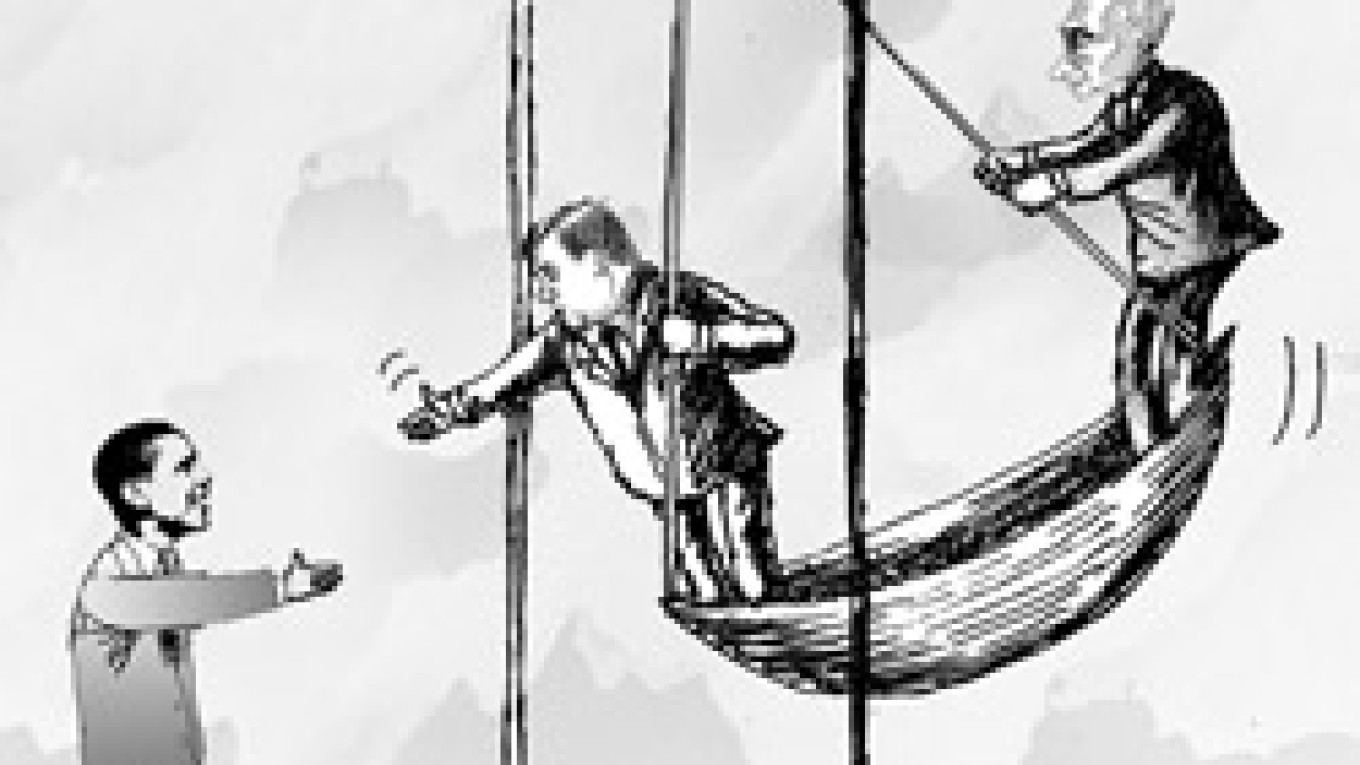
Events on the eve of the summit confirm my misgivings. In an interview with the Associated Press on Thursday, Obama was like a skilled chess player who unexpectedly makes a risky move, giving up the queen to gain control of the match. Obama openly set Medvedev against Putin by saying Medvedev understands that the Cold War approaches toward U.S.-Russian relations are obsolete, while Putin still has one foot in the old ways.
At first, Putin reacted sharply: “We don’t know how to stand with our feet apart,” although even the best English translation cannot capture the familiarity of Putin’s remark that contained the folksy word vraskoryachku. This is an inappropriate vocabulary for a prime minister, particularly when it was used publicly to respond to the U.S. president. Medvedev followed up in an interview with Italian journalists by saying he has an excellent rapport with Putin. Medvedev also answered a question about former Yukos CEO Mikhail Khodorkovsky, saying he didn’t see a political component to his arrest and conviction. In this way, Medvedev indirectly took a jab at Obama, who criticized Medvedev in his written interview last week with Novaya Gazeta for the new allegations that have been brought against Khodorkovsky.
 | |
| To Our Readers | |
|
The Moscow Times welcomes letters to the editor. Letters for publication should be signed and bear the signatory's address and telephone number.
| |
| | |
Obama will spend most of the time during the summit meeting with Medvedev, but these meetings could end up being largely decorative. Perhaps the final agreement on START I, Afghanistan, Iran and all of the other summit topics will be decided during Obama’s “mini-summit” with Putin. Recall how at the Group of 20 summit in Washington in November, the participants — including Medvedev and U.S. President George W. Bush — agreed not to erect protectionist trade barriers against each other. Then, literally a few days later, Putin announced the introduction of prohibitively high customs duties on the import of used Japanese cars in order to protect AvtoVAZ, which is controlled by Sergei Chemezov, Putin’s old friend and colleague from his days as a KGB agent serving in East Germany. It would appear that Putin’s loyalty toward Chemezov was much stronger than his loyalty toward Medvedev or toward Russia’s G20 partners.
How does Russia define improved relations with the United States? Apparently, Moscow’s top priorities are to have Washington stop lecturing it about democracy, to stop interfering in Russia’s internal affairs, to recognize Russia as a superpower on equal standing with the United States and to acknowledge Russia’s “zone of privileged interests” with regard to the former Soviet republics — above all Ukraine and Georgia.
How will Obama react to the fact that on the eve of his arrival in Moscow the Russian army conducted major military exercises on Georgia’s borders under the name “Caucasus 2009,” which looked like preparations for a new war against Tbilisi? And what conclusions has Obama drawn from Medvedev’s friendly handshake with Iranian President Mahmoud Ahmadinejad several weeks ago at the Shanghai Cooperation Organization summit in Yekaterinburg? Of course, Iran has only observer status with the SCO and the visit had been planned months in advance, but Medvedev looked bad on the global arena. After all, the entire world saw Medvedev warmly greeting Ahmadinejad at precisely the moment when most other leaders of democratic countries — Obama included — were expressing their concerns about Ahmadinejad’s repressive measures against political opponents. It is interesting to note that state-controlled television spoke about the Iranian opposition’s protests with the same condemnation as they speak about the “color revolutions” in former Soviet republics or Dissenters’ Marches in Moscow.
Does the United States seriously think that Russia has enough influence in Iran to bridle its nuclear weapons program? In reality, it is in Moscow’s best interests to make sure that a conflict between the United States and Iran continues — as long as the conflict doesn’t get too overheated — because U.S.-Iranian tensions tend to drive up oil prices. This is especially important for Putin, whose short-term anti-crisis plan and long-term modernization strategy don’t go much beyond praying for the return of high oil prices. If U.S.-Iranian relations were to improve, it could lead to better trade relations between the two countries on oil and gas exports — something that would threaten the interests of state-controlled Gazprom and Rosneft.
What does the United States want from Russia? At the top of its agenda is a new strategic arms reduction agreement to replace START I. But Russia will not agree to a new treaty unless the United States cancels its plans to deploy elements of a missile defense system in Poland and the Czech Republic and its goal of creating a global missile defense system, and these terms are unacceptable for the United States.
The Kremlin’s foreign policy is surprisingly similar to Leonid Brezhnev’s foreign policy in the second half of the 1970s. That was when the price of oil suddenly shot through the roof and the Soviet Union was swimming in a sea of petrodollars. Brezhnev began pumping the country’s petrodollars into an ambitious new military program, deployed its military forces in Afghanistan and began sending money and arms around the world to support anti-Western forces — ranging from legitimate governments to some of the world’s most odious terrorist groups. And Moscow continued doing so until the money ran out.
The Kremlin is in a real pickle right now. When Bush was president, most of the world disliked him and his foreign policy, so Russia’s anti-Americanism was a given. But now Obama is in power, and he is winning the hearts of nearly all nations — even those that were formerly anti-U.S. Thus, the Kremlin doesn’t know what to do: join the global trend by supporting Obama or fall back on its traditional anti-Americanism.
Washington’s potential to exert significant influence over Moscow has been greatly overestimated. In fact, it would be a mistake to assume that the United States can actually have more than a superficial impact on Russia. What’s more, it isn’t Obama’s business to meddle in Russia’s internal affairs. On the other hand, however, Obama should not be silent on the country’s most controversial policies both domestically and globally.
This is all the more true considering that many people in the United States have little understanding of where Russia is headed. The Kremlin could once again claim it is “getting up off its knees” and shake its fist at the West, which would require Washington to pursue a policy of containing Moscow. The other option is that Russia will continue to weaken, as the Soviet Union did at the end of the 1980s, in which case the United States needs to have a plan in place for coping with the consequences of its eventual collapse.
Yevgeny Kiselyov is a political analyst and hosts a political talk show on Ekho Moskvy radio.
A Message from The Moscow Times:
Dear readers,
We are facing unprecedented challenges. Russia's Prosecutor General's Office has designated The Moscow Times as an "undesirable" organization, criminalizing our work and putting our staff at risk of prosecution. This follows our earlier unjust labeling as a "foreign agent."
These actions are direct attempts to silence independent journalism in Russia. The authorities claim our work "discredits the decisions of the Russian leadership." We see things differently: we strive to provide accurate, unbiased reporting on Russia.
We, the journalists of The Moscow Times, refuse to be silenced. But to continue our work, we need your help.
Your support, no matter how small, makes a world of difference. If you can, please support us monthly starting from just $2. It's quick to set up, and every contribution makes a significant impact.
By supporting The Moscow Times, you're defending open, independent journalism in the face of repression. Thank you for standing with us.

Remind me later.