


Journalists have a variety of explanations for the apparently senseless violence. Some accuse the Russians of racism or corruption. Others blame the ungovernable culture of mountain tribes. The merit of King's approach is to see the Caucasus and its history as a whole. In scholarly but readable prose, he shows how the mountainous landscape and its strategic location at the crossroads of East and West led to a multiplicity of political, cultural and economic influences. Invaders and traders came from all points of the compass: the Sarmatians, Khazars and Mongols from the north; the Sassanids, Arabs and Seljuks from the south.
The result was an extraordinary mixture of peoples and languages. Even in ancient times, the region was known as one of unparalleled human diversity. Herodotus, Pliny the Elder and Strabo spoke of the bewildering number of interpreters required to do business in its markets. Arab geographers simply labeled the Caucasus the jabal al-alsun or "mountain of tongues," while the American explorer George Kennan marveled in the 1870s that "the Caucasian mountaineers [were] made up of fragments of almost every race and people in Europe and Western Asia, from the flat-faced Mongol to the regular-featured Greek."
Kennan's language may seem quaint, but its racism highlights one of the more delicious semantic ironies of our times. The 18th-century German anthropologist Johann Blumenbach, who was responsible for naming the white race "Caucasian," did so at least partly because he thought that the Caucasus region produced "a most beautiful race of men," and that they were, so to speak, the ideal of the white race. Nowadays, of course, most ordinary Russians take a xenophobic view of the dark-complexioned Muslim peoples of the North Caucasus republics. Indeed they are known disparagingly as the chyorniye, or blacks, of Russia. The war in Chechnya and the hostage-takings at a Moscow theater and a Beslan school have deepened a centuries-old dislike that precedes the days when the local mafia in the Caucasus was run by a Georgian called Dzhugashvili (or Stalin) who would struggle to make it past today's stop-and-search patrols.
Russia has claimed dominion over the Caucasus since the days of its imperial expansion southward, which began in 1552 with Ivan the Terrible's conquest of the khanate of Astrakhan, a relic of Genghis Khan's empire. But it wasn't until the annexation of Georgia at the turn of the 19th century that the tsars obtained a foothold south of the mountains. In 1818, the Russian general Alexei Yermolov founded Grozny (meaning "terrible" or "awe-inspiring") as a fortress to subdue the Chechens. His brutal campaign was hailed as the "drumbeat Enlightenment" by the playwright Alexander Griboyedov, one of many writers to serve in this alien land. "We have just crossed the Terek River," wrote the wife of another Russian official, "and we are now out of Europe."
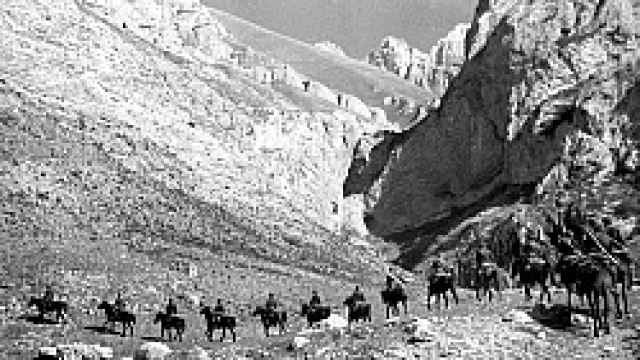 Itar-Tass A reconnaissance mission threads through rough terrain in the North Caucasus in 1942. |  |
| |
It was Alexander Pushkin who reinvented the Caucasus as a domain of Alpine vistas and romantic ennui. King takes his title from the poet's 1822 imitation of Byron, "Prisoner of the Caucasus," the story of a young aristocrat who had, ironically, abandoned St. Petersburg in search of the "ghost of freedom." The poem bestowed upon the Caucasus the status of a Russian tourist attraction. It was as if Yermolov's harsh repression had secured Chechnya and Dagestan as a new realm for pleasure trips. The traveler Ilya Radozhitsky even went so far as to proclaim Georgia an "Italy" of peace and tranquility, despite the predatory tribes.
Nevertheless, King writes informatively about Russia's failure to quell a series of mid-19th century rebellions, notably by the Circassians -- who refer to themselves as Adyghe -- and by the legendary warrior Islam Shamil, who fought the Murid Wars against Russia for almost quarter of a century until he was undone by the defection, in 1851, of his second-in-command, Hadji Murat, a figure immortalized by Leo Tolstoy. Four years earlier, the hill folk of Dagestan -- the word means "mountain country" -- moved down onto the steppe after tsarist forces burned their villages to the ground. On the banks of the Terek they built a new settlement called Tulatovo after its founder Beslan Tulatov. A century later, Tulatovo was renamed Beslan. The uprisings continued into the Soviet period, the last in 1942 prompting Stalin to deport the entire Chechen nation, together with the neighboring Ingush, to Kazakhstan.
King has written books about the Black Sea and the former Soviet republic of Moldova, the latter certainly a neglected subject. The finest chapter in "The Ghost of Freedom" deals with the armed conflicts in the late 1980s over Nagorno-Karabakh in Azerbaijan, over South Ossetia and Abkhazia in Georgia, and over Chechnya in Russia, that helped to bring an end to Soviet power. Unfortunately, as Tony Wood recently observed in his polemical study, "Chechnya: The Case for Independence," the fall of communism heralded the return of an old struggle. In the perception of Islamist radicals, the real Iron Curtain was not the one that separated Eastern and Western Europe but rather the one that cut off Muslims in the Caucasus and Central Asia from their co-religionists in the Muslim heartlands. To them, in other words, the fall of the Soviet Union did not mark the end of the Cold War so much as the beginning of a potential Muslim reconquest.
The latest conflict in Chechnya is best seen as two very different wars. The first, dubbed "Yeltsin's Vietnam," forced Russia the nuclear superpower into a humiliating withdrawal in 1996, in the face of sustained guerrilla attacks. Timely explosions in several Russian cities three years later, and rebel skirmishes in Dagestan led President Vladimir Putin to declare an all-out second war on Chechnya. But where Boris Yeltsin's blundering was at least motivated by a wish to avert Chechen independence, Putin's strategy was to manipulate the fears and prejudices of ordinary Russians. Prejudice thrives on a lack of information. Yet unflinching coverage by Anna Politkovskaya and a few other brave journalists in the North Caucasus exposed the horrors of war, which King places in a wider geographical and historical context.
Hugh Barnes is the Russia editor of openDemocracy.
A Message from The Moscow Times:
Dear readers,
We are facing unprecedented challenges. Russia's Prosecutor General's Office has designated The Moscow Times as an "undesirable" organization, criminalizing our work and putting our staff at risk of prosecution. This follows our earlier unjust labeling as a "foreign agent."
These actions are direct attempts to silence independent journalism in Russia. The authorities claim our work "discredits the decisions of the Russian leadership." We see things differently: we strive to provide accurate, unbiased reporting on Russia.
We, the journalists of The Moscow Times, refuse to be silenced. But to continue our work, we need your help.
Your support, no matter how small, makes a world of difference. If you can, please support us monthly starting from just $2. It's quick to set up, and every contribution makes a significant impact.
By supporting The Moscow Times, you're defending open, independent journalism in the face of repression. Thank you for standing with us.

Remind me later.