

The temperature reached 32.5 degrees Celsius on Tuesday, the highest since July 1996, according to the federal weather service.
No relief is in sight for the next four to five days, with temperatures forecast to peak at 33 degrees on Friday. They should then inch down to 32, and finally sink below 30 at the start of next week.
Relative humidity is at a banya-like 45 percent.
The temperature is four degrees from the all-time high of 36.5 registered in 1938, according to Alexander Frolov, deputy director of the weather service.
In addition to Moscow, the entire European part of Russia is caught in the heat wave that swept across the region four days ago thanks to a warm front bringing hot air up from Africa, Frolov said.
Many Muscovites with dachas have long fled to the country ?€” or at least packed up the children and sent them to the dachas with their grandmothers ?€” to escape the urban heat.
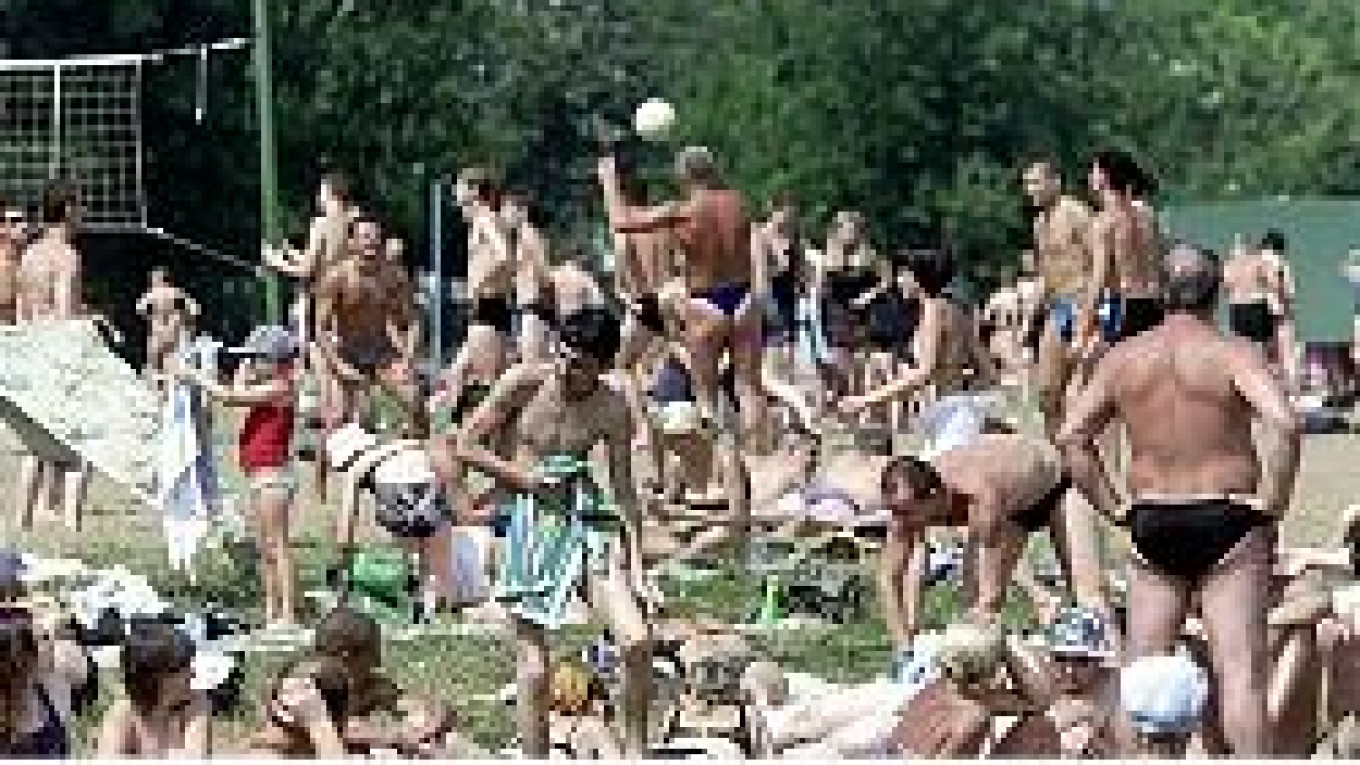
Those stuck in Moscow are turning to the beaches, typically shores running along the many rivers in the city, and the hundreds of outdoor cafes stocked with plenty of cold beer.
Along with the swimming ?€” and often simultaneous drinking ?€” comes a jump in drownings. Sergei Fedotov of the city's emergency service, which registers accidents and emergency calls, said 150 people have drowned in Moscow's rivers, ponds and lakes since the start of the swimming season on June 1.
Fedotov added there has not been an increase in emergency calls over the past few days during the sweltering heat, because many residents have gone to their dachas or on vacation.
Doctors warn that people suffering from cardiovascular problems are most susceptible to strokes and heart attacks during hot days.
Dr. Gennady Sayenko, director at the American Medical Center, said those with cardiovascular diseases should try to stay indoors until the heat subsides, adding that even healthy people should keep out of the sun to avoid heatstroke.
Frolov said that it is not the hot air but the high humidity that makes most people feel ill when temperatures are high.
Although air conditioning brings relief, it can be treacherous, said Dr. Mikhail Sagalovich of the European Medical Center. "People often get sick when they go directly from outdoors to an air-conditioned building" during such hot weather, he said.
Sagalovich also suggested wearing light-colored clothes manufactured of natural fabrics, cotton and linen to help deflect the sun's rays.
Both doctors recommended drinking mineral water and green tea to avoid dehydration.
For those without air conditioning ?€” or those wary of using it ?€” a traditional practice is to dip the curtains in water and then rehang them over the apartment windows.
Alternately, any wet cloth hung at the window can act as a makeshift air conditioner.
When the heat gets unbearable, wash nonwooden floors with plenty of cold water frequently or just splatter some water on the floor, Komsomolskaya Pravda suggested Tuesday in a three-page story about how to deal with the heat.
The newspaper also said that eating eggplant and tomatoes is a good idea because they help the body retain water.
In St. Petersburg, the warm front has led to fierce thunderstorms as it collides with a cold front moving in from Scandinavia. Winds gusting at up to 140 kilometers per hour knocked down hundreds of trees in the city and surrounding areas during a violent 30 minute storm Monday night, cutting off power to many villages. Two people were injured by falling trees.
Lightning during the storm knocked a cross off the 18th-century Smolny Cathedral, which is now used by St. Petersburg City Hall.
Moscow is expected to be spared from similar storms this year and will not see a repeat of the winds that wrecked havoc on the capital after a 1998 hot spell, according to the federal weather service.
Surprisingly, the current heat wave may be having a worse effect on humans than on the animals ?€” even those that never see such temperatures in their natural environments.
Moscow Zoo spokeswoman Natalya Istratova said that most animals easily adjust to high temperatures while some, such as the seven polar bears residing at the zoo, even enjoy lying in the sun.
"Human staffers at the zoo suffer from high temperatures more than the nonhuman staffers," Istratova said.
"Animals always have the choice to stay in the sun or in the shade or to go inside, plus they do not have to work no matter what kind of weather there is," she said.
A Message from The Moscow Times:
Dear readers,
We are facing unprecedented challenges. Russia's Prosecutor General's Office has designated The Moscow Times as an "undesirable" organization, criminalizing our work and putting our staff at risk of prosecution. This follows our earlier unjust labeling as a "foreign agent."
These actions are direct attempts to silence independent journalism in Russia. The authorities claim our work "discredits the decisions of the Russian leadership." We see things differently: we strive to provide accurate, unbiased reporting on Russia.
We, the journalists of The Moscow Times, refuse to be silenced. But to continue our work, we need your help.
Your support, no matter how small, makes a world of difference. If you can, please support us monthly starting from just $2. It's quick to set up, and every contribution makes a significant impact.
By supporting The Moscow Times, you're defending open, independent journalism in the face of repression. Thank you for standing with us.

Remind me later.