

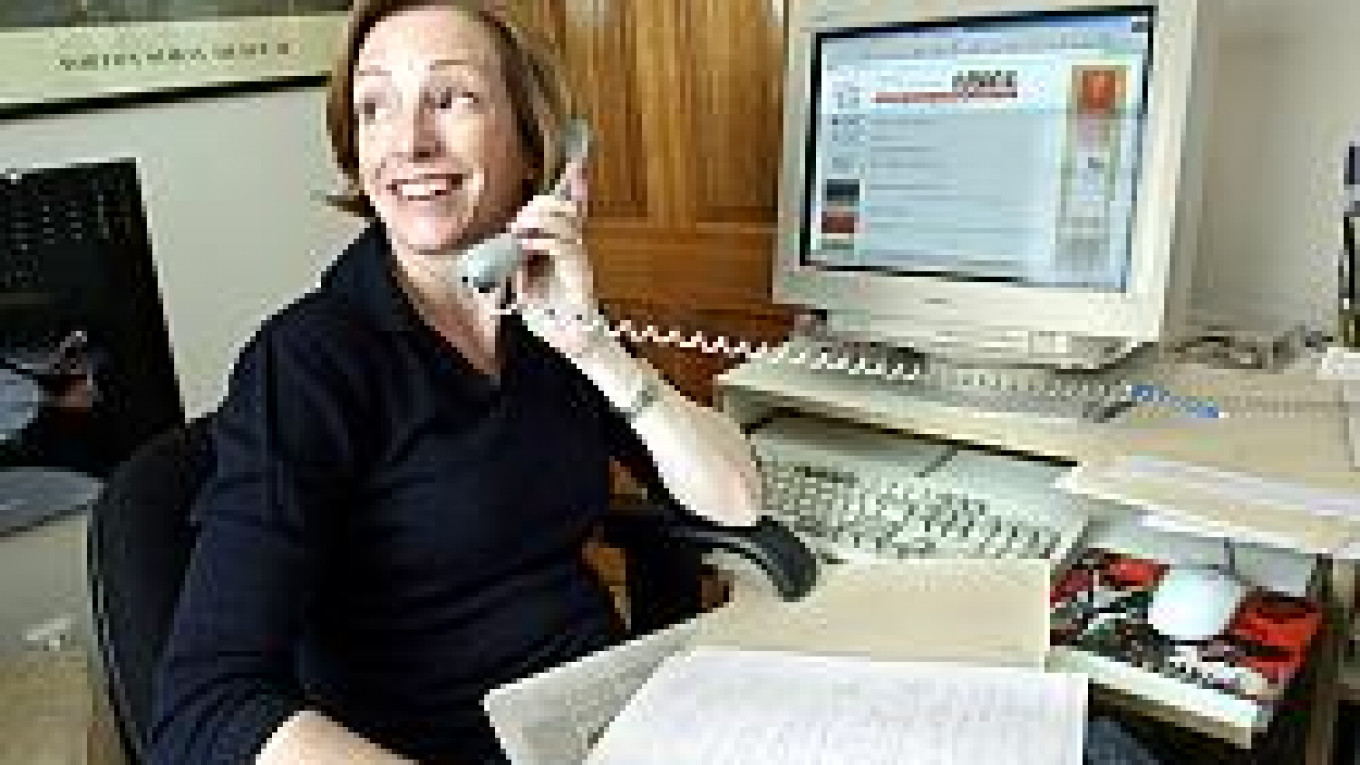
Nothing unusual there, except that hundreds of thousands of people across the United States listen in.
The Dolan sisters aren't just the Dolan sisters. They're the "Satellite Sisters," the name of a live radio show broadcast from Los Angeles.
"The way we imagine the show is if you're sitting around with friends, having coffee, having dinner, what would that sound like?" Dolan said.
The talk show territory they cover, from the serious and not so serious, is seen in the range of segments on a recent show. The first hour was dedicated to sex and teenagers, the second to obesity, and third, Dolan said, "it's June, who doesn't love a wedding disaster story?"
The sisters try to encourage women to talk more about financial and health issues, she said, but, "We're sisters, not experts. We don't give advice."
Instead, they speak from their own diverse experience: Two are single, two are married, one is divorced.
Liz made a career in corporate marketing, Sheila is a first-grade teacher, Monica is a nurse, and Lian is a writer.
Julie, 48, has business cards that identify her as "Julie Dolan, Oldest Sister," but she moonlights as "corporate spouse" to her husband, Trem Smith, who was transferred here to head ChevronTexaco's Russia office two years ago. Their two sons are grown, and her years of working long hours in university admissions offices are over.
"Satellite Sisters" is broadcast live from station KABC in Los Angeles from 6 a.m. to 9 a.m. on Saturdays, and the show is picked up by 100 other stations scattered from Alabama to Alaska.
For Julie, 11 time zones ahead of her West Coast sisters, that means 5 p.m. to 8 p.m.
At 4:30, she disappears into the little room to start the series of preliminary sound checks. There, in her makeshift office, a special clock keeps timing synchronized with the Los Angeles studio to fractions of a second.
"Monica is saying something about interior decorating," she says, half-listening, with a hand over the mouthpiece.
Monica is in Portland, Oregon, where a camera system is rigged up so the three sisters in Los Angeles can see her gesture when she wants to get in on the conversation.
"Here I'm on the phone in my little bedroom and I Instant Message with my producer. That's about as high-tech as it gets."
Contrary to the name, there's no satellite technology involved. The name was inspired during a long family stroll through a field of satellite dishes on the Stanford University campus near San Francisco.
"Plus, we liked the play on words. We're in different locations, but connected personally," Dolan said.
During her days in Bangkok, where her husband was posted for four years before Moscow, she went to the BBC studios to host the show. When the show moved from its first home on National Public Radio to the commercial broadcaster ABC Radio, it was decided that it would be just as easy for Dolan to work from home, via a regular phone line and static filter.
She said there was a camera in the budget for her, but even without it, she can anticipate what the others will say and when. "My youngest sister always has a sassy remark for everything. I can hear her just winding up," Dolan said.
"Because it's a live show, whenever guests don't show up, we have 20 minutes to fill. That's usually when they turn to me and say, 'Julie, any stories from Russia this week?'"
"I'm not an expert," Dolan said, shunning that responsibility. "I'm only qualified to comment on day-to-day life here."
The show caters to an audience that doesn't press her for geopolitical analysis. "The questions I get are a lot about misconceptions. Do I stand in food lines, or how dangerous is it here?" Also, she said, "Maybe because radio is so intimate and the style of the show is to invite people into conversation, listeners send e-mails like, 'Hey, Julie, my aunt is going to St. Petersburg. Do you know a bed and breakfast where she can stay?'"
The sisters also pick books to discuss, taking a page from television talk show host Oprah Winfrey, for whose magazine, O, they write a regular column. Dolan recalls with particular pride that former U.S. Secretary of State Madeleine Albright was recently a guest on the show to discuss her autobiography, "Madam Secretary." This month's book is about Jacqueline Kennedy Onassis.
The morning show is family-friendly, and the technical jargon is sweetly quaint. When all the sisters' microphones are live, rather than just the one or two who are interviewing a guest, they call it an "all-skate," the term used when everyone took the ice at the rink where they grew up in Connecticut.
Dolan sprinkles her speech with well-tested taglines from the show, like, "We try to put the fun back in functional families." Or, "Not every conversation will change your life, but any conversation can." That's also the show's motto, inspired by a weekend from which the whole "Satellite Sisters" concept sprung.
"Oh, yes, that's what we call the 'Born in the Mudbath Story,'" she said, happy to retell a story she's told many times. On a sisters-only retreat from the grind almost 10 years ago, the Dolans hatched a plan to spin their private chats into something bigger amid the cleansing, curative mud of Calistoga, California.
The sisters exchange e-mails during the week to brainstorm for the upcoming show. Dolan said she often runs ideas past her friends from the American and International women's clubs, with whom she regularly goes cross-country skiing in the winter.
In Moscow, only those with broadband connections can listen to streaming audio of the show on the Internet, through kabc.com.
Her husband, Trem, wandering in with a lime-green mug bearing the "Satellite Sisters" logo, said he occasionally tunes in when he's back visiting the United States. But having married into the family more than 20 years ago, "I'm intimately familiar with the show," he said with a gentle wink.
A Message from The Moscow Times:
Dear readers,
We are facing unprecedented challenges. Russia's Prosecutor General's Office has designated The Moscow Times as an "undesirable" organization, criminalizing our work and putting our staff at risk of prosecution. This follows our earlier unjust labeling as a "foreign agent."
These actions are direct attempts to silence independent journalism in Russia. The authorities claim our work "discredits the decisions of the Russian leadership." We see things differently: we strive to provide accurate, unbiased reporting on Russia.
We, the journalists of The Moscow Times, refuse to be silenced. But to continue our work, we need your help.
Your support, no matter how small, makes a world of difference. If you can, please support us monthly starting from just $2. It's quick to set up, and every contribution makes a significant impact.
By supporting The Moscow Times, you're defending open, independent journalism in the face of repression. Thank you for standing with us.

Remind me later.