

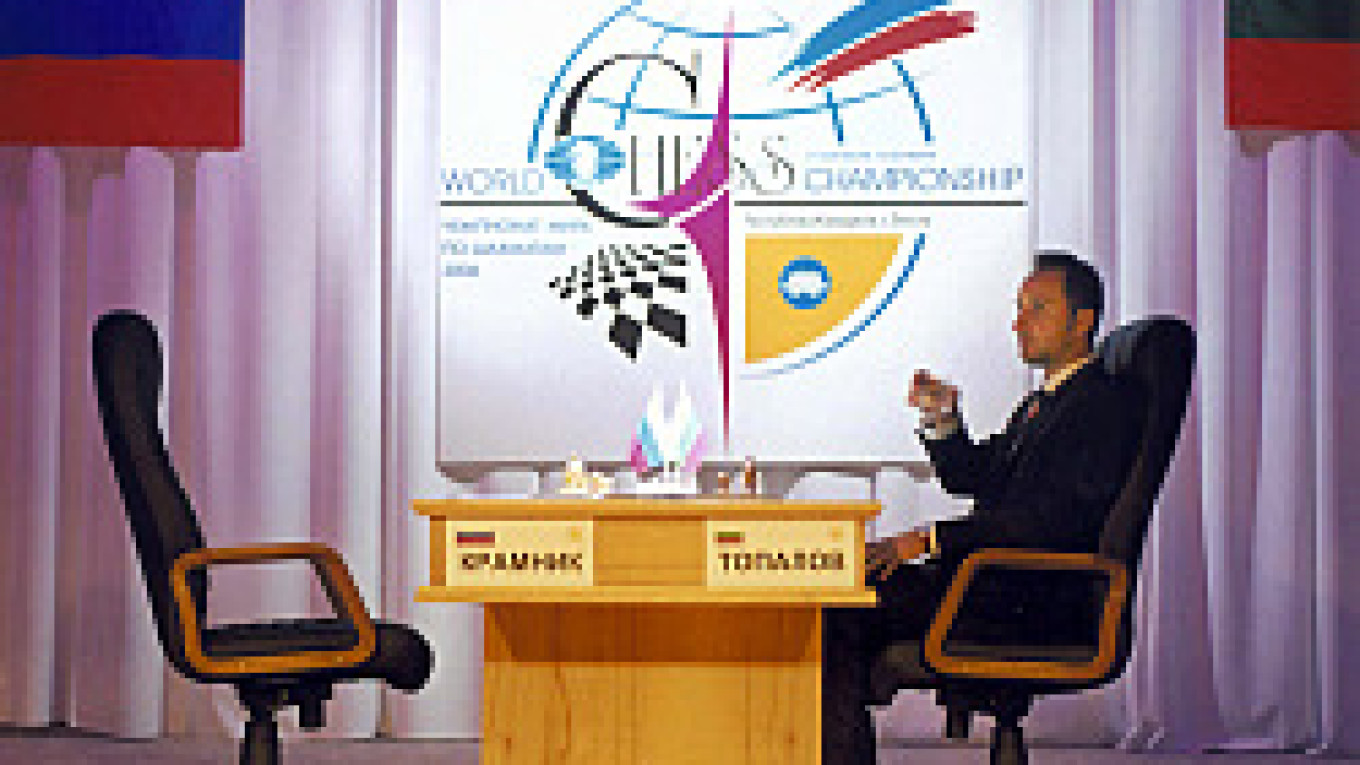
The world chess championship, pitting Russian grandmaster Vladimir Kramnik against Bulgarian Veselin Topalov, is in danger, with Kramnik accused of taking a suspicious number of bathroom breaks.
Leading the match 3 games to 1, Kramnik on Friday forfeited game five to protest a complaint filed by Topalov's manager, Silvio Danailov, suggesting Kramnik was excusing himself improperly. The match is taking place in Elista, the capital of the republic of Kalmykia, located north of Dagestan.
The Russian was cited by Danailov for taking more than 50 breaks during one game in his private bathroom, the one area where the chess master is not under video surveillance during play.
Kramnik threatened to pull out of the match if his bathroom was not reopened and the game he had forfeited was not overturned. Topalov countered that he, too, would pull out if Kramnik's demands were met.
Kalmykia's president, Kirsan Ilyumzhinov, who is also head of the world chess federation, or FIDE, as its French acronym has it, rushed back from Sochi, where he had been at a conference with President Vladimir Putin, to save the match.
Negotiations ran late Friday. On Saturday, Ilyumzhinov announced a timeout between the players. A second timeout was announced Sunday, the first one having apparently expired.
Also on Sunday, Ilyumzhinov said in a statement that the match would resume Monday, but it remained unclear whether the two players had agreed to this and what the score would be. And the Kalmykian president said he had accepted the resignation of the three-man appeals committee that had closed Kramnik's bathroom, adding that, for now, he would rule on any disputes.
The media has dubbed the controversy "Toiletgate" and "Bladdergate."
In the complaint he filed with the appeals committee Thursday, Danailov did not explicitly accuse Kramnik of cheating, presumably with the help of a computer that would tell him the best moves to make.
But match officials were sufficiently alarmed to bar both players from their respective bathrooms.
"Topalov is outraged by the suspicious behavior of his opponent ... who in fact makes most of his significant decisions in the bathroom," Danailov said in a statement Thursday.
Oddly, given the insinuation that he was getting computer help, Kramnik made a blunder in game two that would have enabled Topalov to checkmate him in just two moves -- if the Bulgarian had spotted the error. But he did not, and Kramnik ultimately won the game.
In response to the bathroom ban, Kramnik spent game time Friday lounging in his private room adjacent to the off-limits bathroom. Topalov waited at the chessboard for the Russian to show up.
Video surveillance broadcast on Russian television Friday showed the grandmaster laying on a couch next to the bathroom, occasionally crossing or uncrossing his legs.
After Kramnik had spent an hour of his game time nowhere near the chessboard, Topalov was awarded the game.
Kramnik then held a news conference at which he lashed out at the appeals committee for allowing Danailov access to videotapes of his private quarters.
"I did not sign the contract so I could act in a reality show," Kramnik said in comments broadcast on RTR-Sport television. "This goes against all ethical norms and violates my privacy."
In a statement released Friday, Kramnik's manager, Carsten Hensel, said Kramnik spent a lot of time in the bathroom because the adjacent private room is small.
"Mr. Kramnik likes to walk and therefore uses the space of the bathroom as well," Hensel said.
Danailov said in his statement that, if the match continues, Topalov would not be shaking hands with Kramnik before games.
The bathroom scandal threatens to derail a match that was to determine a universally recognized world chess champion after more than a decade of turmoil.
In 1993, then-world champion Garry Kasparov broke from FIDE to form the now-defunct Professional Chess Association, taking with him the world title.
Kasparov later staged and won two championship matches. FIDE, not recognizing Kasparov's title, held its own competitions.
The international chess scene was left with competing claimants for world champion: Kasparov and whoever who happened to win the FIDE tournament.
In 2000, Kasparov arranged a match with Kramnik, which Kasparov lost. And in May 2002, the two warring factions agreed on a reunification plan dubbed the Prague Agreement.
Chess enthusiasts believed the agreement would play a crucial role in recapturing global interest in chess, which hadn't been seen since the 1972 Bobby Fischer-Boris Spassky match or the epic Anatoly Karpov-Kasparov battles of the 1980s.
The match between Kramnik and Topalov, the reigning FIDE champion, was to unite the chess world at long last. Now that reunification is in jeopardy.
Chess enthusiasts who have been following the controversy on the web site Chessbase.com expressed exasperation and disbelief.
Moscow-based Jean-Paul Charlier wrote: "Dear Veselin and Vladimir, thanks to you, The New York Times writes about chess again. The world is more interested in what Vladimir does in the toilet than in what he does on the board. ... You restored the grandeur of chess. Our noble game needs childish divas and eccentric geniuses. In recent years, normalcy killed it."
A Message from The Moscow Times:
Dear readers,
We are facing unprecedented challenges. Russia's Prosecutor General's Office has designated The Moscow Times as an "undesirable" organization, criminalizing our work and putting our staff at risk of prosecution. This follows our earlier unjust labeling as a "foreign agent."
These actions are direct attempts to silence independent journalism in Russia. The authorities claim our work "discredits the decisions of the Russian leadership." We see things differently: we strive to provide accurate, unbiased reporting on Russia.
We, the journalists of The Moscow Times, refuse to be silenced. But to continue our work, we need your help.
Your support, no matter how small, makes a world of difference. If you can, please support us monthly starting from just $2. It's quick to set up, and every contribution makes a significant impact.
By supporting The Moscow Times, you're defending open, independent journalism in the face of repression. Thank you for standing with us.

Remind me later.